
Best Berlitz Alternatives for Corporate Language Training [2026]
Compare top Berlitz alternatives for corporate language training: live tutors, AI practice, scheduled classes, and Bill 96 compliance.
![Cover Image for Best Berlitz Alternatives for Corporate Language Training [2026]](/_next/image?url=%2Fassets%2Fimages%2Fblog%2F6a7bbd11dc1e9c396e6c3412-1786499684881.jpg&w=3840&q=75)
Best Berlitz Alternatives for Corporate Language Training [2026]
If I were choosing today, I’d split the shortlist like this: Conversaflex for Quebec compliance and role-based French practice, Preply Business and italki for Business for live 1:1 coaching, Lingoda for Teams for scheduled classes, Babbel for Business for self-paced app learning, and Rosetta Stone for Enterprise as a hold-until-verified option.
Here’s the short version:
- Bill 96 changed the buying process in Quebec. Since June 1, 2025, businesses with 25+ employees must put French first in key internal materials and training.
- Live tutoring costs more at scale and depends on calendars.
- AI platforms give 24/7 access, which helps shift-based and distributed teams.
- Role-based practice matters more than test prep when staff need to speak in meetings, client calls, and day-to-day work.
- Not every vendor can support OQLF-style tracking, so Quebec teams need to check reporting before they buy.
If you want the fastest read: Conversaflex stands out for Quebec French, francization tracking, and admin reporting. Preply and italki fit teams that want human-led speaking practice. Lingoda works better for fixed class schedules. Babbel fits light daily learning, but not Bill 96. Rosetta Stone can’t be judged here because the source detail is too thin.
Quick Comparison
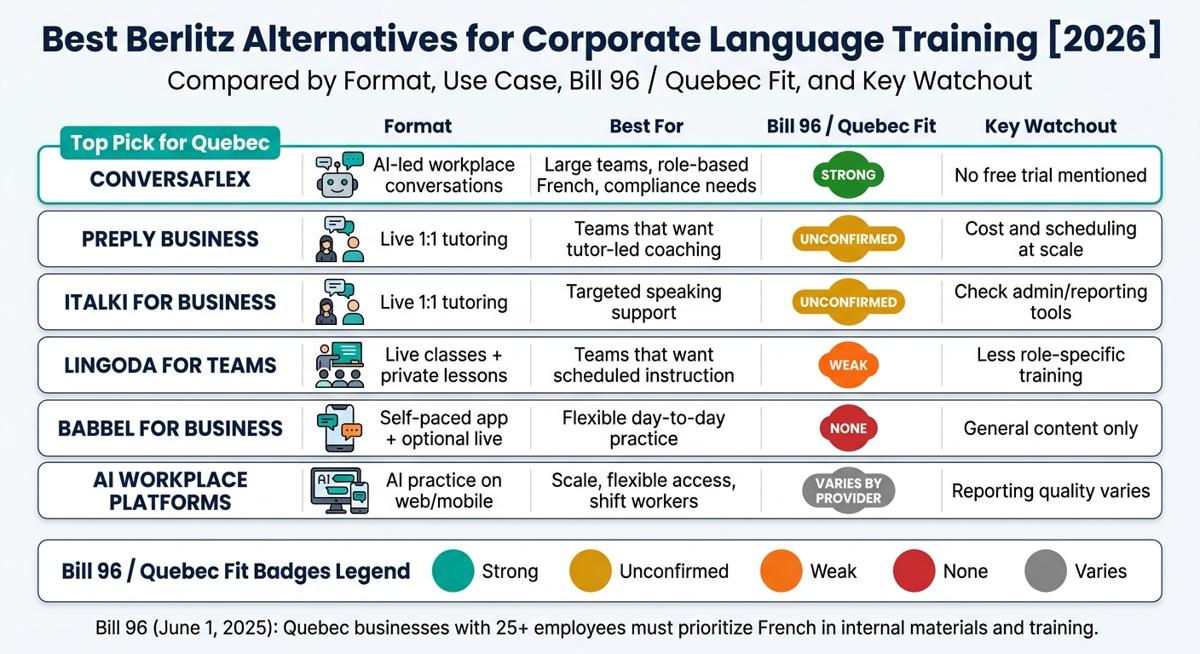
| Platform | Main format | Best for | Bill 96 / Quebec fit | Main watchout |
|---|---|---|---|---|
| Conversaflex | AI-led workplace conversations | Large teams, role-based French, compliance needs | Strong | No free trial mentioned |
| Preply Business | Live 1:1 tutoring | Teams that want tutor-led coaching | Unconfirmed | Cost and scheduling at scale |
| italki for Business | Live 1:1 tutoring | Targeted speaking support | Unconfirmed | Check admin/reporting tools |
| Lingoda for Teams | Live classes + private lessons | Teams that want scheduled instruction | Weak | Less role-specific training |
| Babbel for Business | Self-paced app + optional live | Flexible day-to-day practice | None | General content only |
| Rosetta Stone for Enterprise | Not verified here | Not enough data to assess | Unknown | Source detail is limited |
| AI workplace platforms | AI practice on web/mobile | Scale, flexible access, shift workers | Varies by provider | Reporting quality varies |
My takeaway: if you’re in Quebec, I’d start with compliance reporting first and remove any platform that can’t show it. If you’re outside Quebec, I’d match the platform to how your staff will actually learn: AI vs. traditional language training to see which fits your staff: live coaching, self-paced study, or AI practice at scale.
sbb-itb-7df369b
1. Conversaflex
Conversaflex is an AI-powered workplace language platform built for teams of all sizes, from small groups to organisations with 50,000+ employees.[2]
It centres on three buyer needs: role-based training, measurable reporting, and French language training for employees to ensure Quebec compliance. Put simply, it’s made to match how Canadian organisations work day to day.
Delivery Model
Learners practise AI-led conversations based on their role, skill level, and native language. Along the way, they get real-time feedback on pronunciation and grammar.
The platform can pick up a range of accents, including Quebec French, and it can work alongside live instruction instead of replacing it.
Workplace Customisation
Role-based practice makes a big difference. A nurse, a marketing director, and a software engineer don’t use the same words or face the same situations at work.
That’s why enterprise clients can train a custom model using company data and job titles.[4]
In a GSK Canada pilot, all participants reported stronger spoken French confidence, and 70% used French more at work.[2]
Admin Reporting
Admins can track participation, practice hours, proficiency gains, and skill gaps in one central dashboard. Reporting also connects back to the communication settings each role needs, like meetings or client calls.
For larger organisations, reporting can sync with existing LMS systems.
French Compliance Support
For Quebec employers, Conversaflex can generate francisation reports aligned with OQLF requirements. The Business Plan includes Bill 96 support, unlimited users, an admin dashboard, and custom terminology.[2][3]
For organisations that need more live tutor-led delivery, the next section covers that format.
2. Preply Business
Preply Business offers corporate language training through live 1:1 sessions with vetted tutors. Each learner gets matched based on their schedule and language goals, which makes the setup feel more tailored instead of one-size-fits-all.
It’s a good fit for organisations that want to build employee communication skills through structured, human-led instruction. If you’re reviewing it for Quebec-based teams, it’s worth confirming whether the platform includes reporting that supports French-language tracking and Bill 96 compliance documentation.[1][2]
For teams that want a more structured group-learning format, the next option takes a different approach.
3. italki for Business
italki for Business gives employees live 1:1 tutoring when they need focused language practice.
Like other live tutoring vs. self-paced options, it leans on personalised speaking practice instead of course modules.
Delivery Model
Each session is shaped around the learner’s goals, current level, and pace. That makes it a good fit for teams that need targeted help, not a one-size-fits-all program.
Workplace Customisation
Tutors can adjust sessions for business terms, role-based situations, onboarding, and industry-specific language. That works well for frontline staff who need practical language they can use on the job right away.
Admin Reporting
Before rollout, check participant tracking, outcome reporting, and learner management tools. Those details matter when you need to monitor progress across a team, not just book sessions one by one.
French Compliance Support
For Quebec employers, confirm French-language documentation and Bill 96 support before you commit.
If your team needs structured group learning and scheduled classes, the next option uses a different setup.
4. Lingoda for Business / Lingoda Teams
Lingoda for Business uses live, instructor-led classes for company language training. Lessons are taught by qualified instructors and run either in small groups or as private one-on-one sessions.
Delivery Model
Corporate packages come with flexible scheduling for teams spread across time zones. That works well for organisations with multilingual staff in different places. If your team wants scheduled speaking practice with an instructor and a set class format, this model fits.
Workplace Customisation
Lingoda centres on structured speaking practice and in-class correction from the instructor. In plain terms, it suits teams that want steady, scheduled teaching instead of role-based training or self-paced study.
Admin Reporting
Before rollout, check which attendance tracking, progress reporting, and team admin tools are included. Those details matter when you need to follow results across a group, not just handle individual bookings.
If your team needs more self-paced study options or training built around workplace scenarios, the next option may be a better fit.
5. Babbel for Business
Babbel for Business is a self-paced app for flexible corporate language practice. Lessons are short, usually 10–15 minutes, so it works well for employees who need to fit learning into small pockets of the day. In plain terms, it’s a better match for low-friction daily practice than formal classroom training. If a team wants live instruction too, Babbel Live adds group and 1:1 classes.
It’s a good fit for distributed teams that want flexible practice without the hassle of scheduling.
Delivery Model
The main product centres on live dialogue practice through its AI Conversation Partner, which gives instant feedback on vocabulary, grammar, and listening. That setup works best for general professional communication, not deep role-specific language training.
Workplace Customisation
It can support general onboarding and day-to-day communication, but it does not go far for industry-specific upskilling.
French Compliance Support
Babbel is not a Bill 96 solution. Babbel does not support Bill 96 or OQLF reporting. This lack of compliance can lead to significant Bill 96 penalties for companies operating in Quebec.
| Feature | Babbel for Business |
|---|---|
| Lesson Length | 10–15 minutes |
| Delivery Format | Self-paced app + optional live classes |
| AI Features | AI Conversation Partner (live dialogue practice) |
| Bill 96 / OQLF Support | None |
| Best For | General professional communication and flexible schedules |
If your team needs a more structured enterprise curriculum and a heavier admin rollout, the next option goes in that direction.
6. Rosetta Stone for Enterprise
This comparison only covers platforms with enough verified enterprise detail to judge them against company training needs.
The sources provided here do not include verified enterprise detail for Rosetta Stone for Enterprise. Because of that, this guide can’t assess its delivery model, customisation, reporting, or compliance support.
The next section moves back to platforms with enough verified detail for a direct comparison.
7. AI-Powered Workplace Language Platforms
AI-powered language platforms take a different path than live-instructor programmes. Instead of joining scheduled classes, employees can practise when it fits their day.
Delivery Model
For teams that need scale and flexibility more than fixed class times, AI-powered training moves practice into the flow of work. These platforms are available 24/7 on web and mobile apps, using AI-led conversations to mirror workplace situations and give real-time pronunciation and grammar feedback [2].
That matters in busy workplaces. People can fit in short sessions before a meeting, during a commute, or between tasks, rather than working around a set class schedule. In a GSK Canada pilot, 100% of participants improved their spoken French confidence after using role-tailored AI practice [2].
Workplace Customisation
One of the biggest draws of AI platforms is how closely they can match training to actual roles and sectors. Role-based scenarios let employees practise the language they use on the job, not generic classroom phrases.
A sales rep, for example, can rehearse client conversations. A manager can practise feedback and team discussions. A customer support agent can work through service cases in French. That kind of role fit makes practice feel less abstract and more tied to daily work.
Admin Reporting
Business-tier dashboards give teams a clear view of participation, session frequency, and progress.
For HR and L&D leaders, this makes it easier to see who is using the platform, how often they are practising, and where progress is happening.
French Compliance Support
Conversaflex can generate OQLF-aligned francisation reports and support language-policy tracking [2][3].
The next section breaks down the practical pros and cons of each format.
Pros and Cons by Platform
Not every platform solves the same problem. Some are built for live coaching. Others lean on self-serve lessons. And some focus on workplace practice at scale. This table turns the comparison into a short buying list for Canadian teams.
| Platform | Main Advantages | Main Limitations | Best-Fit Use Case | Canada/Bill 96 Fit |
|---|---|---|---|---|
| Conversaflex | Role-specific AI practice, admin reporting, 24/7 access, and scale | No free trial; LMS integration limited to Learning Partners tier [4] | Quebec-based teams needing Bill 96 compliance and role-tailored French training | Strong - built-in Bill 96 support [3] |
| Preply Business | Live 1:1 tutoring; personalised matching | Higher cost at scale; scheduling depends on tutor availability | Teams wanting structured, human-led instruction | Unconfirmed - verify French-language tracking before rollout |
| italki for Business | Flexible 1:1 sessions; tutor adjusts to role and pace | Verify reporting and learner management tools before rollout | Targeted speaking practice for frontline or specialist staff | Unconfirmed - confirm Bill 96 documentation before committing |
| Lingoda for Business | Live classes; fixed schedules; limited role-specific training | Fixed sessions; limited role customisation | Office-based teams with predictable schedules | Weak - no Bill 96/OQLF support |
| Babbel for Business | Self-paced learning; broad content; no compliance support | General content only; no role-specific scenarios | Employees wanting foundational skills at their own pace | Weak - no compliance features |
| AI-Powered Workplace Language Platforms | Role-based AI practice; 24/7 access; quality and compliance support vary by provider | Provider quality varies widely | Distributed or shift-based teams needing flexible, high-volume practice | Varies - only select platforms include compliance-grade reporting |
For Quebec employers, Bill 96 compliance support is the main filter. If a platform can't help with Bill 96 needs, it's probably out of the running fast. For distributed teams, the big issue is scheduling flexibility. When staff work across shifts, locations, or time zones, fixed-class models can become a headache.
That’s why the shortlist usually comes down to three things: training model, team size, and compliance needs. Some buyers need human-led lessons. Some need scale and round-the-clock access. And some need both, with clear proof that French-language training can stand up to internal and legal review.
Final Recommendation
The right platform comes down to three things: your preferred training format, the kind of reporting you need, and whether Bill 96 applies.
For Quebec-based teams, Conversaflex is the clearest fit because it’s built for Bill 96 readiness. If Bill 96 doesn’t apply, the better pick depends on how you want to deliver training and how many people you need to roll out to.
Outside Quebec, the choice is more about how your workforce learns best:
- live instruction for scheduled coaching
- self-paced learning for more flexibility
- AI-powered workplace practice when you need 24/7 access and role-specific conversations at scale
A simple rule works well here: if Bill 96 applies to your organisation, start with compliance-grade reporting and build your shortlist from that. If it doesn’t, match the format to how your team will actually learn.
If you want to see what that looks like in practice, our corporate language training page walks through the rollout, the reporting and the pricing.
FAQs
How do I choose the right training format for my team?
Start by pinpointing your team’s exact communication gaps and what people need to do in their day-to-day roles with the language. Workplace learning works best when it’s tied to the job, not built around a one-size-fits-all course.
Look for training that includes role-specific scenarios and vocabulary, along with measurable outcomes and steady practice, so you can track progress in a work setting.
What reporting should I ask for before buying?
Ask for reporting that goes well beyond course completion. A completion rate tells you who finished. It doesn’t tell you whether people can use the language on the job.
What you want is reporting that shows how employees apply language skills in role-specific communication. That can include dashboards on day-to-day use, organization-wide progress, individual practice stats, and detailed data your team can use to make decisions with more confidence.
If you operate in Quebec, ask for OQLF-aligned francization reports, records of employee training hours, and compliance reporting.
How can I tell if a platform supports Bill 96 needs?
Look for features built for OQLF compliance, with admin dashboards that can generate official-ready francization reports and track employee training hours.
It should also produce documentation that shows progress toward provincial language-law duties, with measurable tracking that goes beyond course completion and shows improvement in day-to-day workplace communication.




![Cover Image for Corporate Language Training Costs: Conversaflex vs. Tutors, Classes and Apps [2026]](/_next/image?url=%2Fassets%2Fimages%2Fblog%2F68b2425f68bb5e38327dcb5b-1756542781388.jpg&w=3840&q=75)
![Cover Image for Workplace French Training in Canada: Formats, Costs and Funding [Guide 2026]](/_next/image?url=%2Fassets%2Fimages%2Fblog%2Fworkplace-french-training-canada-2026.jpg&w=3840&q=75)