Language Learning for Legal Professionals
French training for lawyers, notaries, paralegals and legal assistants: court proceedings, contract drafting and client communication in Quebec.
Why do legal professionals in Quebec need French specifically?
Because the courts run in it. French is the language of Quebec's judicial system, and Bill 96 tightened the rules on pleadings and on contracts of adhesion. For a lawyer, notary or paralegal that makes French a working requirement rather than a client-service nicety: pleadings, hearings, notarial acts and client advice all happen in it, and the register is formal and unforgiving.
The register is the hard part, not the vocabulary
Legal French is not general French with extra words. It has its own formality, its own set phrases, and a precision where an approximate synonym changes meaning. Practitioners who are comfortable in everyday French still hesitate the first time they have to be exact on the record.
- Pleadings and written submissions, where phrasing is scrutinised
- Oral argument and examinations, where you cannot pause to look something up
- Contract drafting, and the difference between terms that translate badly
- Notarial acts, which have their own fixed forms
- Client advice, where you have to be both precise and understandable
What Bill 96 changed for legal practice
The 2022 amendments touched the profession directly rather than only as an employer. Several provisions have been challenged in court and the practical position has shifted since, so treat the below as the shape of the obligation and check current guidance from the Barreau or the Chambre des notaires before relying on any specific requirement.
- Rules on pleadings filed in English by legal persons, and on who bears the cost of translation — litigated, and worth verifying as it stands today
- Contracts of adhesion must be presented in French before a party can agree to another language
- Professional orders set French-proficiency requirements for admission to practice
- Firms with 25 or more employees carry the same OQLF registration obligation as any other business
Practising the situations rather than studying the language
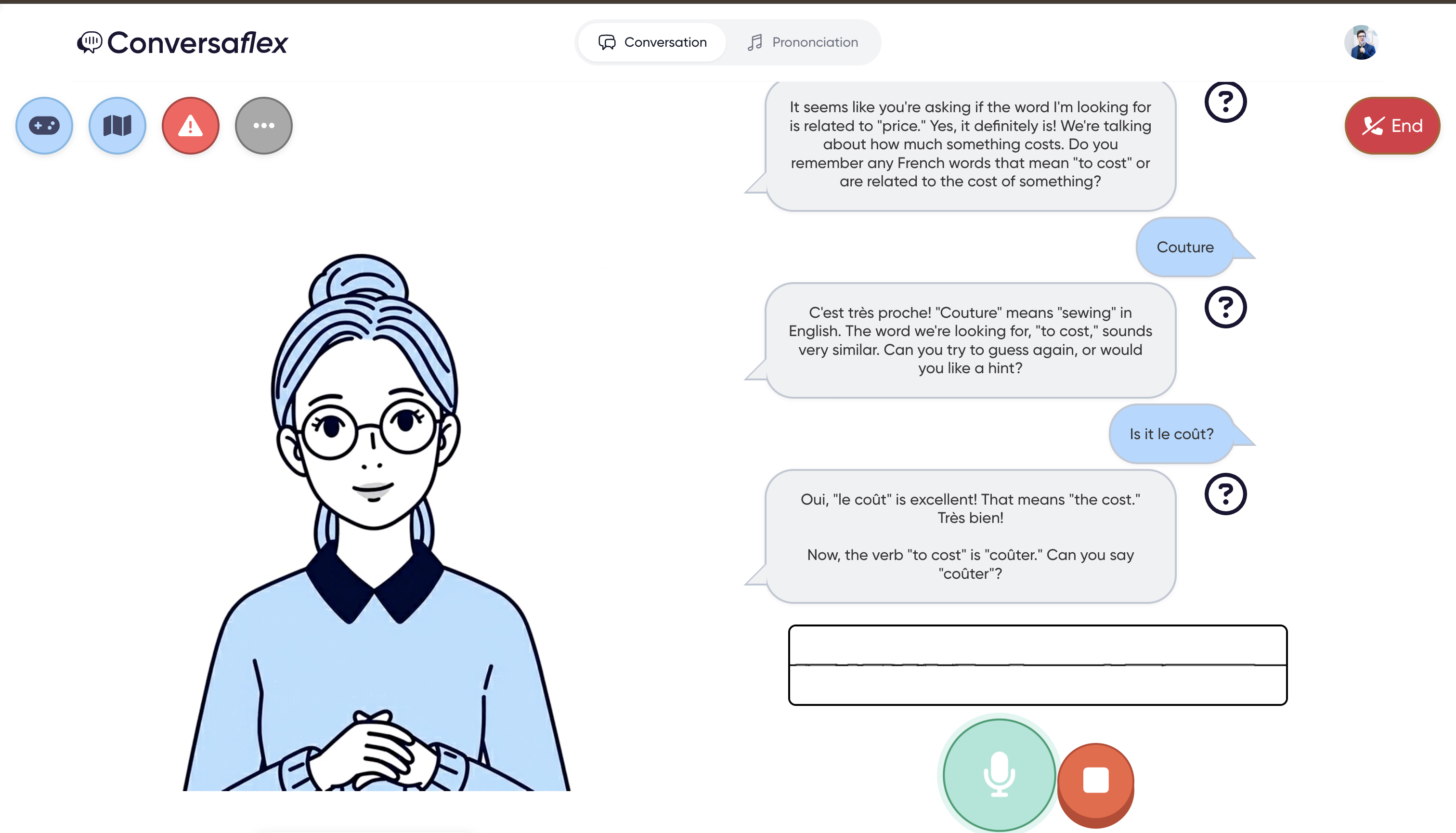
The useful unit is a situation, not a grammar point. A practitioner needs the twenty or thirty exchanges their practice actually contains, repeated until the hesitation goes, which is the opposite of how most legal-French instruction is organised.
- Role-play an examination, a client interview, a negotiation, a call with opposing counsel
- Terminology by practice area — employment, real estate and family law do not share a vocabulary
- Real-time correction on pronunciation and register, which is what marks a second-language speaker in court
- Unlimited repetition, at whatever hour a billable practice allows
Trusted by leading organizations

Key results after just a few months
Measurable impact on confidence, collaboration, and daily language use.
Confidence Improvement
Noticed an improvement in their confidence
Cross-site Collaboration
Felt more confident participating in cross-site collaboration
More French at Work
Used more French at work after the pilot
Why growing organizations choose Conversaflex
Hear from leaders who transformed their teams' language skills with Conversaflex.
Conversational breakthrough
What Conversaflex gave me is the conversation. That's what I was really missing to make it to the next level of speaking and understanding French.
Rebecca
Asset Laboratory Study Manager, GSK
Round of applause
I was able to share full sentences about our sales performance, which was met with a round of applause from the Quebec team.
Nick
Marketing Director, GSK
Customer service
In the service industry, communication is everything. Our team needed to connect with French-speaking customers naturally and confidently — Conversaflex made that possible.
Mike C.
CEO, Hair Salon
Bilingual sales team
Our sales team managed to properly learn how to pitch and answer questions about the company in both English and French. It completely transformed how we operate.
Sleiman
CEO, Josephine Care
Confidence to speak
My French is not perfect, but I'm definitely not afraid to try. I delivered a full speech in French at our company town hall and received a round of applause.
Michelle
Senior Leader, GSK
Real-world results
Being able to understand what the physicians were saying and understand the presentation was really eye-opening. I wouldn't have been able to do that before the program.
Kathy
Medical Science Liaison, GSK
FAQ
How does Conversaflex help law firms comply with Quebec's Bill 96 language requirements?
What legal French terminology do lawyers and notaries learn with AI-powered training?
Can legal professionals practice French for court proceedings and tribunal hearings?
How quickly can legal professionals achieve workplace French proficiency?
The learner journey
Every session is a real conversation — spoken, corrected, and adapted in real time.