



















Conversaflex logo
Book a demo
For HR and L&D teams

Get your teams working in English

Unlimited spoken practice with an AI partner trained on each employee's role, plus the progress reporting HR needs.

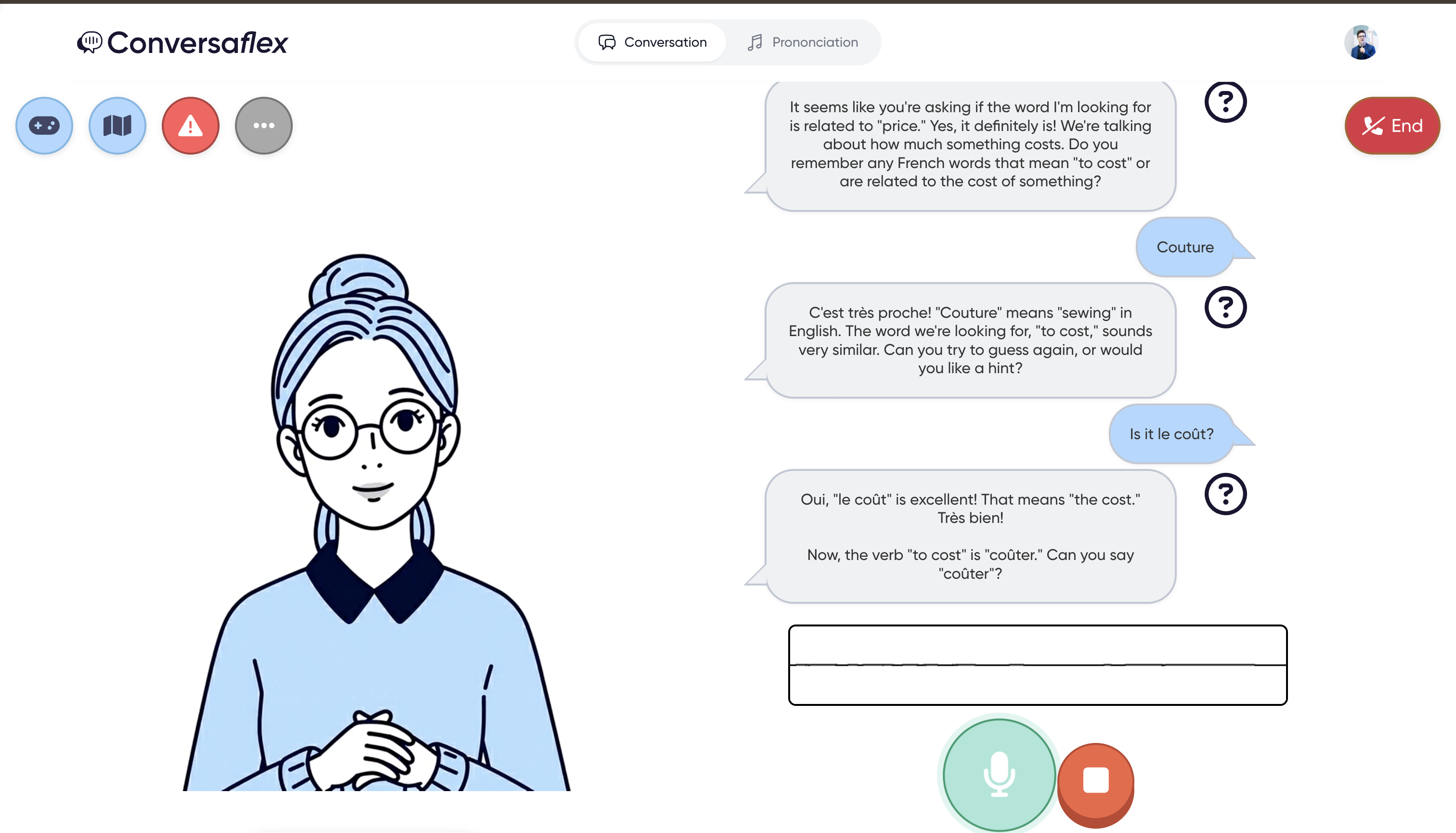
An employee holding a spoken conversation with the Conversaflex AI partner
Why teams choose Conversaflex

Language training that fits into the workday

Speaking practice, any time

Every employee gets an AI conversation partner on any device, 24/7. No classes to schedule, no cohort to keep together.

Built around each role

Employees rehearse the conversations their own job contains — client calls, meetings, safety briefings — at their own level.

Progress HR can report

Who is practising, how much, and how their level is moving, in one dashboard you can export.

What you get

One platform for your employees and for HR

An employee in a spoken conversation with the Conversaflex AI partner

Unlimited conversation practice

Employees speak out loud with a patient AI partner that corrects them as they go, pronunciation included. Ten to twenty minutes, whenever it fits.

  • Role-plays drawn from the employee's own job
  • Pronunciation feedback on what they actually said
  • Every level from CEFR A1 to C2
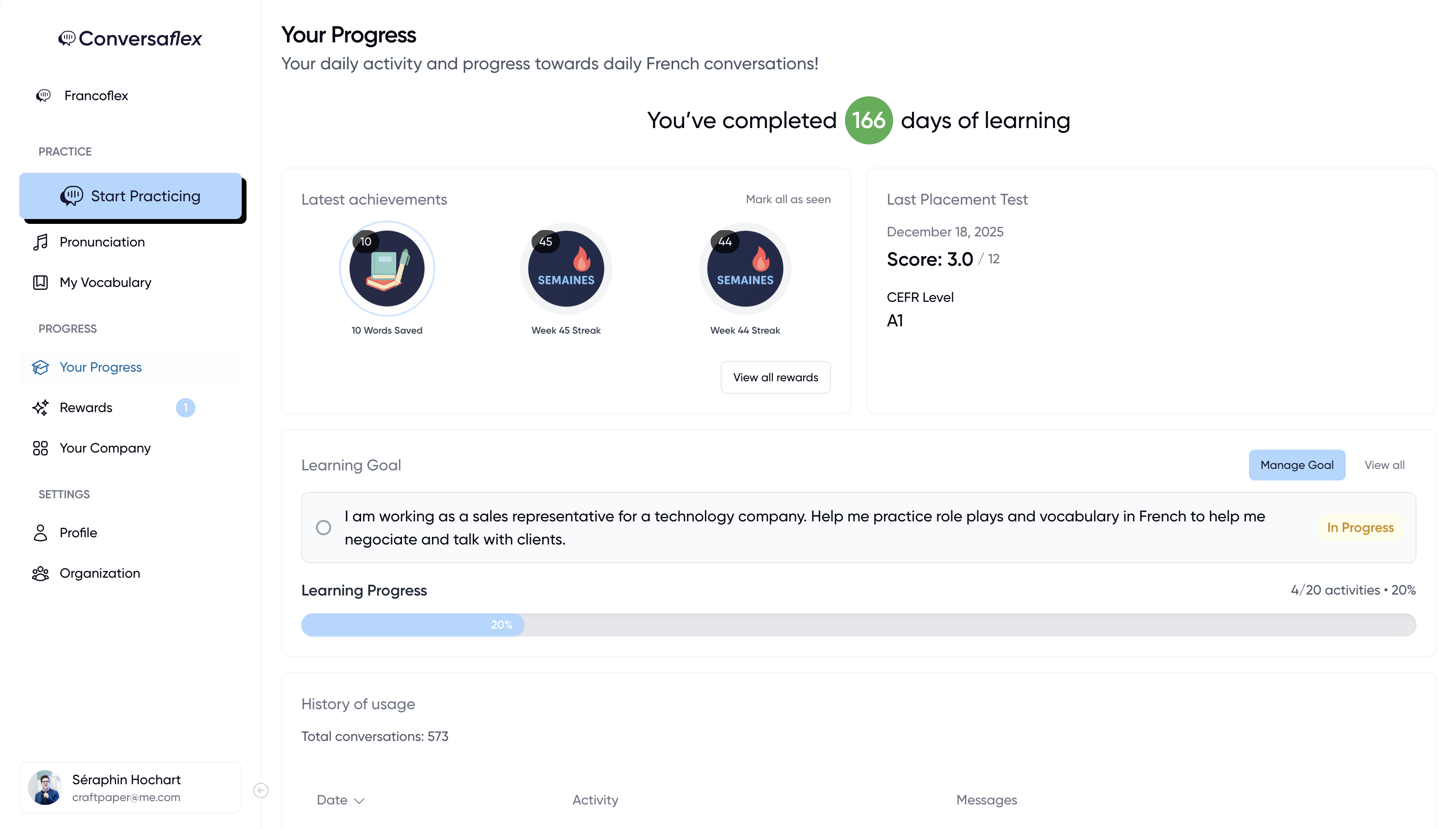
An employee's progress page: learning goal, achievements and placement test level

A learning path for every employee

A placement test sets each employee's starting point, and their plan adapts from there. Nobody is bored, and nobody is lost.

  • A placement test on first sign-in
  • Learning goals set for each employee
  • Streaks and rewards that keep practice going
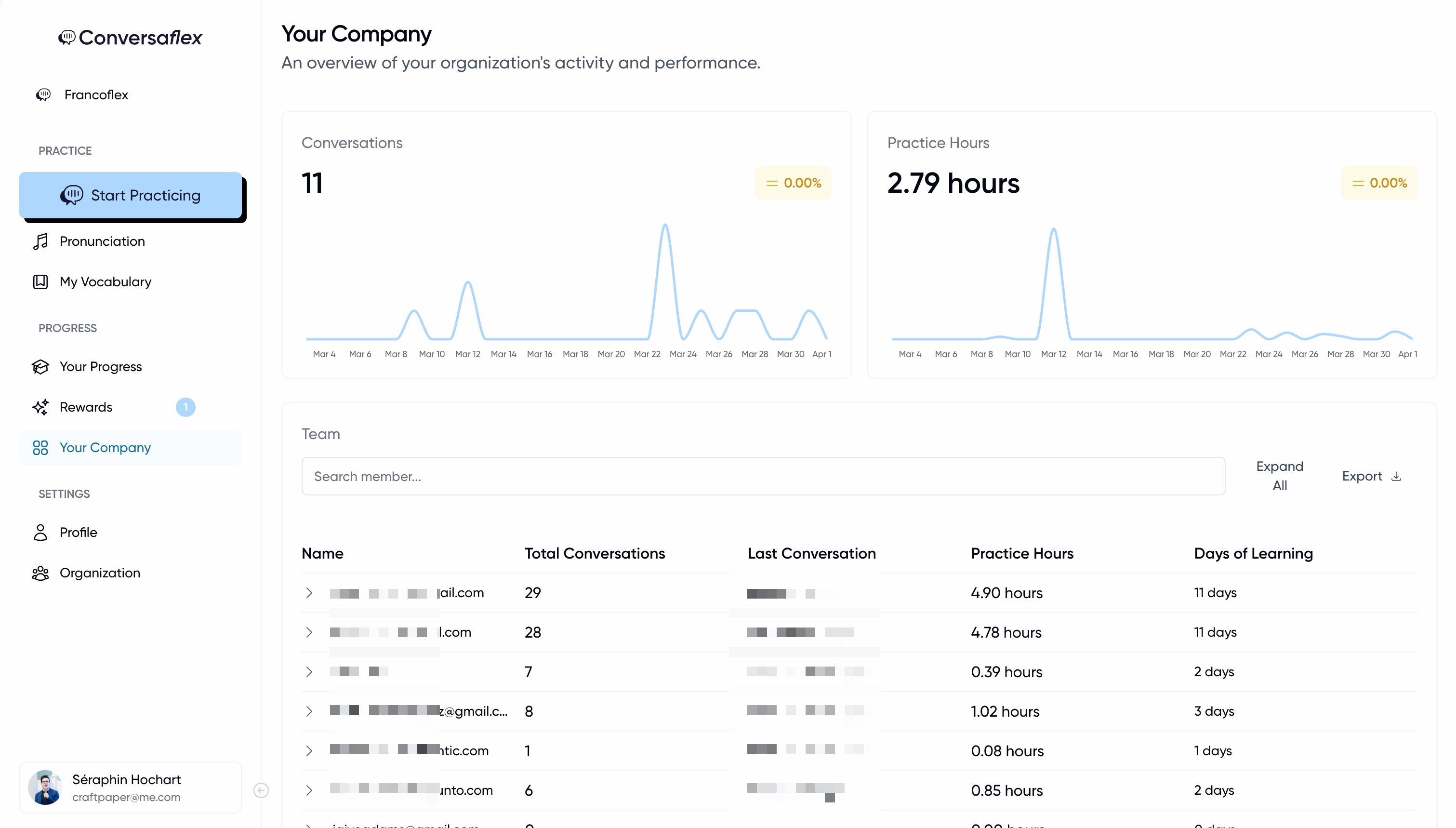
The company dashboard: team conversations, practice hours and per-learner activity

The reporting you will be asked for

One admin view for the whole organization: who is practising, how much, and when they last spoke — without chasing anyone.

  • Conversations and practice hours, week by week
  • A participation record you can export for compliance files, Bill 96 included
  • A weekly summary in your inbox
Industries

Powering progress across industries

Case studies

Delivering proven impact through language training

Delivering proven impact

GSK built spoken French confidence across their workforce and saw 100% of participants improve.

GSK logo

GSK

Global Pharmaceutical Leader

Confidence BuildingWorkplace FrenchMeasurable Results

GSK Canada piloted Conversaflex to strengthen communication skills, increase inclusion, and expand internal talent mobility. Through conversation-first AI practice tailored to each role, the company built real spoken confidence across teams.

100%

Confidence improvement

90%

Cross-site collaboration confidence

70%

Increased French usage at work

Testimonials

Why growing organizations choose Conversaflex

Hear from leaders who transformed their teams' language skills with Conversaflex.

Conversational breakthrough

What Conversaflex gave me is the conversation. That's what I was really missing to make it to the next level of speaking and understanding French.

Rebecca

Asset Laboratory Study Manager, GSK

Round of applause

I was able to share full sentences about our sales performance, which was met with a round of applause from the Quebec team.

Nick

Marketing Director, GSK

Customer service

In the service industry, communication is everything. Our team needed to connect with French-speaking customers naturally and confidently — Conversaflex made that possible.

Mike C.

CEO, Hair Salon

Bilingual sales team

Our sales team managed to properly learn how to pitch and answer questions about the company in both English and French. It completely transformed how we operate.

Sleiman

CEO, Josephine Care

Confidence to speak

My French is not perfect, but I'm definitely not afraid to try. I delivered a full speech in French at our company town hall and received a round of applause.

Michelle

Senior Leader, GSK

Real-world results

Being able to understand what the physicians were saying and understand the presentation was really eye-opening. I wouldn't have been able to do that before the program.

Kathy

Medical Science Liaison, GSK

Pricing

Choose Your Plan

Whether you're learning individually or training your team, we have a plan that fits your needs.

Most Popular

Business

Empower your team with French language training. Ideal for companies of all sizes.

  • Unlimited team members
  • Admin dashboard & analytics
  • Custom vocabulary for your industry
  • Bill 96 compliance support
  • Dedicated account manager

Learning Partners

For language schools and LMS platforms like Degreed. Integrate AI-powered French practice into your offering.

  • White-label options available
  • Learner progress reports
  • LMS & platform integration
  • Admin dashboard & API access
  • Volume pricing discounts
In detail

How it works, in detail

Employers buy English training when the language is already blocking the work — a technician who cannot escalate a fault to head office, a manager who goes quiet on a client call. Conversaflex gives each employee unlimited spoken practice with an AI partner trained on their role, and gives HR the participation and level data to show it is working.

What is English language training for employees?

English language training for employees is workplace-specific instruction that an employer funds so staff can do their jobs in English — running a meeting, handling a client call, writing a clear email. It is scoped to the work, not to a syllabus: progress is measured against the CEFR scale from A1 to C2, and employers track participation and level movement rather than attendance alone.

What English language training for employees has to cover

General English courses teach the language in the abstract. Employees need the twenty or thirty situations their job actually contains, practised until they stop being difficult. That is a narrower target than a course syllabus and a far more useful one.

  • Meetings: interrupting politely, disagreeing, asking for repetition without losing face
  • Client and customer conversations, including complaints and bad news
  • Written English that gets read: email, tickets, incident reports, handover notes
  • The vocabulary of one industry rather than all of them — a nurse and a site foreman need different words
  • Presenting and being questioned, which is where confident readers still freeze

How this differs from a business English course

A scheduled business English course puts a group in a room with a teacher for a fixed number of hours. It works, and it is expensive, hard to schedule across shifts, and gives every learner the same hour regardless of level. AI-led practice changes the economics of the speaking part specifically — the part learners get least of and need most.

  • Unlimited speaking time: a class of eight gives each person a few minutes an hour, a private session gives them fifty
  • Available at 06:00 or between shifts, which is when frontline staff are actually free
  • Adapts per learner, so a B1 and a C1 on the same team are not sharing a syllabus
  • No cancellations, no rescheduling, no minimum cohort to start
  • Costs scale with headcount rather than with instructor hours

Levels, time and reporting: what a rollout looks like

The questions HR asks are rarely pedagogical. They are: who is at what level, how long until they improve, and what do I show my director in six months. Every learner starts with a placement so the baseline is a number rather than a guess.

  • A free placement test puts each employee on the CEFR scale (A1–C2) before anything is assigned
  • Fifteen to twenty minutes of speaking a week is enough to move a level over a few months
  • Manager dashboards show participation, practice time and level movement per person and per team
  • Learning paths are set by role, so a sales team and a maintenance team get different practice
  • Exports for the board, and for anyone who has to justify the budget line

English training for employees in Canada

Canadian employers have a specific version of this problem. Teams in Quebec often work in French internally and in English with clients, head office or suppliers elsewhere in Canada and the United States, and newcomers frequently arrive with strong technical skills and untested workplace English.

  • Quebec employers can count language training toward the 1% workforce-training obligation under Bill 90
  • Learner records sit in a Canada-resident database and scheduled processing runs in Montreal
  • Teams that need French as well as English can run both from the same account and the same dashboard
  • Support in French, English and Spanish, from a team in Montreal

How to learn English for work with Conversaflex

  1. 1

    Practise real professional situations

    Cover meetings, presentations, customer conversations, email writing, feedback, negotiations, and industry-specific vocabulary.

  2. 2

    Get direct explanations

    Learners receive clear rules, short examples, and reusable takeaways for grammar, phrasing, tone, and register.

  3. 3

    Build speaking and listening confidence

    Guided role-plays, pronunciation tips, listening checks, transcripts, and follow-up questions make practice active instead of passive.

  4. 4

    Know what to practise next

    Personalized learning paths, review lists, and admin dashboards help learners and managers see progress over time.

FAQ

Frequently asked questions

What is Conversaflex and how can it help employees learn English?

Conversaflex is an AI language-practice platform for workplace teams. Employees practise realistic English conversations and receive feedback, explanations, and next-step practice.

Can Conversaflex help with business English writing and speaking?

Yes. Learners can practise speaking, listening, pronunciation, email phrasing, meeting language, presentations, and professional vocabulary.

Does English practice adapt to each learner?

Yes. Conversaflex can adapt to level, role, objectives, and pace so employees practise the English they are most likely to use at work.

Can HR or L&D teams monitor engagement?

Yes. Admin dashboards help teams understand activity, progress, and which learners may need additional support.

How long does English language training for employees take to show results?

Most learners doing fifteen to twenty minutes of spoken practice a week show measurable movement within two to three months, and a full CEFR level typically takes six to twelve months depending on the starting point. Movement from A2 to B1 is usually faster than B2 to C1, because the higher levels are about precision rather than coverage.

What does English training for employees cost?

Pricing is per learner and falls as the number of employees rises, with an initial setup and then unlimited practice rather than per-hour instructor fees. That is the main structural difference from a classroom provider: adding a learner costs less than adding a class. See the pricing page for current plans, or contact us for a quote at team size.

Can we run English and French training for the same team?

Yes. One account covers French, English and Spanish, and a single dashboard reports on all of them. This is common in Quebec, where the same organisation often needs French for compliance and English for clients outside the province.

Do employees need a certain level to start?

No. The placement test covers A1 to C2 and practice adapts to whatever it finds. Complete beginners get more scaffolding and slower speech; advanced learners get harder questions and are pushed on precision and register rather than vocabulary.

Contact

See whether it fits your team

One short conversation is enough for us to say whether this suits your organization, and to tell you honestly if it does not.

  • We reply within one business day
  • A demo built around your team's roles
  • Pricing for your headcount, with no commitment