Language Learning for Healthcare Professionals
Trusted by Josephine Care. AI-led French training for clinical and administrative teams, from patient intake to interdisciplinary rounds.
What kind of French do clinical teams actually need?
Patient-facing French, which is narrower and higher-stakes than general French. A clinician needs intake, history-taking, consent, explaining a procedure, and handover — situations where being misunderstood has consequences and where patients are often anxious, in pain, or elderly and unlikely to switch languages to help. Quebec's professional orders also set French requirements for admission to practice.
The situations that carry risk
Clinical language failures cluster in a small number of moments. Training that covers those moments properly is worth more than broad coverage, because the rest of the shift is tolerant of imprecision and these are not.
- Intake and history-taking, where a missed detail changes the plan
- Consent conversations, which have to be understood to be valid
- Explaining a diagnosis, a procedure or a medication regimen to a worried patient
- Handover between shifts and between disciplines, where information is most often lost
- Families, who are frequently the ones asking the questions
Professional orders and the language requirement
For regulated professions the requirement is not only the employer's. Quebec's professional orders require an appropriate knowledge of French for admission, and internationally trained clinicians frequently arrive with strong clinical skills and untested working French.
- Candidates who need to reach the required standard to practise
- Internationally trained staff whose clinical French has never been assessed
- Existing staff who read and write adequately but avoid speaking
- CEFR placement so the gap is a number rather than an assumption
Training that fits a clinical schedule
Healthcare is the hardest sector to get into a classroom. Shifts rotate, coverage is tight, and the people with the biggest language gap are often the least able to leave the floor for an hour at a fixed time.
- Practice at any hour, in short sessions, without booking coverage
- Role-specific vocabulary — nursing, allied health and administration differ
- Unlimited repetition of the same difficult conversation until it stops being difficult
- Participation and progress reporting for managers and for francisation files
Trusted by leading organizations


Key results after just a few months
Measurable impact on confidence, collaboration, and daily language use.
Confidence Improvement
Noticed an improvement in their confidence
Cross-site Collaboration
Felt more confident participating in cross-site collaboration
More French at Work
Used more French at work after the pilot
Why growing organizations choose Conversaflex
Hear from leaders who transformed their teams' language skills with Conversaflex.
Conversational breakthrough
What Conversaflex gave me is the conversation. That's what I was really missing to make it to the next level of speaking and understanding French.
Rebecca
Asset Laboratory Study Manager
Round of applause
I was able to share full sentences about our sales performance, which was met with a round of applause from the Quebec team.
Nick
Marketing Director
Medical presentations
Being able to understand what the physicians were saying and understand the presentation was really eye-opening. I wouldn't have been able to do that before the program.
Kathy
Medical Science Liaison
FAQ
How does Conversaflex help healthcare organizations comply with Quebec's Bill 96 language requirements?
What French vocabulary do healthcare professionals learn with AI-powered training?
Can healthcare teams practice French for patient interactions and clinical documentation?
How quickly can healthcare employees achieve workplace French proficiency for Quebec settings?
The learner journey
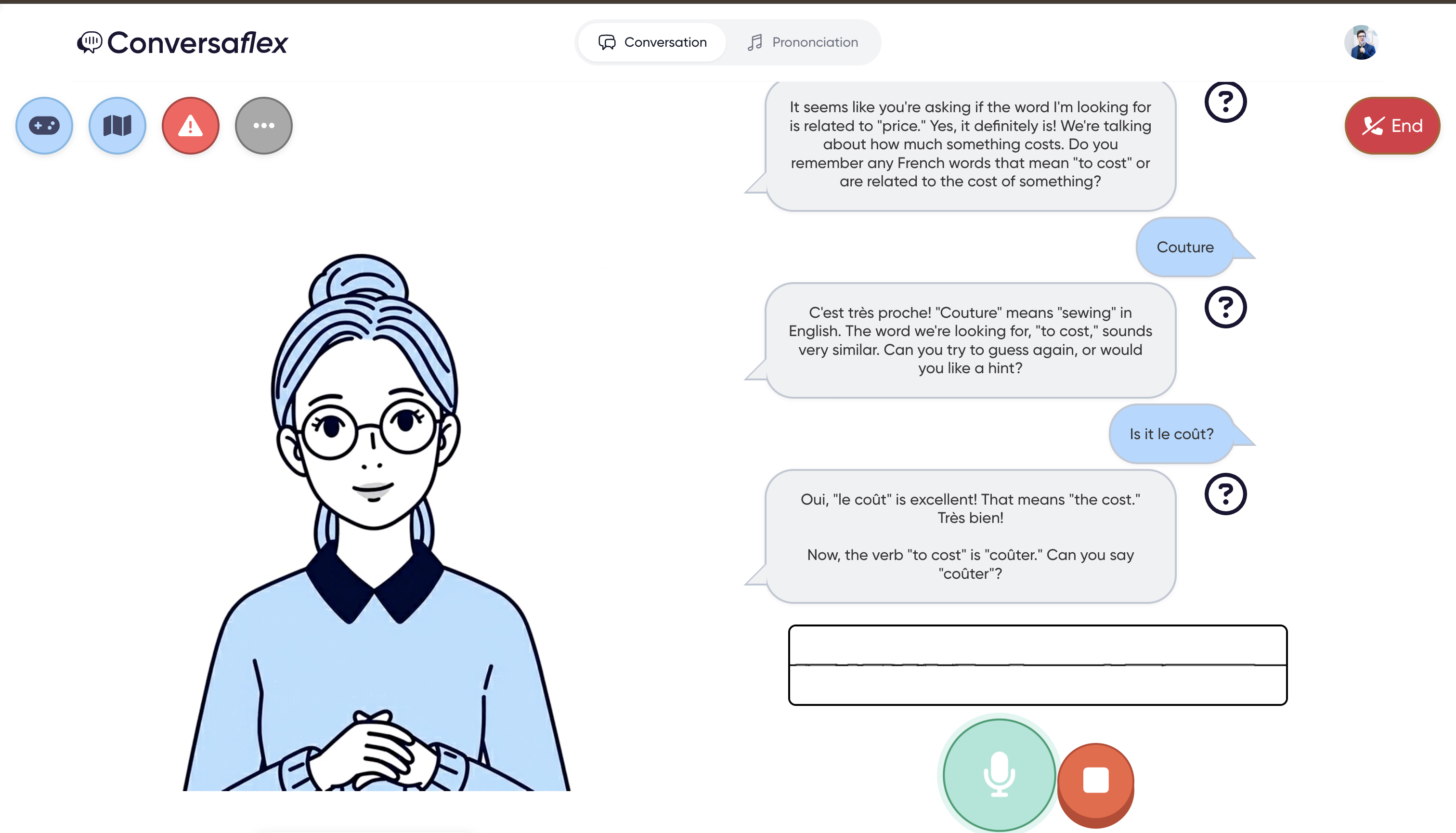
Every session is a real conversation — spoken, corrected, and adapted in real time.