Language Learning for Human Resources
French training for HR leaders, CRHA members and L&D teams: manage francization, onboard employees in French and build bilingual workplaces in Quebec.
Book a demo
Francization Compliance

Talent Retention
Inclusive Workplace Culture

What does HR need French for in a Quebec workplace?
HR carries the francisation file. That means the OQLF registration and certificate, the francisation committee once the organisation passes 50 employees, the analysis of the language situation, and the evidence that training happened — all of it produced and corresponded in French. It is a different language need from the rest of the business: less customer vocabulary, more policy, governance and record-keeping.
The francisation committee is an HR job, and it runs in French
At 50 employees a Quebec organisation must form a francisation committee, and at 100 it must have at least six members. The committee's output — status reports, action plans, minutes, correspondence with the OQLF — is the paper trail an audit reads.
- Running a meeting in French, including disagreeing and summarising, not just following along
- Writing the analysis of the language situation and the francisation programme
- Correspondence with the OQLF, which has its own register and expects it
- Minutes and status reports that an inspector will read years later
- Explaining the obligation to managers who do not yet see why it is theirs
Recruitment and onboarding are where language policy becomes real
A francisation programme that does not reach hiring is a document. Job postings, interviews, offer letters and the first week are the points where a new employee learns whether French is genuinely the language of work or a compliance artefact.
- Job postings and interview questions in French, including for roles hired in English
- Offer letters, contracts and policy acknowledgements
- Onboarding and safety induction, which carry legal weight when they are misunderstood
- Performance reviews and difficult conversations, which most managers avoid in a second language
What HR has to be able to show
The obligation is organisational and the evidence is administrative, which is why this lands on HR rather than on the people doing the training. The question at audit is not whether everyone speaks perfect French; it is what you did and whether you can prove it.
- Who trained, for how long, and how their level moved, per employee and per team
- CEFR placement at the start so the baseline is a number rather than an impression
- Exports that go into a francisation file without being retyped
- Bill 90 training-levy eligibility, so the spend is often already committed
Doing it without adding headcount
The reason francisation programmes stall is rarely disagreement about the goal. It is that scheduling classes across shifts, chasing attendance and compiling reports is a job nobody has been given.
- Employees practise on their own time, at any hour, with no cohort to assemble
- Participation and progress arrive as data rather than as a spreadsheet someone maintains
- One account covers French, English and Spanish, which matters for teams that need more than one
- Support in French from a Montreal team, which is who the file has to make sense to


Key results after just a few months
Measurable impact on confidence, collaboration, and daily language use.
Confidence Improvement
Noticed an improvement in their confidence
Cross-site Collaboration
Felt more confident participating in cross-site collaboration
More French at Work
Used more French at work after the pilot
Why growing organizations choose Conversaflex
Hear from leaders who transformed their teams' language skills with Conversaflex.
Conversational breakthrough
What Conversaflex gave me is the conversation. That's what I was really missing to make it to the next level of speaking and understanding French.
Rebecca
Asset Laboratory Study Manager, GSK
Round of applause
I was able to share full sentences about our sales performance, which was met with a round of applause from the Quebec team.
Nick
Marketing Director, GSK
Customer service
In the service industry, communication is everything. Our team needed to connect with French-speaking customers naturally and confidently — Conversaflex made that possible.
Mike C.
CEO, Hair Salon
Bilingual sales team
Our sales team managed to properly learn how to pitch and answer questions about the company in both English and French. It completely transformed how we operate.
Sleiman
CEO, Josephine Care
Confidence to speak
My French is not perfect, but I'm definitely not afraid to try. I delivered a full speech in French at our company town hall and received a round of applause.
Michelle
Senior Leader, GSK
Real-world results
Being able to understand what the physicians were saying and understand the presentation was really eye-opening. I wouldn't have been able to do that before the program.
Kathy
Medical Science Liaison, GSK
FAQ
How does Conversaflex help HR teams comply with Quebec's Bill 96 francization requirements?
What role do francization committees play, and how can Conversaflex help?
Can HR teams use Conversaflex for employee language training programs?
What is the ROI of language training for HR departments?
The learner journey
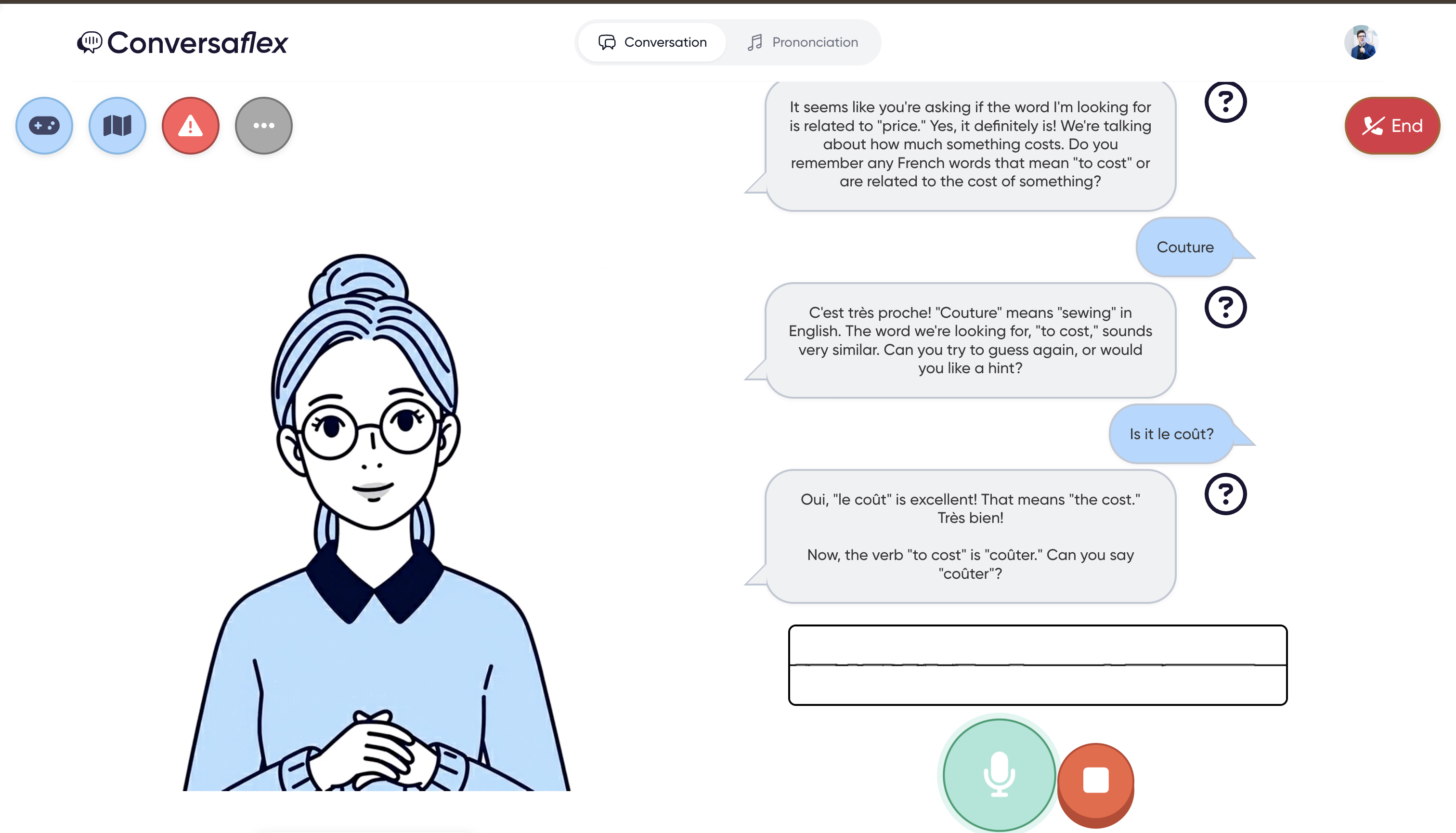
Every session is a real conversation — spoken, corrected, and adapted in real time.