Ultimate Guide to Corporate Language Rollout
Step-by-step plan to set role-based language targets, pilot training, protect privacy and meet Quebec French duties.

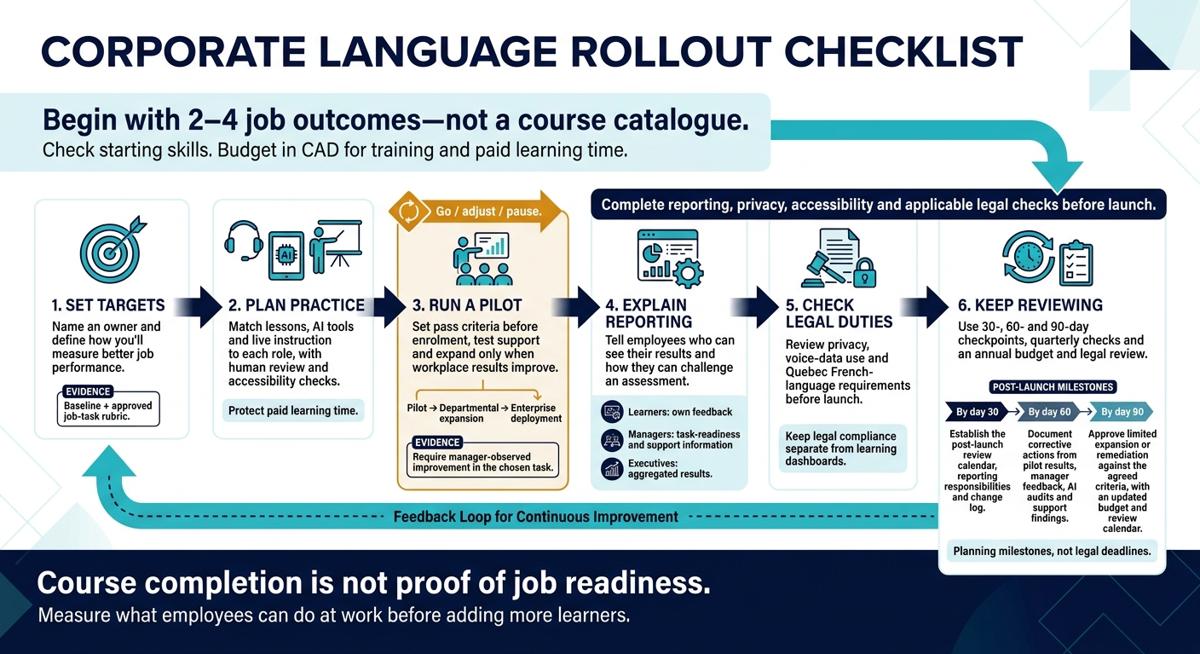
I’d start a corporate language rollout with 2–4 job outcomes - not a course catalogue. Choose tasks employees need to handle, check their starting skills and budget in Canadian dollars for training and paid learning time.
My rollout checklist covers six steps:
- Set targets: Name an owner and define how you’ll measure better job performance.
- Plan practice: Match AI vs. traditional language training methods to each role, with human review and accessibility checks.
- Run a pilot: Set pass criteria before enrolment, test support and expand only when workplace results improve.
- Explain reporting: Tell employees who can see their results and how they can challenge an assessment.
- Check legal duties: Review privacy, voice-data use and Quebec French-language requirements before launch.
- Keep reviewing: Use 30-, 60- and 90-day checkpoints, quarterly checks and an annual budget and legal review.
My rule: course completion is not proof of job readiness. Measure what employees can do at work before adding more learners.
Build Role-Based Training with AI
Turn the role targets above into delivery plans, practice rules and tool requirements.
Choose Learning Plans and Delivery Methods
Build each learning pathway around what people need to do at work:
- Onboarding: workplace introductions, policies, safety language and core systems.
- Customer-facing staff: service recovery, plain-language explanations and industry terminology.
- Managers: meetings, coaching, written communication and sensitive conversations.
- Technical teams: procedures, documentation, troubleshooting and cross-functional collaboration.
- Quebec teams: workplace French built into role tasks.
Each plan should name the language, starting level, vocabulary, delivery channel, weekly practice time, target date and reassessment method.
| Delivery method | Flexibility | Personalisation | Manager insight | Scale | Admin load |
|---|---|---|---|---|---|
| Self-paced learning | High | Moderate | Moderate | High | Low to moderate |
| Live instruction | Low to moderate | High | High | Moderate | High |
| AI-supported practice | High | High | Moderate to high | High | Moderate |
| Blended delivery | Moderate to high | High | High | Moderate to high | High |
Use self-paced learning to build basic vocabulary and AI-supported practice to rehearse conversations. Choose live or blended learning for safety-critical, regulated or emotionally sensitive communication. Automated completion data is not proof that someone can perform the task at work.
Next, match these needs to a platform that supports role-specific practice at scale.
Assess Conversaflex for Workplace Training
Conversaflex supports French, English and Spanish through AI-led conversations, role-specific practice, pronunciation feedback and skill tracking over time. The training adjusts to learners’ levels and native languages. Check these features against the role targets you’ve already set.
Before buying, review dashboards, customisation, accessibility, integrations, report exports and access controls. Verify that you can assign training by role, language and level, and deploy it across departments.
Check accessibility rather than assuming it’s available. Confirm support for captions, transcripts, keyboard navigation, screen readers and non-voice alternatives. Ask for details on LMS integration, APIs and single sign-on.
Request a written per-seat quote in CAD that covers employee volume, languages, minimum seats, implementation, support and renewal terms. Don’t assume there’s a published standard price.
Once the platform fits your workflow, set content review and access rules before launch.
Set Content and Review Rules
Require practice scenarios based on approved job tasks, with feedback suited to each learner’s level. Beginners need short corrections. Advanced learners need feedback on nuance, register, clarity and concision.
Assign human reviewers to check terminology, factual accuracy, language quality, suitability across communities and sensitive situations. Record approval dates and content versions before release.
Set separate permissions for creating lessons, assigning training, viewing results and exporting records. Give learners and reviewers a clear route to flag and escalate incorrect, biased, unsafe or inappropriate AI feedback.
Keep confidential customer, patient, employee and business information out of practice unless approved safeguards and contractual controls apply. Use synthetic or redacted material instead.
Build Support and Launch in Phases
Once content and review rules are set, assign owners, define pilot controls and check launch readiness.
Assign Responsibilities and Protect Learning Time
Before enrolment, name an executive sponsor to approve the business case, budget and expansion decisions. Appoint a program owner to manage delivery and keep the rollout tied to business goals.
Give each group a clear remit: HR or L&D handles learner policy and records; managers oversee attendance and job alignment; IT manages access; and legal or privacy staff review contracts and data flows. Administrators handle enrolment and reporting, while employee or union representatives provide input on participation and accommodations. Smaller organisations can combine roles, but every responsibility needs a named owner, backup contact and escalation route.
Set aside paid time each week for two self-directed sessions and one coached or AI-supported practice session. Confirm paid-time arrangements, shift coverage and accommodations.
Send employees a plain-language notice explaining the business reason for the program and whether participation is mandatory, voluntary or role-based. Explain what managers can see, whether individual scores affect performance reviews, and how employees can correct records or challenge an assessment. Seek employee or union input when scheduling or monitoring affects working conditions.
Pilot the Program Before Expanding
Approve a pilot charter that defines the business problem, target roles, locations, learner count, languages, duration, budget and vendor scope. Include baseline measures, the support model and a decision date.
Choose employees with a clear workplace need - not just enthusiastic volunteers. Set success thresholds before enrolment, such as 80% completion, measurable improvement in a defined role-based assessment and no unresolved high-risk privacy or security issues. Activate accounts only after charter approval, and use the pilot to test the model before expanding.
| Stage | Scope | Main risks | Approval criteria | Required evidence |
|---|---|---|---|---|
| Pilot | One or two roles, locations or shifts; a limited learner group | Weak baseline, low adoption, unsuitable content, untested data handling | Charter approved; privacy, security and accessibility checks complete; support owner named; success measures fixed | Baseline and post-pilot results, learner and manager feedback, incident log, cost and support data |
| Departmental expansion | Several teams using the same role pathways | Inconsistent manager support, scheduling conflicts, uneven access across shifts or locations | Pilot targets met; content revised; managers trained; reporting validated; high-risk issues closed | Team comparisons, adoption and completion data, accessibility outcomes, support capacity and revised forecast |
| Enterprise deployment | Multiple departments, provinces, languages and employment arrangements | Scale-related privacy exposure, inconsistent policy application, integration failure and labour-relations concerns | Executive approval; contract and privacy documentation complete; communications and training ready; service-level and escalation procedures tested | Readiness checklist, security and privacy sign-off, accessibility verification, administrator training, budget and benefits case |
Hold a go/no-go review after each stage. Assess learning gains, workplace application, employee experience and whether the program can run as planned. Completion alone isn’t enough: require manager-observed improvement in the chosen task. Record the decision to expand, adjust or pause.
Check Launch Readiness
Before sending invitations, verify learner identities and assignments, notice or consent records, administrator permissions, manager report access, approved-device access and compliance sign-offs. Confirm Quebec French-language communications and materials.[1][2]
Test accessibility, browser compatibility, mobile performance and support coverage across locations and shifts. Walk through the full learner journey: invitation, enrolment, activity completion, help request and manager report access.
Publish support contacts and response times. For serious incidents, provide immediate escalation to the appropriate privacy, security, legal or HR lead.
Set Reporting, Privacy and Legal Rules
Measure Learning and Job Performance
Once the program is live, keep performance reporting separate from legal compliance. Track participation, demonstrated skill and business results separately. Assess the same job tasks at baseline, an interim checkpoint and program completion. Use the same rubric and human-reviewed evidence throughout.
Give learners their own feedback, managers only task-readiness and support information, and executives only aggregated results. Restrict HR and administrator access by role. Suppress results for small groups where employees could be identified.
| Metric | Definition | Data source | Reporting frequency | Owner |
|---|---|---|---|---|
| Completion rate | Percentage finishing assigned activities by the deadline | Learning records | Weekly | Learning administrator |
| Task proficiency | Percentage meeting the approved job-task rubric | Human-reviewed assessments | Baseline, interim and completion | Language assessor |
| Workplace transfer | Observed use of the target skill at work | Structured manager checklist | 60 or 90 days after completion | People manager |
| Business result | Change in an agreed service or error indicator | Operational records | Monthly or quarterly | Business-unit owner |
| Compliance status | Required reviews and fixes completed | Compliance register | Each rollout gate and quarterly | Privacy lead or counsel |
Define denominators, baseline periods and evidence standards before collecting data. Completion and AI scores do not prove workplace competence, business impact or compliance. Check AI scoring against human-reviewed samples, and record assessment conditions and model versions. Account for staffing changes and workload shifts that may affect business results independently of training.
Protect Employee and Voice Data
Ask the privacy lead to determine which federal or provincial rules apply. PIPEDA generally covers employee information in federally regulated workplaces. Quebec, Alberta and British Columbia have similar private-sector laws.[5][6]
Before collecting recordings, transcripts, results or backups, document each field’s purpose, notice or consent requirements, access rights, retention period and deletion method. Treat voice and performance data as potentially sensitive. Complete a privacy impact assessment where required.[7][8]
Map where data is stored, processed and accessed remotely, including by subcontractors. For Quebec, assess transfers outside the province through the required privacy impact assessment process. Contracts should cover security, breach assistance, access requests, deletion confirmation and secondary use. Check whether prompts, audio or results are used to train AI models, and prohibit that use unless separately approved.
Canadian hosting alone does not satisfy privacy obligations. Before learning data affects promotion, pay or discipline, require privacy, human-rights and employment-law review, human assessment and an appeal path.
Document Quebec French-Language Duties
Where Quebec applies, document French-language duties separately from general privacy controls. Maintain records under the Charter of the French Language and current OQLF guidance. This includes French versions of employment and staff-training documents generally required by law.
For a non-French job requirement, retain the duties analysis and records of reasonable steps taken to avoid that requirement. Official guidance sets a registration trigger of at least 25 employees in Quebec for six months, with registration due within the following six months. The extension to employers with 25–49 employees took effect on June 1, 2025.[4] Verify counting rules and deadlines before relying on them.
| Requirement | Owner | Retained records | Review frequency | Escalation route |
|---|---|---|---|---|
| Track headcount and registration trigger | HR and legal | Monthly counts, calculation and registration confirmation | Monthly near threshold | Quebec counsel |
| Maintain French employment and training documents | HR and communications | Approved French versions and release records | Before release; annually | Legal/language lead |
| Justify non-French job requirements | Hiring manager and HR | Duties, alternatives considered and approval | Each requisition | Employment counsel |
| Manage francization and reporting | Francization lead | OQLF correspondence, assessment, plan, certificate and reports | OQLF deadlines; applicable reporting cycle | Executive sponsor |
Track assessment, francization-plan and committee obligations where applicable, including the three-year reporting cycle for certified enterprises.[3] French language training alone does not establish compliance: it cannot fix missing French documents or justify an unsupported English requirement. Keep legal findings and corrective actions separate from learning dashboards.
Maintain and Review the Program
After launch, put the program on a fixed review cycle. The goal is to catch and correct issues before they spread.
Review Skills, Content and AI Quarterly
Each quarter, the program owner should meet with L&D, managers, IT, privacy and HR. Bring in legal or Quebec French-language specialists as needed. Review job-task performance and role impact, proficiency changes by role and language, manager observations, content accuracy and relevance, and AI feedback quality. Compare results with the baseline, rather than relying only on course completion.
Update vocabulary and practice when products, processes or regulations change. Reassess employees after promotions, transfers or reorganizations. Keep a change log that records the issue, affected roles, owner, priority, decision, due date and validation result. Check that new staff materials have approved French versions for Quebec employees.
Have trained bilingual reviewers independently sample AI feedback across major first-language groups, accents and proficiency levels. Check pronunciation, grammar, word choice, register, cultural appropriateness, task relevance and scoring consistency. Escalate harmful or inaccurate feedback for review right away instead of waiting until the next quarter.
Use these findings to guide the monthly, annual and expansion reviews below.
Set Review Schedules and Expansion Criteria
Base expansion decisions on a fixed review cycle and agreed criteria. Review participation, support requests and critical AI issues monthly. Each quarter, bring together review findings and business outcomes. At least annually, review access permissions, vendor security documentation, retention settings and legal changes.
Enrol new employees through controlled onboarding. Remove access promptly when staff leave, change roles or no longer need sensitive content. Review privacy and security when data use or technology changes, check legal obligations when they change, and review budgets before expansion.
Set expansion thresholds before the pilot. Criteria can include:
- At least 70% monthly active participation, documented improvement in task-based assessments and positive manager ratings.
- No unresolved high-severity privacy or AI issues, support response times within the agreed service level and a cost per active learner within budget.
High completion rates without workplace improvement call for revised practice - not more enrolments.
Follow a 30-, 60- and 90-Day Plan
Use the first 90 days to turn pilot results into a repeatable review and action cycle.
| Milestone | Required action |
|---|---|
| By day 30 | Establish the post-launch review calendar, reporting responsibilities and change log. |
| By day 60 | Document corrective actions from pilot results, manager feedback, AI audits and support findings. |
| By day 90 | Approve limited expansion or remediation against the agreed criteria, with an updated budget and review calendar. |
Treat these as planning milestones, not legal deadlines. Procurement, privacy review, collective agreement requirements and legal readiness may take longer. Review results, costs, legal changes and scope annually, and record whether to continue, pause or expand the program.
FAQs
How do we calculate our language program’s ROI?
Measure how employees use French at work and how it affects business results, not just course completion or attendance. Set a baseline with CEFR or the Francisation Scale, then reassess at regular intervals.
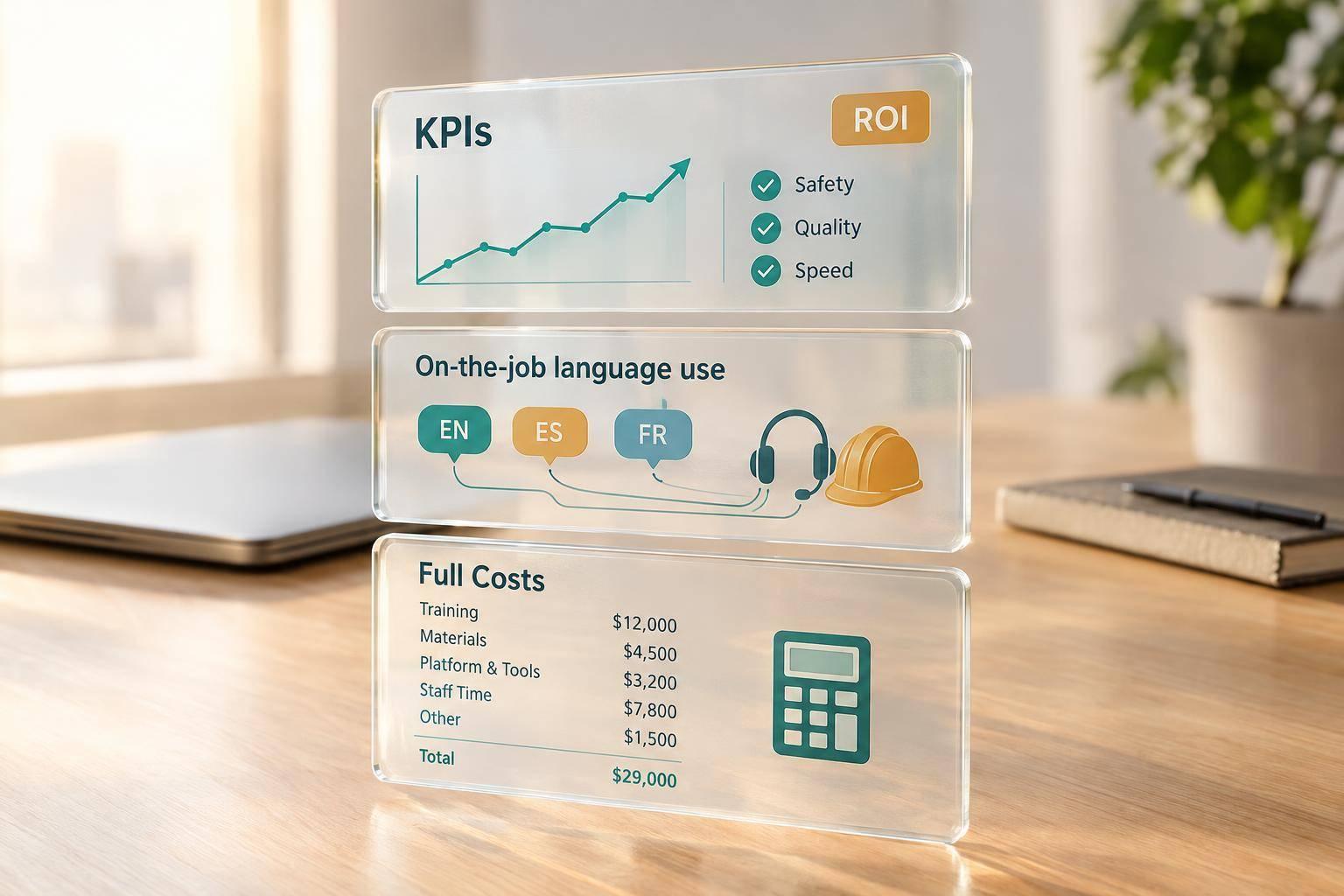
How to measure ROI on multilingual workforce training walks through the full calculation. Track training spend in CAD alongside proficiency gains, role-specific task performance, fewer communication errors, faster onboarding, a better customer experience, and lower costs linked to hesitation.
Use Conversaflex’s role-specific progress data to link training to productivity, reduced risk, and evidence of practical French ability for OQLF audits.
How can we support employees with language-learning anxiety?
Give employees a low-pressure space to build confidence through repeated, private practice. AI-powered tools like Conversaflex let them practise on their own devices in 10- to 20-minute sessions - without having to perform in front of others or follow a rigid schedule.
A patient, non-judgmental AI partner helps employees rehearse job-specific situations, such as team meetings and client updates. They can work on terminology and pronunciation before high-stakes workplace conversations.
Can language training alone meet Quebec’s French-language requirements?
No, language training alone is generally not enough. The Charter of the French Language sets duties that training can’t meet on its own: French employment and training documents (section 41), customers’ right to be informed and served in French (section 50.2) and, for businesses with 25 or more employees in Quebec, registration and francization with the Office québécois de la langue française (OQLF) (section 139). The OQLF can inspect a business to check how these duties are met in practice.
Training supports a francization program by building the French staff use at work. Keep participation records and progress reports alongside your francization documents, not in place of them.