
What Is Francisation? Meaning, Process & Requirements in Quebec [2026 Guide]
2026 Quebec francisation guide: who must comply, OQLF timelines, linguistic analysis, training, committees and penalties.
![Cover Image for What Is Francisation? Meaning, Process & Requirements in Quebec [2026 Guide]](/_next/image?url=%2Fassets%2Fimages%2Fblog%2F6a7052002f6aeb480bfeca55-1785753063287.jpg&w=3840&q=75)
What Is Francisation? Meaning, Process & Requirements in Quebec [2026 Guide]
If your business in Quebec has 25+ employees, francisation is not optional. In 2026, it means I need to make French the normal language of work, HR, internal tools, and customer service, then follow the OQLF process on time.
Here’s the short version:
- All employers must serve the public in French first
- At 25 employees, I must register with the OQLF within 6 months
- I then have 3 months after registration to file a linguistic analysis
- At 100+ employees, I must set up a Francisation Committee
- Fines can start at $3,000 to $30,000 for a first offence
- Some temporary foreign workers may need Level 4 oral French after 3 years in Quebec, and I must show I gave access to francisation training
This is not just about translating a few documents. It means checking contracts, handbooks, software, emails, signage, websites, job postings, and customer communications to make sure French is the default.
What I’d focus on first: register on time, review all French-language gaps, fix HR documents, check internal systems, and keep records for OQLF follow-up.
The article below walks through who must comply, what must be in French, and how the registration, analysis, plan, and certificate process works.
Bill 96: Complying with Quebec’s Strengthened French Language Protections
sbb-itb-7df369b
Who Must Comply and What the Rules Cover
All Quebec employers have to serve the public in French. That means French-first communications and services, not French as an afterthought. From there, workforce size decides the extra steps you need to take. Put simply, francisation ties your employee count to the right set of compliance tasks.
Business Thresholds: All Employers, 25+ Employees, and 100+ Employees
Workforce size sets the exact duties that apply:
| Business Size | Key Requirements |
|---|---|
| All employers | Serve the public in French through French-first communications and services; prove a non-French language is genuinely required for the role |
| 25–99 employees | Register with the OQLF, complete a linguistic analysis, and obtain a Francisation Certificate |
| 100+ employees | All of the above, plus establish a Francisation Committee with management and worker representation |
For businesses with 25 to 99 employees, the next step is registration with the OQLF and completion of the linguistic analysis process. A Francisation Committee is needed only if the OQLF asks for one. Once a business reaches 100 or more employees, forming a Francisation Committee becomes mandatory.
Workplace Documents, HR Practices, and Customer Communications That Must Be in French
The scope here is broad. On the HR side, French must be used for employment contracts, offer letters, employee handbooks, internal policies, performance documentation, and safety procedures. Job postings also have a clear rule: they must appear in French first, or at the same time as another language, and French must have equal prominence.
This also reaches into day-to-day operations. IT systems, software, and internal communications like emails, memos, and project notes must work in French. On the customer side, service interactions, marketing materials, brochures, and social media content must all give priority to French.
French Training Rights for Workers and Newcomers Through Francisation Québec
Employees may work in French. Another language can be required only if the role genuinely calls for it.
As of 17 December 2025, workers who have been present in Quebec for three years must show Level 4 oral French for immigration or work-permit purposes [3]. Employers must also prove they gave those workers access to francisation services [3]. So training access is part of the compliance picture, not some side issue. These rules feed straight into the registration and linguistic analysis process.
The Francisation Process: Registration, Analysis, Plan, and Certificate
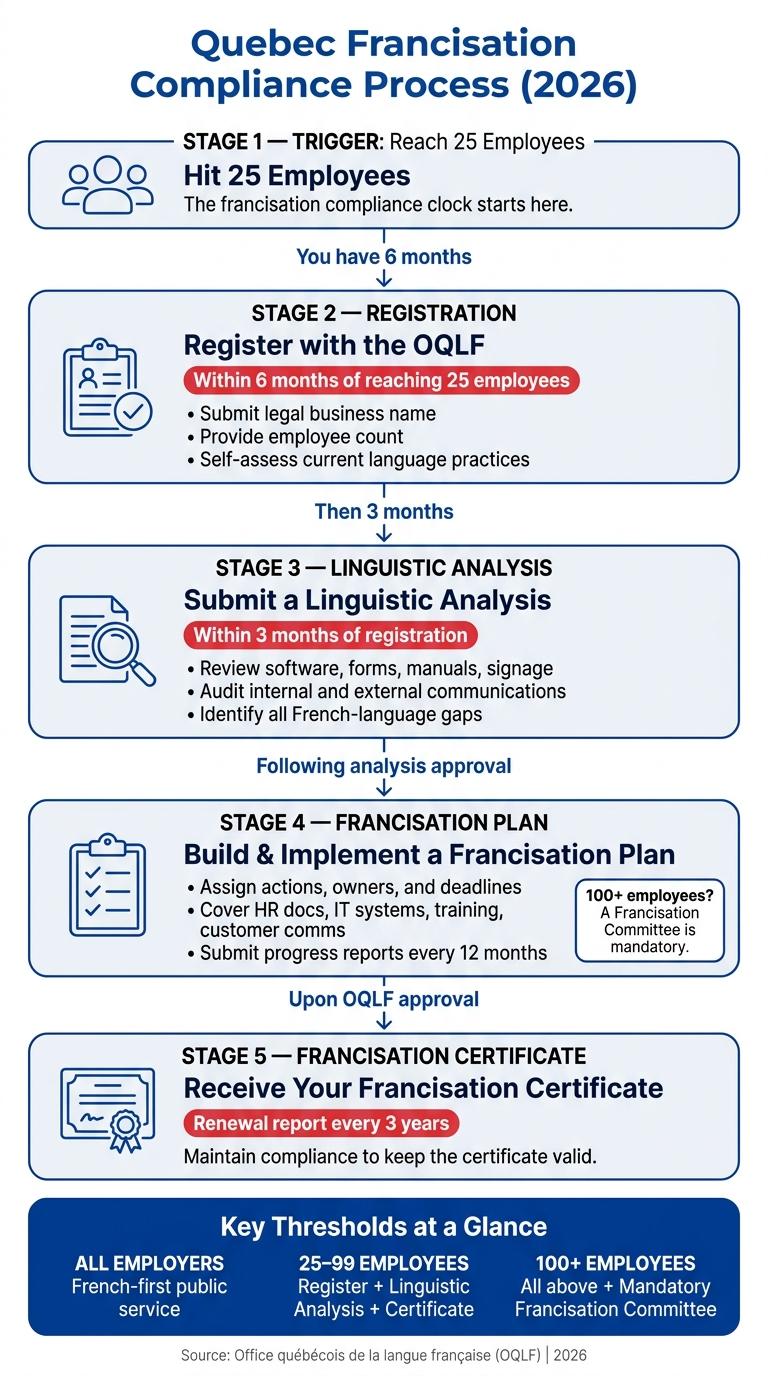
If your business has hit 25 employees, this is where the OQLF process starts. At that point, you need to register, send in a linguistic analysis, and put a francisation plan in place.
Step 1: Register With the OQLF After Reaching the Employee Threshold
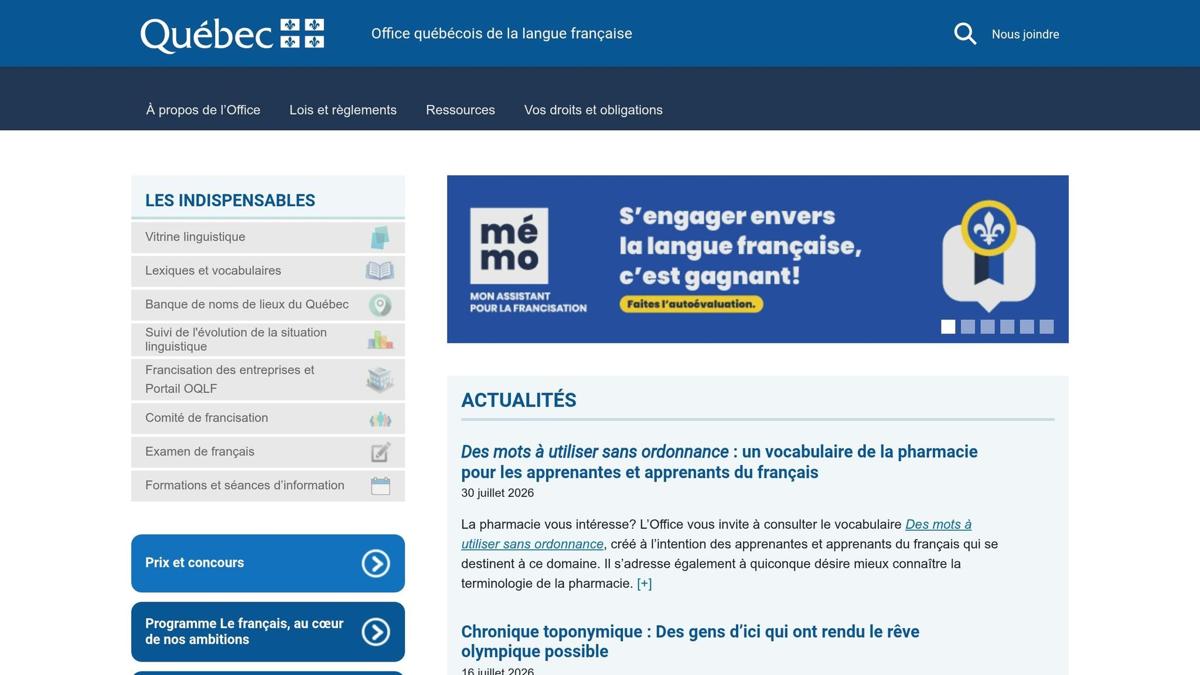
You have six months from the date you reach 25 employees to register with the OQLF.
That registration includes your legal business name, your employee count, and a self-assessment of your current language practices. In plain terms, you're telling the OQLF who you are, how many people you employ, and where things stand with French in your workplace.
Step 2: Submit a Linguistic Analysis and Build a Francisation Plan
Within three months of registration, you need to submit a linguistic analysis.
This analysis looks at how French is used across your operations. That includes software, forms, manuals, workplace signage, and both internal and external communications. The goal is simple: spot the gaps before you try to fix them, often with the help of francisation consulting services.
That review then feeds into your francisation plan. The plan sets out what needs to change, who is responsible for each item, and when each task will be done. A good way to handle it is to tie every gap to a clear owner and deadline.
| Area Reviewed | Current Gap | Required French Measure | Timeline |
|---|---|---|---|
| HR documents (contracts, policies) | English-only templates | Translate and adopt French versions | Short-term (0–3 months) |
| Internal software / IT systems | No French interface | Enable French language settings or source French-compatible tools | Medium-term (3–6 months) |
| Employee language skills | Low French proficiency in key roles | Schedule francisation training with progress tracking | Ongoing |
| Customer-facing communications | Materials not consistently available in French | Update customer service, web, and marketing materials in French | Short-term (0–3 months) |
The plan also needs a communication strategy for internal use, such as HR, contracts, and IT, and external use, such as marketing, web, and customer service. On top of that, it must include a training piece that covers skill checks, training schedules, and progress tracking.
Step 3: OQLF Follow-Up, Francisation Committee Duties, and Certificate Issuance
Once the plan is approved, implementation begins.
From there, you must submit progress reports every 12 months. The OQLF may also carry out inspections to confirm that French is being used in a steady way across your operations.
If you have 100 or more employees, you must maintain a Francisation Committee made up of management and employee representatives [2].
Once the OQLF approves the plan, it issues a Francisation Certificate. But that isn't a one-and-done document. To keep it valid, you must submit maintenance reports every three years.
| Stage | Deadline | Key Requirement |
|---|---|---|
| Registration | Within 6 months of reaching 25 employees | Submit business details and self-assessment |
| Linguistic Analysis | Within 3 months of registration | Review software, forms, manuals, signage, and communications |
| Francisation Plan | Following analysis approval | Assign actions, owners, and implementation timing |
| Progress Reporting | Every 12 months (implementation phase) | Submit status updates to the OQLF |
| Certificate Maintenance | Every 3 years (post-certification) | Submit reports to maintain the certificate |
How to Put Francisation Into Practice at Work
Once registration is done, the day-to-day work begins: policy, training, and records. Start with a written policy. Then turn that policy into role-based training and clear proof of progress.
Build a French Workplace Policy for HR, Operations, and Customer Service
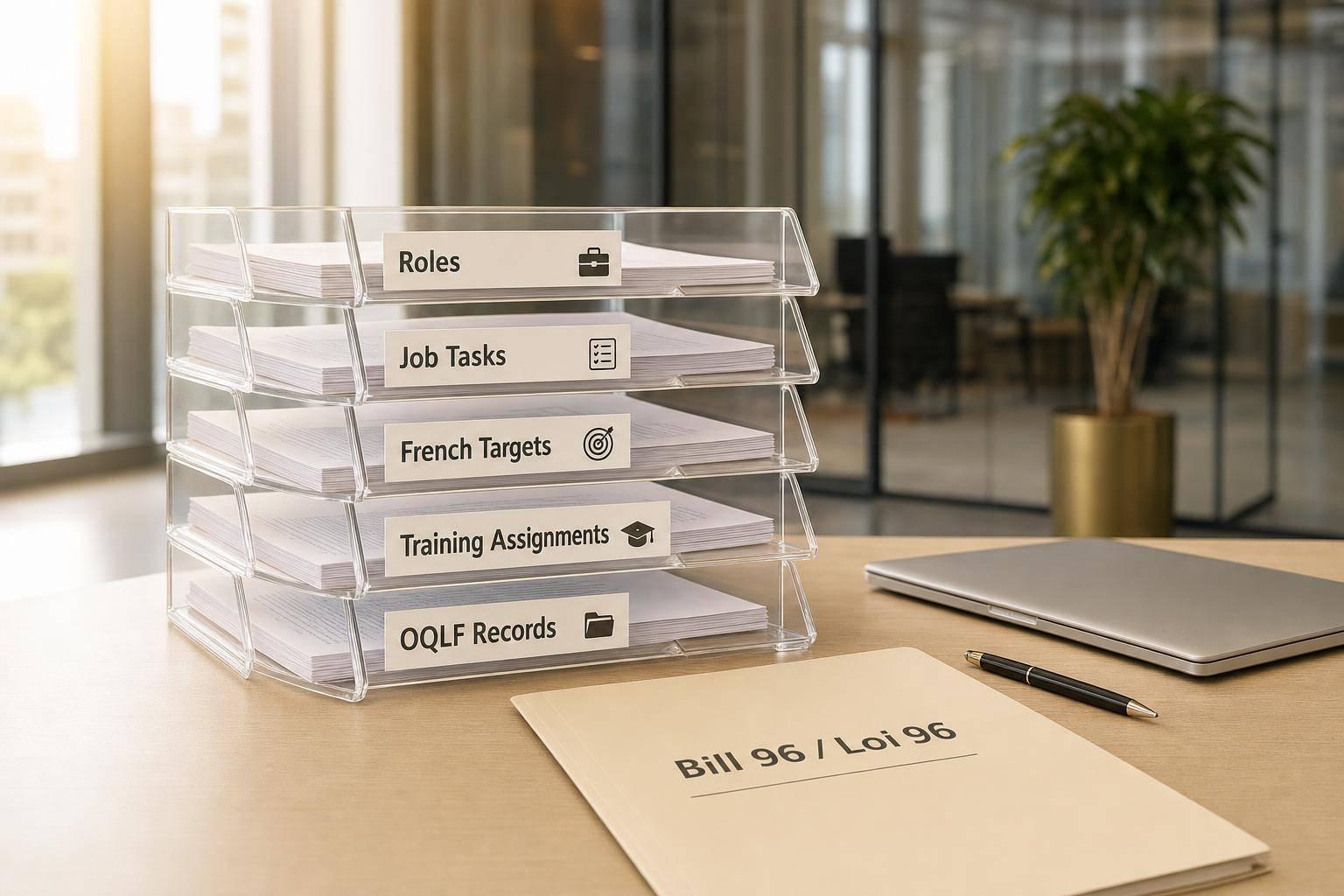
Your policy should spell out how French is used at work, how staff are trained, and how records are kept.
The table below shows what to include and what can go wrong if something is left out [1].
| Mandatory Policy Item | Recommended Best Practice | Risk if Missing |
|---|---|---|
| French as default internal language | Provide AI tools for real-time practice | High: fines and OQLF non-compliance |
| Job postings in French first | Include French level requirements in job descriptions | High: legal challenge to hiring process |
| French-first customer service | Role-specific vocabulary training | Medium: reputational damage and customer loss |
| Contracts and handbooks in French | Digital access to French versions of all HR documents | High: fines and OQLF non-compliance |
Employers must also support francisation access for international workers affected by French-language permit renewal rules [3].
A policy sets the standard. Training is what makes that standard usable in everyday work.
Use Employee Training to Close Real Compliance Gaps
Training needs to match the language demands of each role. A warehouse lead, an HR manager, and a customer service rep don’t use the same terms every day, so they shouldn’t get the same training either. Role-specific training helps close workplace language gaps faster [1].
Track Progress With Documentation and AI-Powered Training Support
Good recordkeeping matters just as much as training itself. AI tools can track practice time, measure progress, and generate OQLF-ready reports [1][2]. That gives employers a clear paper trail instead of a loose set of notes and spreadsheets.
Conversaflex, for example, offers an admin dashboard, custom industry vocabulary, and automated OQLF-aligned progress reports [1]. In a 2024–2025 pilot, GSK Canada used Conversaflex to strengthen communication and internal talent mobility in Canada. The results: 100% of participants reported improved confidence, a 90% increase in confidence for cross-site collaboration, and 70% of participants increasing their actual usage of French at work [1].
Using one platform to track learning time, proficiency gains, and OQLF-ready progress reports makes follow-up much easier. If the OQLF asks how your team is progressing, you’ll have the records ready instead of scrambling to piece them together.
Common Compliance Scenarios and Key Takeaways
The rules are a lot easier to handle once you map them to the situations employers deal with every day.
When an SME Crosses 25 Employees and Needs a Fast Compliance Plan
Once a business hits 25 employees, it should act right away on registration, linguistic analysis, and a French-language document review.
| Immediate Action | Why It Matters |
|---|---|
| Register with the OQLF within 6 months | Starts the formal compliance process |
| Submit a linguistic analysis within 3 months of registration | Shows gaps in HR documents, internal systems, and customer-facing materials |
| Audit and translate HR documents | Employment contracts, offer letters, and policies must be in French |
| Review internal systems for French interfaces | Software and tools used by Quebec employees must work in French |
French training access also forms part of compliance for affected temporary workers. Workers who have been in Quebec for three years must meet the French-language rule tied to their immigration or work-permit process [3].
That may sound like a short checklist, but it touches a lot of day-to-day operations. HR paperwork, employee tools, and language training all need to line up fast once the threshold is crossed.
For larger employers, those same rules extend into head-office processes, shared systems, governance, and public materials.
What Larger or Out-of-Province Employers Should Review First
If a company runs centralized systems outside Quebec, those systems still need to work in French for Quebec employees. That includes HR portals, payroll systems, and other internal tools. Employment contracts and commercial agreements sent from head office must also be available in French.
Public-facing channels need a close look too. Quebec-targeted websites must default to French, and public signage has to follow Quebec's French prominence rules. For employers with 100 or more employees, setting up a Francisation Committee is mandatory.
| Review Category | Priority Action |
|---|---|
| HR Systems | Ensure centralized portals and payroll systems have French interfaces |
| Legal/Contracts | Translate HQ-issued employment contracts and commercial agreements |
| Internal Systems | Update internal systems to include French versions |
| Public Presence | Set Quebec-targeted websites to French default; verify signage requirements |
| Governance | Establish a Francisation Committee (mandatory for 100+ employees) |
A good way to think about it: if Quebec employees use it, read it, sign it, or see it, it likely needs a French version or a French-first setup.
Conclusion: The Main Francisation Requirements to Act on in 2026
The next step is practical: avoid non-compliance fines by turning these requirements into policy, training, and tracking.
FAQs
How do I count employees for the 25-employee threshold?
Count every employee linked to your establishment’s Quebec operations, no matter their status or where they work. That includes full-time and part-time employees.
If your business has 25 or more employees, it must follow Quebec’s francisation rules, including registration and workplace language duties.
What proof should I keep for an OQLF review?
Keep clear records that show your organization meets Quebec’s language rules. That means holding on to documents such as employee training records, tracked training hours, progress reports, and proof that staff had access to francization services.
You should also keep compliance reports that show a clear audit trail of language learning activities. On top of that, save proof that you met specific obligations, such as providing language access for international personnel.
Can I still require English for some jobs in Quebec?
Yes - but only in limited cases. Under Quebec’s current legal framework, including Bill 96, French is the main workplace language.
You can require English only when the role genuinely calls for regular communication in another language and you’ve taken all reasonable steps to avoid making that part of the job.
Putting francisation first can help lower compliance risk and support retention.




![Cover Image for Corporate Language Training Costs: Conversaflex vs. Tutors, Classes and Apps [2026]](/_next/image?url=%2Fassets%2Fimages%2Fblog%2F68b2425f68bb5e38327dcb5b-1756542781388.jpg&w=3840&q=75)
![Cover Image for Workplace French Training in Canada: Formats, Costs and Funding [Guide 2026]](/_next/image?url=%2Fassets%2Fimages%2Fblog%2Fworkplace-french-training-canada-2026.jpg&w=3840&q=75)