How to Measure ROI on Multilingual Workforce Training
Calculate true ROI for multilingual workforce training by tallying full costs, verifying on-the-job language use, and linking gains to KPIs.
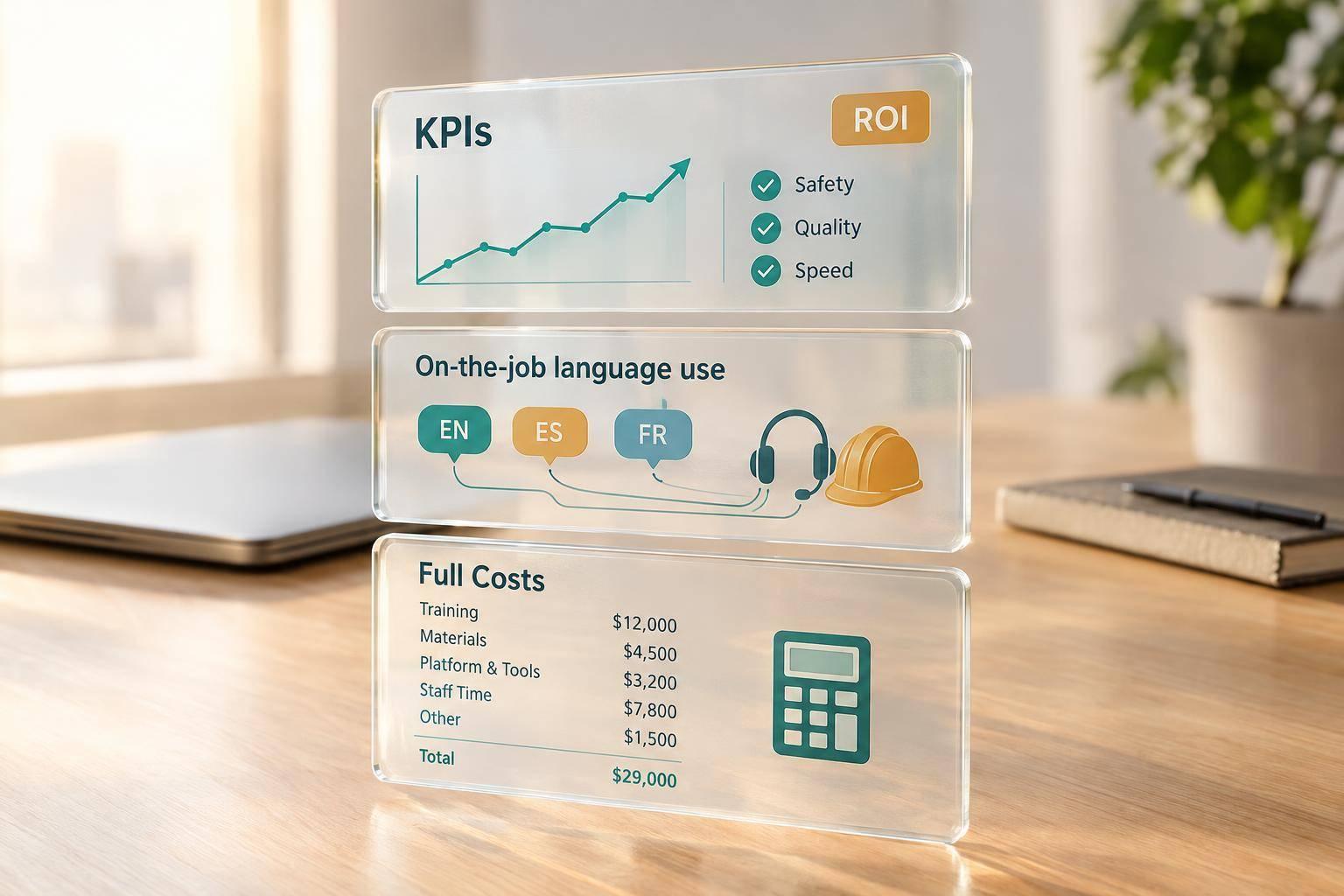
Multilingual workforce training pays off when job results - not just test scores - justify its cost. Calculate ROI as [(returns linked to training − total program cost) ÷ total program cost] × 100. For example, a hypothetical $60,000.00 in returns against $40,000.00 in costs produces a 50% ROI, with all amounts in CAD.
A sound calculation follows four steps:
- Set a baseline: Gather 8 to 12 weeks of data and define skill targets for each role.
- Count all costs: Include fees, setup, support and paid learning time.
- Check workplace results: Confirm skill use, then measure changes in service, errors, productivity and retention.
- Test the return: Account for other workplace changes, avoid counting savings twice and compare low, base and high estimates.
Track learning monthly and review ROI quarterly once enough data are available. Keep freed time separate from cash savings, protect employee data and check Québec requirements where applicable. Use the findings to decide whether to continue, change or expand training.
Step 1: Calculate Total Cost and Cost per Learner
Count Fees, Administration and Paid Learning Time
Create one cost register for the full investment, using your actual quote or invoice rather than assumed rates. Record contracted seats, billing frequency, discounts, optional services, taxes and renewal terms. Format amounts as $1,250.00 and note whether they are before or after tax. This total is the cost base for every later ROI calculation.
| Cost category | Calculation method | Data owner | Reporting frequency |
|---|---|---|---|
| Platform or seat fees | Invoice or contract amount, plus taxes and adjustments | Procurement / Finance | At purchase and quarterly |
| Setup, integration and customisation | Supplier invoice plus internal project hours × fully loaded hourly rate | IT, Procurement and Finance | At launch and when scope changes |
| Assessments, coaching and support | Vendor charges plus facilitator, coaching and help-desk hours | Learning and Development, HR and IT | Monthly during delivery |
| Administration, reporting and manager support | Recorded support hours × loaded hourly rate | Business managers and Learning and Development | Monthly |
| Learner paid time | Recorded learning hours × learner-specific or role-based loaded hourly rate | HR, Payroll and Learning and Development | Monthly |
| Facilities, travel and equipment costs | Attributable expenses | Finance or Operations | Monthly or per event |
| Work coverage or productivity cost | Attributable coverage or capacity cost | Operations / Finance | Monthly or quarterly |
| Maintenance and evaluation | Renewal, content updates, reporting and evaluation hours | Learning and Development and Finance | Quarterly |
Keep fixed implementation costs separate from variable per-seat costs, and cash spending separate from paid learning time. Ask Payroll for loaded rates that cover wages, benefits and employer payroll costs. Include paid practice and assessment time, but don’t count the same hours under both learning and administration.[1][2]
Assign seat charges and learner hours directly to each team. For shared implementation, administration or reporting costs, document an allocation rule and apply it consistently. That rule could use active learner count, headcount, usage hours or management time.
Check that team totals match the overall register. Use records rather than estimates where possible, keep the reporting period consistent, and document how annual charges and one-time setup costs enter the calculation.
Calculate Cost per Learner and Skill Target
Use the same total programme cost to calculate cost per enrolled, active and completed learner. Define these groups before reporting, and use the same definitions across teams:
- Enrolled: assigned a seat.
- Active: meets a stated activity threshold.
- Completed: finishes the required training and assessment.
Divide total cost by the learner count in each group. Check those counts against training records, payroll and Finance data.
Calculate cost per target achiever = total programme cost ÷ learners who meet the stated skill target. Record the target, assessment version, assessment date and pass threshold with each result. Completion alone does not prove readiness for the job.
Calculate cost per level gained only when the assessment framework clearly defines levels and supports comparable assessments over time. Don’t treat levels as equal gains; use cost per target achiever instead.
From Cost to Value: Measuring the Real Return On Investment of Employee Training
Step 2: Measure Language Skills and Job Readiness
Once you know the costs, check whether employees can use what they’ve learned on the job. For the progress metrics worth tracking, see what progress data shows about language training ROI.
Track Time to Reach Target Skills
Define readiness through observable job tasks, not broad fluency. Assess conversation, comprehension, job vocabulary, pronunciation, and reading or writing where needed. Set a minimum score for each critical skill. A strong score in one area shouldn’t hide a safety or comprehension gap.
Assess employees before training, immediately afterwards and at follow-up. Keep the tasks, difficulty and scoring rules the same each time. Use the follow-up to check retention and workplace use.[3][4] Passing a test isn’t enough; employees need to apply those skills at work.
Track learning hours to target separately from elapsed calendar time. Record lesson, practice and assessment hours, along with the baseline date, target date and first valid workplace-confirmed pass.
Report the median hours among employees who reach the target, plus the percentage who reach it within 30, 60 and 90 days. Keep employees marked “not yet at target” in the cohort totals so the results don’t favour faster learners. This shows how fast each team reaches the target - not just how many employees finish the course.
Conversaflex can log these activities and flag readiness gaps. But learning progress alone doesn’t confirm workplace use.
Confirm Workplace Use Before Assigning Financial Value
Have managers observe the defined tasks and record whether employees work independently, with prompting, or with support. Compare those observations with quality reviews of calls, service notes or other relevant work. Use the follow-up check to confirm that employees apply their learning on the job.[3][4] Assign financial value only after that transfer is confirmed.
For verified reductions in supervision, onboarding or task time, calculate:
Estimated labour value = verified hours saved × loaded hourly rate
Don’t count the same saved hours under both onboarding and supervision. Record the measurement period, supporting records and benefit owner.
Treat saved time as freed capacity unless staffing or overtime spending falls. Document whether that capacity was reused or left unused. Don’t assign a dollar value to test gains alone.
Step 3: Connect Language Gains to Business Results
Measure Customer Service, Errors, and Rework
Once employees can use the language at work, link those gains to business results. Use the Step 2 skill target to choose one or two business KPIs per role. Treat each link as a hypothesis, not proof:
Better comprehension may reduce repeat contacts.
Use consistent rates, such as errors per 1,000 transactions, and compare similar customer mixes and reporting periods. Pair each language gain with the KPI it should affect.
| Language-growth measure | Business KPI | Financial calculation (CAD) | Data sources | Review period |
|---|---|---|---|---|
| Proficiency gain | First-contact resolution; repeat contacts | Avoided repeat contacts × cost per contact; validate against satisfaction | Learning platform, CRM, QA records | Monthly |
| Accuracy gain | Documentation errors; missed handoffs; rework | Verified rework hours saved × loaded hourly compensation | Quality audits, case records, payroll | Monthly or quarterly |
| Time to target skill | Time to productivity | Productive days gained × loaded daily compensation | Learning records, onboarding data, manager sign-off | Each cohort |
| Workplace use | Voluntary turnover; internal mobility | Avoided exits × documented replacement cost | HRIS, exit data | Quarterly or annually |
Track handling time alongside customer satisfaction, complaints, resolution accuracy and safety checks. Faster service means little if accuracy or safety drops. Track interpretation spending separately: training does not replace required professional interpretation.
Estimate Retention and Staffing Savings
Track turnover, absenteeism, internal mobility and related staffing costs over several quarters or longer. Estimate avoided exits by comparing employees with similar peers.
Document replacement costs, including recruitment, onboarding, temporary coverage and manager time. Exclude productivity losses already counted elsewhere. Also, separate career progression from transfers driven by staffing shortages.
Check How Much Training Contributed
After linking language gains to KPIs, estimate how much of the change came from training. Choose the strongest comparison your data support. Match teams by role, tenure, workload, location and customer mix, and record other workplace changes that could affect results.
| Method | Data needs | Strengths | Limits |
|---|---|---|---|
| Before-and-after | Same team’s baseline and post-training language scores and KPIs | Simple; useful for monitoring | Cannot separate training from other changes |
| Matched-team comparison | Both teams’ baseline and follow-up results | Helps account for shared changes | Different managers, workloads or motivation can distort results |
| Time-series monitoring | Repeated weekly or monthly results before and after training | Shows trends and whether gains persist | Other initiatives happening at the same time can still explain improvement |
When pre-training trends are similar, estimate contribution ≈ trained-team change − comparison-team change. Report sample sizes, missing data and uncertainty. Describe the result as an estimated contribution, not causation.
Use stable team or cohort identifiers where possible. Define access, retention, use and employee review rights for individual results.[5] Employee performance ratings, voices and personnel records may constitute personal information.[6]
In Québec, check the private-sector privacy act, as amended by Law 25, before combining identifiable language assessments with performance, health, attendance or customer data. Suppress small groups that could identify employees, report results in aggregate where possible, and limit access to identifiable records.
Step 4: Calculate ROI and Test Assumptions
Calculate Net Benefits, ROI and Benefit-Cost Ratio
After estimating attributable benefits in Step 3, choose a single measurement period, such as 12 months. Compare team results using cost per learner, time to skill gain and business outcomes.
Match attributable benefits to all programme costs incurred during that period: provider fees, platform or licence charges, implementation, administration, assessments, manager and administrator time, learner support and paid learning hours.
Record amounts in Canadian dollars. State whether costs are before tax and whether benefits include avoided-cost estimates. Report confidence intervals, inclusion rules and privacy/compliance status, such as Bill 90 workplace compliance, separately from the monetary calculation.
Net benefits = attributable monetary benefits − programme cost
ROI (%) = (net benefits ÷ programme cost) × 100
Benefit-cost ratio = monetary benefits ÷ programme cost [8][9]
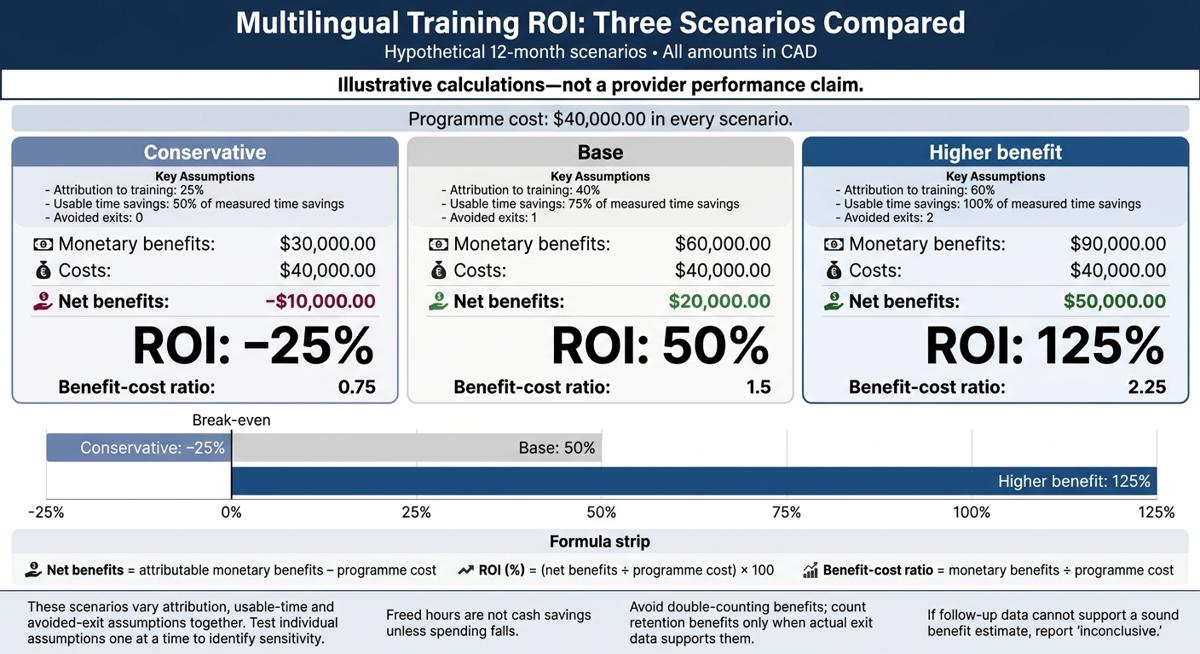
Hypothetical Canadian-dollar calculation - not a provider performance claim: Over 12 months, $60,000.00 in attributable monetary benefits minus $40,000.00 in programme costs produces $20,000.00 in net benefits. ROI is 50%, and the benefit-cost ratio is 1.5: $1.50 in measured benefits for every $1.00 invested. [8][9]
State whether the headline result reflects documented cash savings, estimated time value or both. Freed hours are not cash savings unless spending falls. Beside each benefit, record its source, calculation and training-attribution adjustment. Don’t count the same hours twice.
Compare Conservative, Base and Higher-Benefit Scenarios
These hypothetical scenarios apply different attribution, usable-time and avoided-exit assumptions to the same underlying measurements. The estimated benefits change, but the 12-month programme cost stays at $40,000.00. Ground each benefit in records rather than assumptions alone. [7][9]
| Hypothetical scenario | Attribution to training | Usable time savings | Avoided exits | Monetary benefits | Costs | Net benefits | ROI | Benefit-cost ratio |
|---|---|---|---|---|---|---|---|---|
| Conservative | 25% | 50% of measured time savings | 0 | $30,000.00 | $40,000.00 | −$10,000.00 | −25% | 0.75 |
| Base | 40% | 75% of measured time savings | 1 | $60,000.00 | $40,000.00 | $20,000.00 | 50% | 1.5 |
| Higher benefit | 60% | 100% of measured time savings | 2 | $90,000.00 | $40,000.00 | $50,000.00 | 125% | 2.25 |
Test attribution, freed-time value, redeployment rate, avoided-exit cost and benefit duration one at a time. Identify which assumptions have the greatest effect on whether language training produces measurable value across teams.
Count retention benefits only when actual exit data supports them - not intent-to-stay scores. Keep the negative scenario visible. If follow-up data cannot support a sound benefit estimate, report the result as inconclusive rather than forcing a positive return. Use these results to guide the final review of the training cycle.
Conclusion: Review Results and Adjust Training
Use the same baseline, cost, skill and outcome measures in every review cycle.
Review Team Metrics Monthly and ROI Quarterly
Track these measures in a monthly dashboard and a quarterly ROI review. Keep separate fields in your monthly checklist for learning progress and business outcomes:
- Learning progress: enrolment, active learners, completion, paid learning time, assessment scores, cost per learner, skill gains and time to target.
- Business outcomes: customer-service results, errors, rework, absenteeism and retention.
Review financial returns quarterly once enough data are available. Report monetary benefits, net benefits, ROI and benefit-cost ratio over matching periods. Use six- or 12-month windows to assess retention.
Combine training, operations, HR and finance records. Assign one owner to each metric and record its source, period, calculation date, assumptions and exclusions. Label results as measured, estimated or not monetized.
Protect Employee Data and Check Québec Requirements
Apply privacy controls before sharing results that use employee data. Limit collection, restrict access and suppress small-group results that could identify employees.[10][12][5] Check which privacy rules apply: federal, Québec, Alberta or British Columbia.[13][14]
For Québec, check current Charter of the French Language and Bill 96 requirements through official guidance or legal advice. Document why any language requirement is necessary for the job.[11] Treat training data as one input to language policy and compliance records - not as proof of compliance.
Plan the Next Training Cycle
Use the results to decide whether to keep, change or expand the program. Reassess role-specific targets and business outcomes after employees have had enough time to apply their skills. For customer-service roles, four to eight weeks after a learning milestone may be suitable.
If skill scores improve but customer outcomes do not, check practice opportunities, manager reinforcement, target clarity and other workplace factors. Keep confidence, inclusion and other non-monetized outcomes visible. State the limits of the findings and use conservative estimates.
Continue when skills improve, workplace use is documented and business results move in the expected direction. Modify when learning improves but use or business impact remains weak. Expand only after results repeat across more than one team or reporting period, and the costs and privacy impacts are clear. The corporate language rollout guide sets out the gates for each stage of expansion.
FAQs
How can we fairly compare ROI across different roles?
Don’t use the same metrics or give them the same weight for every role. Choose the two or three communication tasks that most affect job performance, then match your metrics to those tasks.
For customer support, focus on pronunciation clarity and response speed. For sales, prioritize speaking proficiency and role-specific vocabulary. Tie language progress to results in each role to show how training reduces job-specific risks and improves business results.
How can small teams measure ROI with limited data?
Track job-specific progress, not just login times. Set a language baseline before training, then reassess using the CEFR or Quebec’s Francisation Scale.
Use a one-page scorecard to record training costs in Canadian dollars (CAD), language progress, success with role-specific tasks, and reductions in communication errors or resolution times. Connect these measures to outcomes such as better customer service or less hesitation. Review the scorecard quarterly to keep training aligned with day-to-day work needs.
Can training be worthwhile without positive financial ROI?
Yes. Financial metrics like revenue per employee and lower rework costs matter. But training also builds employee confidence, engagement, collaboration and a sense of belonging. For organizations in Quebec, language training also helps meet Bill 96 requirements.
Treating training only as a cost centre misses gains in workplace skills and reduced risk - value that may not show up in financial results right away.