
Workplace French Training in Canada: Formats, Costs and Funding [Guide 2026]
Compare formats, costs, funding and Quebec compliance for workplace French training in Canada, with rollout and measurement tips.
![Cover Image for Workplace French Training in Canada: Formats, Costs and Funding [Guide 2026]](/_next/image?url=%2Fassets%2Fimages%2Fblog%2Fworkplace-french-training-canada-2026.jpg&w=3840&q=75)
Workplace French Training in Canada: Formats, Costs and Funding [Guide 2026]
If I had to sum this up in one line: the best workplace French plan in Canada in 2026 is the one that fits job tasks, schedule limits, and Quebec compliance rules — not just test levels.
Here's the short answer:
- I'd expect many employer-paid programmes to land around $300 to $600 CAD per learner, per month for intensive training.
- Group classes cut per-person cost when teams share the same level and job needs.
- 1-on-1 coaching suits managers and other high-stakes roles, but costs more.
- Tutoring is best for follow-up and targeted practice between sessions.
- Online and hybrid delivery help multi-site and shift-based teams.
- Microlearning and AI practice give staff 24/7 access and work well for large rollouts.
- In Quebec, businesses with 25+ employees face OQLF francization duties, and non-compliance can lead to fines from $3,000 to $30,000.
- Public support such as Francisation Québec can cut employer spend, though schedule and course setup may be less flexible.
- I'd measure success by work tasks: can staff take a call, join a meeting, write an email, or explain a safety step in French? That matters more than a CEFR label on its own.
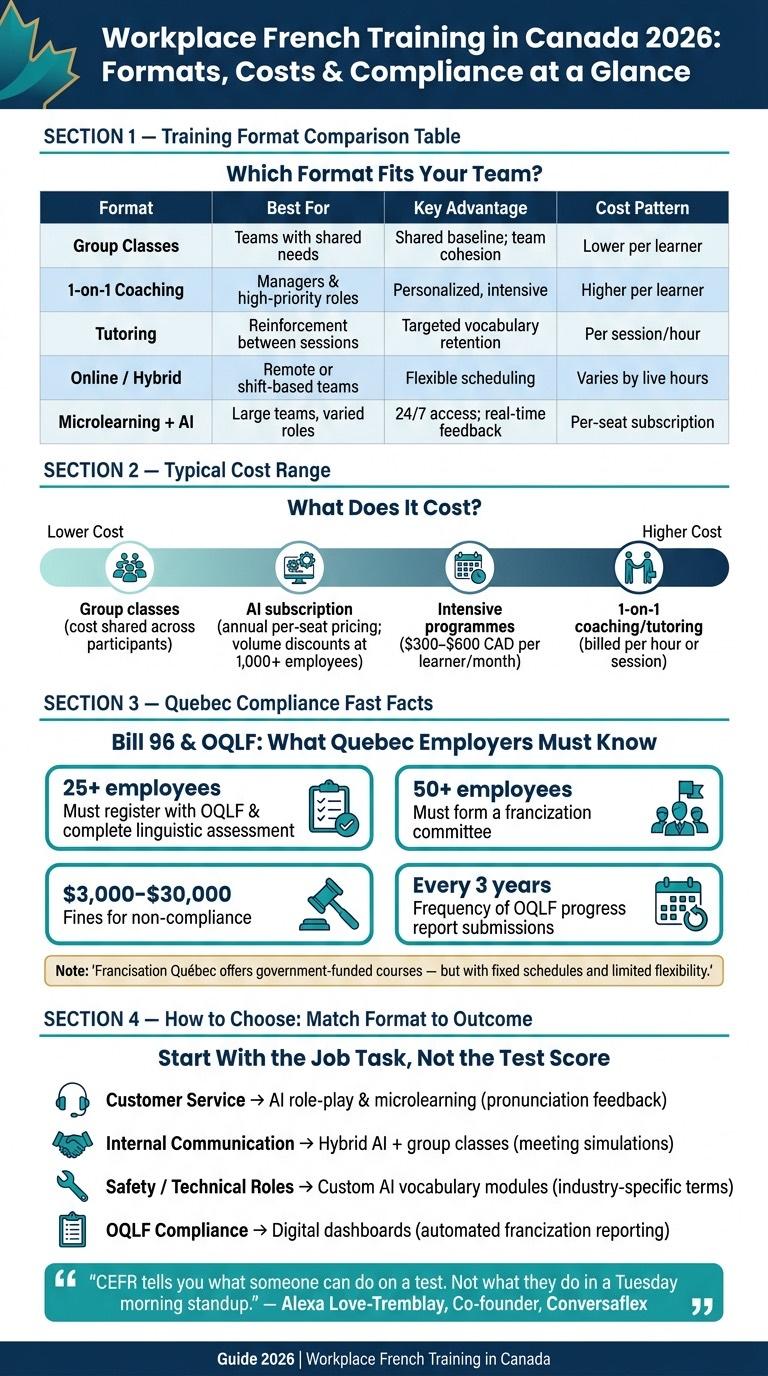
Quick comparison
| Option | Best fit | Main cost pattern | Watch-out |
|---|---|---|---|
| Group classes | Teams with shared needs | Lower per learner | Harder with mixed levels |
| 1-on-1 coaching | Leaders, key staff | Higher per learner | Less scalable |
| Tutoring | Extra support | Per session or hour | Works best as support, not the full plan |
| Online / hybrid | Remote, shift, multi-site teams | Varies by live hours | Needs good scheduling |
| Microlearning + AI | Large teams, varied roles | Per-seat subscription | Better results when tied to job tasks |
The main point: I wouldn't pick a format based on price alone. I'd look at who needs French, what they need to do in French, how often they can train, and whether OQLF reporting is part of the job.
French training formats for companies in 2026
Choose the format that fits your team's schedule, role demands, and language targets. In most cases, the best programmes mix formats instead of leaning on just one.
Group classes, one-on-one coaching, and tutoring
Group classes make sense when several employees need the same workplace French. They help build a shared baseline across the team, which can make day-to-day communication smoother.
One-on-one coaching fits managers, bilingual leads, and other high-priority roles. These employees often deal with harder communication tasks, so they need more tailored support.
Tutoring works best as backup between scheduled sessions. It helps employees hold on to what they've learned and practise specific vocabulary before they need it in actual workplace situations.
Online, on-site, and hybrid delivery
Online delivery cuts down on scheduling and travel issues, which makes it a strong option for distributed teams or companies spread across multiple sites. Most live virtual sessions run on video platforms.
On-site training gives teams more live speaking time. That said, travel and scheduling can make it tougher to scale across a larger company.
Hybrid setups blend both approaches. Teams can join shared virtual sessions for common language goals, then use in-person or one-on-one time for role-specific needs. For shift-based teams, scheduling flexibility usually matters more than format preference.
Microlearning and AI-supported workplace practice
Microlearning uses short, focused sessions that employees can fit into commutes, breaks, or gaps between meetings. It's a good match for field teams or employees without fixed desks who might otherwise miss training.
AI-supported practice makes role-specific conversation practice possible at scale. Instead of generic vocabulary drills, tools like Conversaflex let employees practise the exact situations they face at work, with real-time pronunciation feedback and 24/7 access. That matters because knowing the words isn't the same as using them in a live conversation.
For HR teams dealing with Bill 96 compliance, platforms like Conversaflex can also track practice hours and progress through admin dashboards, which supports OQLF reporting requirements.
| Format | Best For | Key Advantage |
|---|---|---|
| Group Classes | Common workplace language needs | Shared baseline; team cohesion |
| One-on-One Coaching | Managers and high-priority roles | Intensive, personalized attention |
| Tutoring | Reinforcement between sessions | Targeted vocabulary and retention support |
| Online / Hybrid | Distributed or shift-based teams | Flexible scheduling; multi-site delivery |
| Microlearning + AI | Scalable, role-specific practice | 24/7 availability; real-time feedback |
That fit question leads straight to price: the same format can cost very differently depending on intensity and customization.
Pricing ranges and cost factors
Typical price ranges by format
Workplace French training in Canada can cost a little or a lot. It mostly comes down to how the programme is delivered.
The biggest driver is format. Live instruction tends to cost more because you're paying for instructor time. Subscription-based options usually scale better, especially for larger teams. In Canada, structured courses often cost about $300 to $600 CAD per learner, per month for intensive programmes.
From there, the pricing model shifts by format. One-on-one coaching and tutoring are often billed by the hour or by session. Group classes spread that instructor cost across several learners, which brings the per-person price down. Other formats are usually sold as hourly rates, annual subscriptions, or fixed programme fees.
AI-supported practice works a bit differently. It's usually sold as an annual, per-learner subscription. And as headcount grows, the per-seat cost often drops. So if you're training 1,000 employees or more, total enterprise spend goes up, but the cost per learner tends to go down. Higher-tier plans also tend to include reporting and compliance tools.
| Format | Typical charging model | Typical cost structure |
|---|---|---|
| One-on-One Coaching / Tutoring | Per hour / per session | Dedicated instructor time; higher per-learner cost |
| Group Classes | Per group / per course | Cost shared across participants |
| AI-Supported Subscription | Annual, per learner | Per-seat pricing with volume discounts |
| Hybrid (AI + Live Instruction) | Subscription base + live add-ons | Total cost rises with instructor hours and group size |
| Microlearning | Monthly or annual subscription | Pricing depends on content depth and gamification features |
What raises or lowers total programme cost
Group size is one of the biggest levers. If more learners can join the same live session, the per-person cost usually drops. But there's a catch: that works best when learners have similar language levels and similar job needs. Mixed-level groups often need more prep and more tailoring, which adds cost.
Customization is another big factor. If a company needs role-specific scenarios or industry vocabulary, the price usually goes up. The same goes for programmes that rely on custom AI models trained on business data or on highly specialized job contexts. Put simply, job-specific training costs more because it has to match actual workplace tasks, not just general French.
Compliance reporting can push a buyer into a higher price tier too. For Quebec employers dealing with Bill 96 and OQLF needs, tools that track learning hours and generate structured progress reports are often part of higher-tier plans, not entry-level ones.
A few cost drivers show up again and again:
- More weekly sessions
- In-person delivery
- Custom scenarios
- Job-specific scenarios
These ranges are a starting point. Funding and reimbursement options can lower the net cost.
Want to see what the practice itself looks like? Take a free 5-minute conversation with the Conversaflex AI tutor — no signup required.
Funding and reimbursement options in Canada and Quebec
Training doesn't have to come entirely out of your employer's pocket. Once you have a rough sense of pricing, the next move is simple: lower the net cost through public support, internal training budgets, or both. What you can access depends on where your business operates and how many employees need training.
Quebec francization, Bill 96, and public funding options
In Quebec, French training is often tied directly to compliance. Businesses with 25 or more employees must register with the OQLF and complete a linguistic assessment. If the workplace is not compliant, the employer has to put a French language program in place and submit progress reports every three years. Organizations with 50 or more employees also need to create a francization committee with management and employee representatives.
The stakes aren't small. Non-compliant businesses can face fines of $3,000 to $30,000 and may lose access to government contracts and public grants. So for many Quebec employers, language training is both a compliance expense and a workforce investment. In practice, compliance and funding often go hand in hand.
Francisation Québec offers government-funded French courses and tutoring for eligible employees. That can help with cost. The trade-off is flexibility: fixed schedules and a set curriculum can make it harder to match training to specific roles or day-to-day job needs.
| Funding / Support Source | Who Qualifies | What it helps with | Main Constraints |
|---|---|---|---|
| OQLF Francization Program | Quebec businesses with 25+ employees | Path to certification; helps avoid fines and preserve access to public contracts | Requires registration, linguistic assessment, and regular reporting |
| Francisation Québec | Employees and businesses in Quebec | Government-funded French courses and tutoring | Limited flexibility; follows government curriculum and schedules |
| LMIA (EIMT) support | Employers of foreign workers in Quebec | Helps support permit renewal and talent retention | Employer must prove access to francization services |
Employer budgets, reimbursement policies, and market-specific equivalents
Outside public programs, French training is often paid for through HR or L&D budgets. In Ontario, for instance, companies often pay for French training to serve francophone communities better and grow their reach across Canada, with the cost covered directly by the employer.
What gets approved varies from one company to the next. But the pattern is pretty clear: employers want to see a return. That might mean stronger compliance, better employee retention, or smoother customer conversations.
For HR teams, reporting can matter almost as much as the lessons themselves. Platforms that track learning time per employee and export progress reports can make OQLF paperwork much easier to handle. That's worth weighing alongside the upfront price. Our guide to which budgets you can use for your team's French classes in Quebec goes deeper on the funding side.
With funding sorted out, the next step is picking the format that fits your team's schedule, roles, and compliance needs.
How to choose the right format for your team
Once you know the cost, the next step is choosing a format that fits your team's day-to-day work and the result you need from training.
Match the format to workforce constraints
Cost matters, but fit matters more.
If your team works remotely or on shifts, they need training they can access when it suits them. Fixed group schedules often get in the way. Group classes work best for shared needs. Coaching makes sense for high-stakes roles. And AI tools are a strong fit when language levels vary a lot across the team.
For large rollouts, a hybrid model usually works best: live instruction for nuance, AI for frequent practice.
Match the format to the business outcome
The simplest way to choose is to start with the job result you want. Then match the format to the task people need to handle at work.
| Business Outcome | Best Format Match | Key Feature to Look For |
|---|---|---|
| Customer service confidence | AI-supported practice | Real-time pronunciation feedback |
| Internal team coordination | Hybrid or group classes | Onboarding and team meeting scenarios |
| Safety and technical vocabulary | AI with custom vocabulary | Custom terminology for medical, engineering, or trades contexts |
| Bill 96 / OQLF compliance | AI-supported practice | Compliance tracking |
| Executive and leadership communication | 1-on-1 coaching or AI | Leadership meetings and high-stakes conversations |
Measure progress by workplace tasks, not just CEFR level. For example, can staff handle a team meeting, explain a safety step, or speak with a client in French without stalling out?
Platforms that generate automated francization reports can also make OQLF reporting easier to manage.
Rollout by use case and key takeaways
Customer service, internal communication, safety, and job-specific vocabulary
The best way to choose a format is simple: start with the work people need to do in French. That means looking at the task itself — customer-facing conversations, internal meetings, safety steps, or field-specific terms.
For customer service teams, AI role-play and microlearning usually work best. They help staff practise short, repeatable responses for live calls, reception desks, and day-to-day interactions. The aim isn't perfect grammar. It's giving people the ability to respond in French with speed and confidence when things get busy.
For internal communication, a hybrid model often makes more sense. AI gives employees a low-pressure space to rehearse before higher-stakes moments like daily stand-ups or all-hands meetings. In a GSK Canada pilot, 100% of participants reported improved confidence in spoken French, and 70% increased their actual use of French at work after using AI-powered conversation practice.
For safety-critical and technical roles, generic conversational French isn't enough. People in these jobs need the right words for the right setting. A nurse, an engineer, and a laboratory manager don't speak the same way on the job, so custom AI vocabulary modules are a strong fit when employees need exact language for medical, technical, or safety contexts.
The table below links each use case to the format that fits best.
| Use Case | Best Format | What to Prioritize |
|---|---|---|
| Customer service | AI role-play & microlearning | Pronunciation feedback, standardised greeting scenarios |
| Internal communication | Hybrid (AI + group) | Meeting and all-hands simulations, low-pressure practice space |
| Health & safety / technical | Custom AI vocabulary modules | Industry-specific terminology, not generic conversational French |
| Bill 96 / OQLF compliance | Digital tools with dashboards | Automated tracking of practice hours and francization reporting |
For distributed or shift-based teams, mobile-first AI tools are often the easiest fit. People can use them between tasks, during commutes, or outside set training windows.
As Alexa Love-Tremblay, Co-founder of Conversaflex, put it:
"CEFR tells you what someone can do on a test. Not what they do in a Tuesday morning standup. Those are very different things."
That line gets to the heart of it. What counts most is whether employees can do the job in French when the moment comes. Success should be measured by task performance, not test scores.
Want to model this for your own team? See Conversaflex business pricing or talk to us about your program.
FAQs
How many training hours should we plan per employee?
A fixed number of workshop or classroom hours is no longer the best way to plan language training. More organizations now focus on continuous, daily learning instead of chasing a set hour target.
That shift makes sense. Language skills grow through regular use on the job, not just in a classroom. So training should fit into day-to-day work. Ongoing practice through role-specific conversations tends to work better than generic lessons.
Can beginners and advanced staff train in the same program?
Yes. Conversaflex supports employees across different CEFR levels, with placement testing that sets a starting point from A1 to C2.
That means beginners and more advanced staff can learn within the same overall program while following a path shaped to their level, role, and day-to-day work.
What should we ask a provider before signing a contract?
Ask three things:
- How do you measure impact beyond CEFR levels in workplace situations like meetings or client interactions?
- How much of the content is generic versus tailored to employees' roles?
- What data does the HR dashboard show about progress and day-to-day communication at work?
These questions help you check whether the program supports business results, not just test scores.




![Cover Image for Corporate Language Training Costs: Conversaflex vs. Tutors, Classes and Apps [2026]](/_next/image?url=%2Fassets%2Fimages%2Fblog%2F68b2425f68bb5e38327dcb5b-1756542781388.jpg&w=3840&q=75)
![Cover Image for Best Berlitz Alternatives for Corporate Language Training [2026]](/_next/image?url=%2Fassets%2Fimages%2Fblog%2F6a7bbd11dc1e9c396e6c3412-1786499684881.jpg&w=3840&q=75)