
Babbel for Business vs Rosetta Stone Business: 2026 Comparison (+ AI Alternatives)
2026 comparison of Babbel and Rosetta Stone for workplace training, plus when AI tools better support Québec French, role fit and compliance.

If I had to sum it up fast: Babbel for Business fits simple rollouts for small teams, Rosetta Stone Business fits larger groups that want more speaking practice, and AI-first tools fit teams that need job-based training and Québec French support.
If you’re choosing for a Canadian workplace in 2026, here’s the short version:
- Babbel for Business works best for short, self-paced lessons and easy uptake.
- Rosetta Stone Business works better for broad language learning and spoken practice.
- Neither tool is a strong pick for Bill 96 reporting or Québec French needs.
- AI-first options make more sense when you need role-based practice, task tracking, and local French support.
One stat stands out: in a 2025–2026 pilot at GSK Canada, 100% of Conversaflex participants said their spoken French confidence improved, and 70% said they used more French at work.
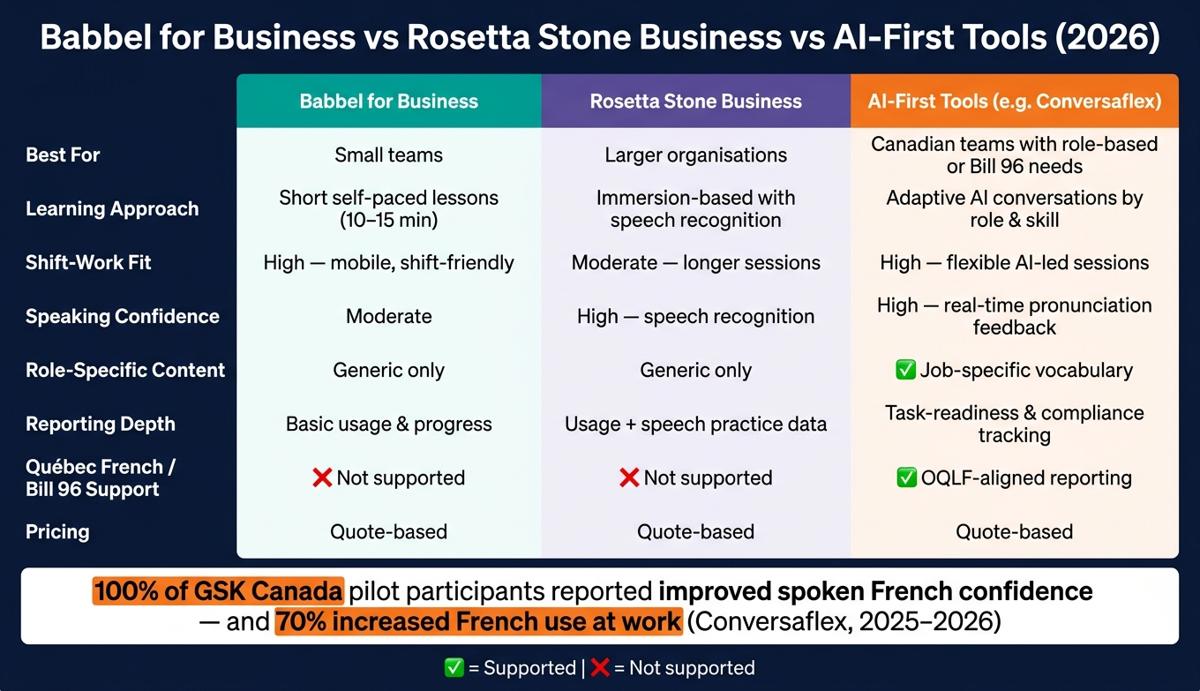
Quick Comparison
| Option | Best for | Main strength | Main limit |
|---|---|---|---|
| Babbel for Business | Small teams | Short lessons, simple rollout | Basic reporting |
| Rosetta Stone Business | Larger organisations | Speech practice and broad skill building | Generic job fit |
| AI vs. traditional language training tools like Conversaflex | Canadian teams with role-based or Bill 96 needs | Job-specific training, Québec French support, compliance tracking | Quote-based pricing |
If I were screening these options, I’d focus on four things first: adoption, reporting, role fit, and Québec French support. That’s what this comparison covers.
sbb-itb-7df369b
Babbel for Business
Babbel for Business works best for teams that want simple, low-friction language training, not deep admin controls or heavy enterprise setup.
Learning approach and employee adoption
The platform uses short, self-paced lessons that slide into the workday pretty easily. The focus is on general conversation and practical workplace language, so employees can pick it up without much ramp-up.
For frontline or distributed teams, that matters. People can learn in small chunks without blocking off formal training time, which often makes day-to-day adoption a lot easier.
Business features, reporting, and rollout fit
For buyers, the main question is pretty simple: is that ease of use enough for your rollout and reporting needs?
| Feature | Babbel for Business |
|---|---|
| Lesson length | 10–15 minutes |
| Primary focus | General conversation and practical workplace language |
| Feedback type | Instant AI feedback |
| Pricing model | Quote-based |
| Best for | Easy rollout for small teams |
Babbel is a good fit for teams that want lightweight, self-paced language training. But if compliance tracking or role-specific content sits high on your list, it doesn’t go far enough.
Rosetta Stone Business
Rosetta Stone Business uses an immersion-based model to help learners build broad language skills. That makes it a better fit for organisations that want broad language exposure, not task-specific job training.
Immersion model, speech practice, and workplace relevance
Its speech recognition gives employees a way to practise pronunciation and feel more at ease speaking. That helps. But pronunciation practice on its own doesn’t get someone ready for actual job tasks. Generic programs may not prepare employees for role-specific tasks or technical vocabulary [1].
Administration, reporting, and enterprise support
For business buyers, the next issue is scale. How well does the model hold up when you need administration tools and reporting across a large group?
Rosetta Stone Business is geared toward larger organisations. Its setup works well for teams that want one consistent starting point across many learners [1].
| Feature | Rosetta Stone Business |
|---|---|
| Learning model | Immersion-based |
| Speech practice | Yes, with speech recognition |
| Best for | Large organisations building broad language foundations |
Usage and progress reports can show activity and advancement, but they do not show whether employees can do the job in the target language [1]. That leaves one practical question: is a broad foundation enough for your team’s day-to-day work?
Babbel for Business vs Rosetta Stone Business
Side-by-side comparison table for 2026 buyers
Both platforms can work well. The main trade-off is pretty clear: Babbel leans toward speed and easy rollout, while Rosetta Stone leans toward longer practice and spoken confidence.
| Feature | Babbel for Business | Rosetta Stone Business |
|---|---|---|
| Best fit | Small teams needing fast, low-friction rollout | Larger organisations building broad language foundations |
| Language coverage | General workplace language | Broad language foundation |
| Shift-work fit | High - short, mobile sessions suit shift-based schedules | Moderate - sessions require more time per sitting |
| Admin controls | Flexible, team-friendly dashboard | Scalable enterprise tools |
| Reporting depth | Basic usage and progress tracking | Usage tracking plus speech practice data |
| Speaking-confidence fit | Moderate - conversational practice | High - speech recognition supports spoken confidence |
These differences matter most when you line them up with the team in front of you.
Best choice by business need
For frontline onboarding, Babbel has the edge. Its short, mobile-friendly sessions fit shift-based schedules, which makes life easier for teams that can't set aside big blocks of time.
For customer-facing teams, Rosetta Stone stands out more. Its speech recognition focus helps when staff need to build spoken confidence for live conversations, not just read or tap through lessons.
There is a catch with both platforms: neither one changes much by role or department. So if you're hoping for coursework shaped for sales, support, warehouse staff, or office teams, both mainly lean on generic lessons.
On reporting, both give you usage and progress data. Rosetta Stone goes a bit further with speech practice tracking, while Babbel keeps things more basic.
For Bill 96-driven French training, neither option is a strong match. Both offer standard French content, but neither includes OQLF-aligned reporting tools. That means compliance-focused reporting needs aren't covered by either platform, leaving companies exposed to Bill 96 penalties.
That gap is where AI-first workplace language training starts to make more sense.
AI-powered options for workplace language training
When AI-first training works better than standard course platforms
This is where AI-first training starts to make a difference.
Fixed lesson paths can help with general exposure. But they often fall short when employees need to handle actual work tasks. AI-first platforms adjust to role, first language, and skill level, so learners practise the kind of communication they need on the job. The focus shifts to task readiness, not generic fluency.[1][3]
Standard course platforms usually track things like logins and time spent. AI-first tools go further by tracking performance in job-specific communication scenarios. For HR teams, that means data that's far more useful.[1]
"CEFR shows test ability, not day-to-day performance." - Alexa Love-Tremblay, Co-founder, Conversaflex [1]
For Canadian organisations, Québec French is often a sticking point. AI-first tools can support Québec French accents and vocabulary better than standard French course content.[4]
Conversaflex for role-specific French and English training
For Canadian teams, the main draw is simple: training that fits real roles and Québec French needs.
When teams need role-specific practice, standard course paths stop being enough.
Conversaflex is an AI-first platform built for workplace language training, with a strong focus on French and English in Canadian professional settings. It adjusts lessons to a learner's job title, native language, and skill level, so practice lines up with the learner's role.
Its main features include:
- Real-time pronunciation feedback
- AI-led adaptive conversations
- Job-specific vocabulary
- Continuous skill tracking
- OQLF-aligned compliance reporting for organisations dealing with Bill 96
In a 2025–2026 pilot at GSK Canada, all participants reported improved spoken French confidence, and 70% increased French use at work.[2] Rebecca, an Asset Laboratory Study Manager at GSK, said:
"What Conversaflex gave me is the conversation. That's what I was really missing to make it to the next level of speaking and understanding French." - Rebecca, Asset Laboratory Study Manager, GSK [2]
Conversaflex's Business plan is quote-based and includes unlimited users, an admin dashboard, custom vocabulary sets, and Bill 96 compliance support.
Conclusion: Which platform fits your needs in 2026
In practice, the right choice comes down to what your team needs most. If you're looking for broad language exposure, a standard platform may do the job. If your team needs help with specific tasks, reporting, and Canadian workplace language needs, AI-first training is the better fit.
If you are comparing these against an AI-led option, our corporate language training for employees page sets out the formats, the reporting and what a rollout involves.
FAQs
Which option is easiest to launch company-wide?
Conversaflex is built for simple, company-wide rollout for HR teams. Its 24/7 AI tutor means you don’t need to book live tutors or juggle staffing limits, which makes it much easier to grow from a small group of users to more than 50,000.
It also comes with an admin dashboard for tracking progress, built-in OQLF compliance reporting for rules such as Bill 96, plus support for white-label deployment and LMS integration.
How should I evaluate Bill 96 reporting support?
Check whether your language training provider offers OQLF-aligned compliance reporting. It should track employee training hours in detail and generate the documentation needed to show compliance with Québec’s language requirements.
Also look for admin dashboards that do more than show course completion. You want clear visibility into learner progress, practice activity, and communication performance in workplace settings.
What matters most for Québec French training?
The priority is practical, job-specific conversation practice, not a one-size-fits-all curriculum.
Training should mirror real work. That means practising the kinds of exchanges employees deal with every day, like client requests, service updates, or technical explanations. It should also account for Québec-specific accents and regional terms, so the practice feels like the workplace people are actually in.
Businesses also need a clear view of how employees are doing in day-to-day tasks. On top of that, they need OQLF-aligned reporting to track training hours and help support Bill 96 compliance.




![Cover Image for Corporate Language Training Costs: Conversaflex vs. Tutors, Classes and Apps [2026]](/_next/image?url=%2Fassets%2Fimages%2Fblog%2F68b2425f68bb5e38327dcb5b-1756542781388.jpg&w=3840&q=75)
![Cover Image for Workplace French Training in Canada: Formats, Costs and Funding [Guide 2026]](/_next/image?url=%2Fassets%2Fimages%2Fblog%2Fworkplace-french-training-canada-2026.jpg&w=3840&q=75)