
Best AI French Tutors in 2026: Voice Agents, Apps & Tools Compared
Compare voice-first platforms and apps for Canadian workplace French—Québec support, pronunciation feedback and team features.
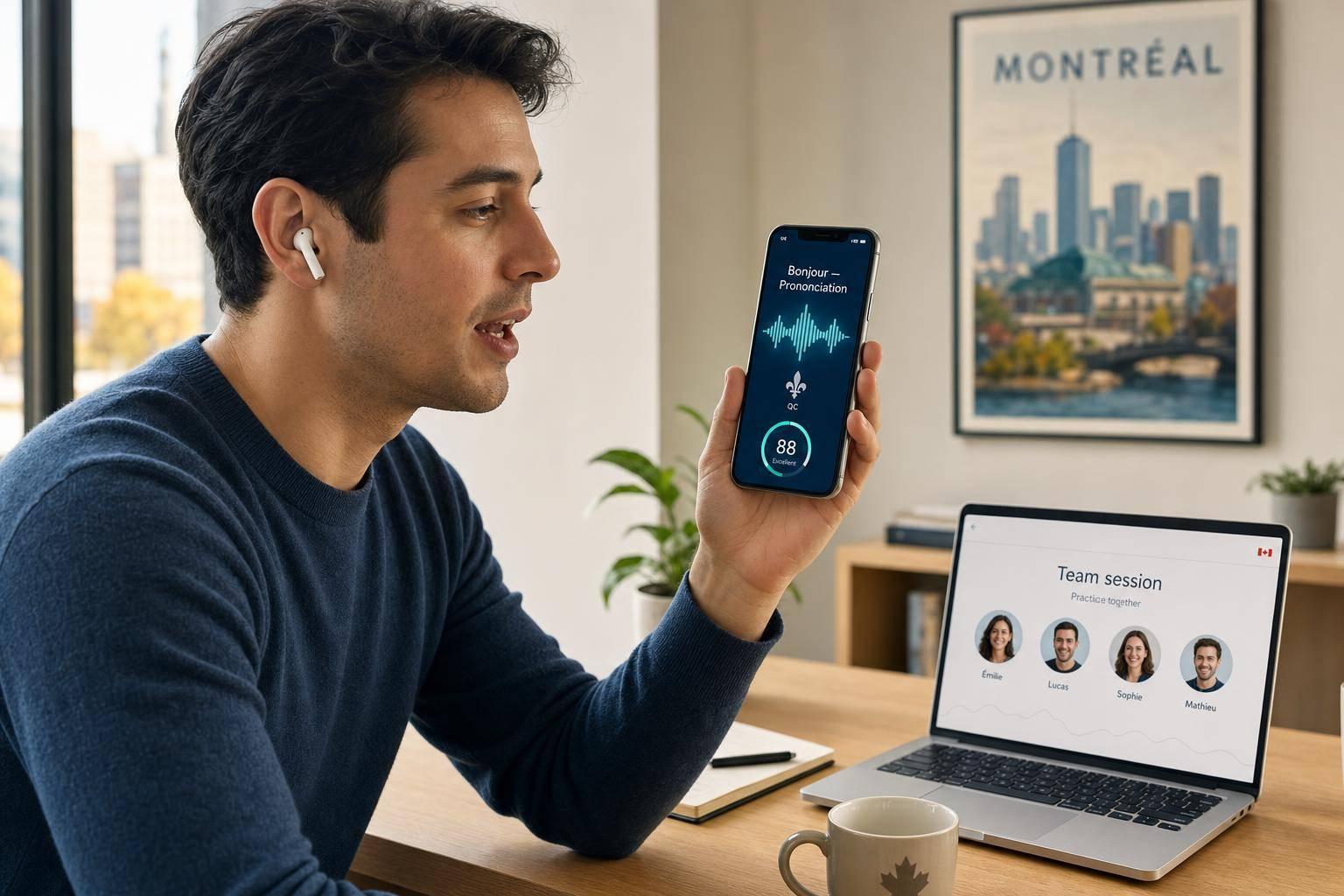
If you need French for work in Québec, I’d put Conversaflex first. If you want solo daily study, I’d look at Duolingo Max or Babbel. That’s the short answer.
Here’s what this comparison covers at a glance:
- Conversaflex for workplace speaking, Québec French, team tracking, and Bill 96 support
- Talkpal AI and Langua, which could not be judged from the source material
- Duolingo Max for habit-building and basic speaking drills
- Babbel for self-paced business French lessons
- Busuu for solo practice, with limits for work use
I’m looking at the things that matter most for Canadian learners and employers:
- Speaking practice
- Pronunciation feedback
- Workplace French
- Québec French support
- Team use
- Pricing in C$ where available
A few points stand out fast:
- In a GSK Canada pilot, 96% of Conversaflex users said their speaking confidence improved
- 70% said they used more French at work
- 90% said they felt more confident working across sites
- App-based tools are often fine for vocabulary and habit-building, but they can stall when you need live back-and-forth
ChatGPT vs Gemini: Which One Is Better for Practicing French?
sbb-itb-7df369b
Quick Comparison
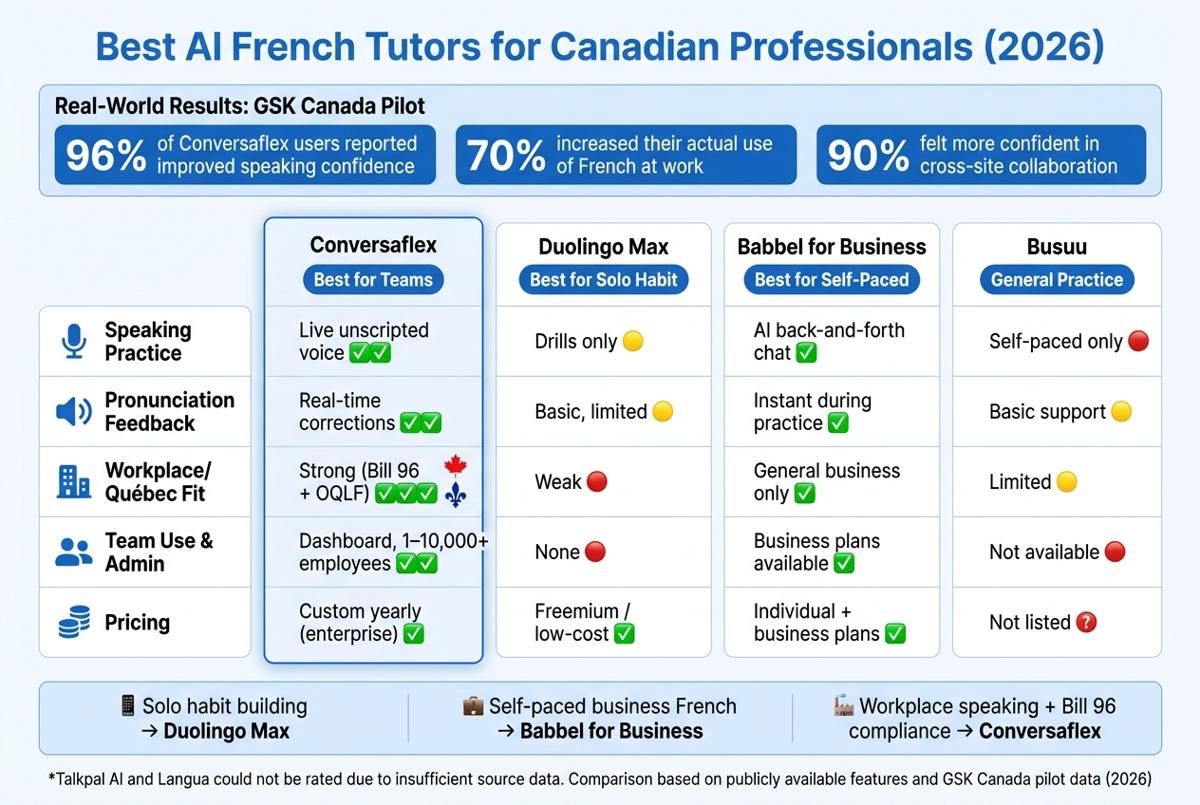
| Tool | Best for | Speaking practice | Pronunciation feedback | Workplace/Québec fit | Pricing |
|---|---|---|---|---|---|
| Conversaflex | Teams and professionals in Québec | Live, unscripted voice practice | Real-time corrections | Strong fit for role-based French and Bill 96 compliance reporting | Custom yearly business pricing |
| Talkpal AI | Not rated | Not enough source detail | Not enough source detail | Not enough source detail | Not enough source detail |
| Langua | Not rated | Not enough source detail | Not enough source detail | Not enough source detail | Not enough source detail |
| Duolingo Max | Solo learners building a habit | Good for drills, less so for open conversation | Basic feedback | Weak fit for workplace French and Québec use | Low-cost app tier |
| Babbel | Self-paced business learners | Back-and-forth AI chat | Instant feedback during practice | Fine for general business French, limited for Québec work needs | Individual and business plans |
| Busuu | General solo practice | Self-paced practice | Basic support | Limited fit for team training in Québec | Pricing not listed in sources |
My take: if you need to speak French in meetings, client calls, or team chats in Québec, a voice-first work platform will usually fit better than a general app. If you’re learning on your own, an app may still be enough.
Here’s the breakdown.
1. Conversaflex
Conversaflex is made for professionals who need to use French on the job. Founded in Montreal by Alexa Love-Tremblay and Séraphin, it was built with workplace French in Quebec in mind.
Speaking Practice
The AI voice agent focuses on natural, unscripted conversation. It recognises a broad range of accents, including Quebec French. The practice scenarios match day-to-day work situations, like onboarding a colleague, giving a presentation in a meeting, or leading a team huddle.
It also tailors training by role. Nurses can practise medical terms, engineers can talk through technical specifications, and sales teams can rehearse bilingual pitches.
"What Conversaflex gave me is the conversation. That's what I was really missing to make it to the next level of speaking and understanding French." - Rebecca, Asset Laboratory Study Manager, GSK [1]
Pronunciation Feedback
Feedback shows up in real time, pointing out pronunciation and grammar mistakes during the conversation. The system is trained to recognise strong accents from different native languages, which helps make the feedback more accurate.
A pilot at GSK Canada found that 96% of users noticed an improvement in their speaking confidence after a few months on the platform [3].
That same feedback then carries over into role-based practice.
Workplace French
The platform supports sector-specific vocabulary for pharmaceutical, healthcare, engineering, manufacturing, construction, mining, legal, and human resources teams. For Quebec employers, the Business plan includes automated francisation reports for OQLF and Bill 96 compliance.
An admin dashboard lets teams track participation and progress across groups ranging from 1 to 10,000+ employees.
In the GSK Canada pilot:
- 70% of participants increased their actual use of French at work
- 90% reported more confidence in cross-site collaboration [1]
"I was able to share full sentences about our sales performance, which was met with a round of applause from the Quebec team." - Nick, Marketing Director, GSK [1]
Pricing
Business pricing is custom and billed yearly per employee, with volume discounts. Shorter-term contracts are also available. Learning Partners get white-label and API access.
Next: app-based options for lighter daily practice.
2. Talkpal AI
The sources provided don’t give enough solid detail to judge Talkpal AI as a tool for learning French.
So instead of guessing, it makes more sense to move on to tools with clearer, source-backed features for daily French practice.
3. Langua
Langua couldn’t be assessed using the same criteria as the other tools in this comparison.
The sources reviewed for this article don’t provide enough reliable information about Langua’s French-learning features or pricing. Because of that, this comparison does not score its speaking practice, pronunciation feedback, workplace use, or licence options. For a deeper look at how these technologies work, see our guide on AI voice agents for French.
The article then moves on to app-based tutors with clearer feature and pricing details.
4. Duolingo Max
Duolingo Max is a gamified French app built for general practice. In this comparison, it’s the first app aimed at the mass market.
Speaking Practice
Duolingo Max uses adaptive learning to review weaker words and phrases, which can help with retention. That said, some users hit a plateau once they get past the basics:
"I reached a point where it wasn't bringing me much anymore. I knew the words I wanted to use, but I wanted to be able to have a conversation. I wanted to be able to speak to someone naturally." - Kristy McClatchey, Mental Health Worker [2]
The drills can help you remember vocabulary, but they don’t replace live back-and-forth. So while the app is useful for practice, it’s not built for job-specific French.
Pronunciation Feedback
Duolingo Max does check pronunciation, but the feedback is fairly limited. It can also miss nuances in Quebec French, which matters for learners in Canada. As McClatchey noted:
"I had difficulty finding [an AI] that understood me and, especially, that used Quebec French. It was mostly French from France tools." [2]
The exercises are good for repetition, not live conversation with an AI tutor.
Workplace French
Duolingo Max is made for general French, not business or industry-specific use. It doesn’t include workplace scenarios or Bill 96 support. That makes it a better fit for casual practice than workplace training.
Next, the comparison shifts to another app with different strengths.
5. Babbel
For learners who want structured, self-paced practice, Babbel feels more like a general language app than AI-driven workplace training.
Speaking Practice
Babbel's AI Conversation Partner lets learners practise back-and-forth conversation without a human tutor. That said, the practice stays broad. So if your team needs French for a field like tech, legal, or healthcare, Babbel doesn't go into that level of job-specific language.
Pronunciation Feedback
The platform gives instant feedback during conversations, which helps learners spot mistakes while they're speaking instead of later on. That's useful. But it doesn't go far enough for people who need polished speech in client-facing roles. Its strong point is live correction during practice, not deeper coaching tied to job roles.
Workplace French
Babbel is a good fit for general professional communication like meetings, travel, and day-to-day business situations. But it doesn't include industry-specific terms or workplace scenarios built for certain sectors.
For Canadian companies working in Quebec, that's a gap. There are no Bill 96 reporting or tracking features, and no advanced team tracking for HR groups handling language training needs.
Pricing
Babbel offers both individual and business subscription options. Babbel for Business uses a self-paced setup, which makes scheduling easy. But the focus stays on general French, with no tools for technical training or compliance-driven programs.
6. Busuu
Busuu sits in the general-purpose language app tier. It's a self-paced French app that works fine for solo practice, but it falls short for French language training for employees. It can help with day-to-day repetition, not the kind of live, job-specific French that working professionals need.
That puts it in the same broad group as other self-paced apps. In plain terms, its fit for workplace French is limited.
Its pronunciation feedback can help with practice, but that's not the same as job-ready coaching. It also doesn't offer the role-specific guidance or compliance support teams need for Québec workplace requirements. Pricing details aren't available in the source material. For teams, it lacks the structured support needed for workplace French.
The next section breaks these tools down by type, from voice agents to general learning apps.
Pros and cons by tool type
French learning tools do different jobs. A vocabulary app, a voice agent, and a workplace platform aren't trying to solve the same problem.
For Canadian workplaces, the main test is simple: does the tool help people speak at work and meet Québec rules? A strong test score doesn't always mean someone can handle a meeting, a client call, or a day-to-day exchange on the job.
| Category | Strengths | Limits | Best For | Price tier |
|---|---|---|---|---|
| Workplace Platforms | Role-based vocabulary, Bill 96/OQLF compliance, HR admin dashboards, scalable for 1–10,000+ employees | Higher cost; requires organisational setup; limited single-user options | HR-led training, Québec-based teams, regulated teams and employers | Business/Enterprise (custom quote) |
| Voice-First AI Agents | Real-time pronunciation feedback, reduces speaking anxiety, 24/7 availability, simulates lifelike workplace scenarios | May lack structured grammar curriculum; requires stable internet for voice processing | Building fluency and confidence for meetings and calls | Mid-range (subscription) |
| App-Based Tutors | Gamified engagement, low cost, solid for basic vocabulary and grammar habits | Plateaus at conversational level; no compliance tools; lacks professional or industry-specific depth | Casual learners, beginners, daily habit building | Low (freemium or $8–$15/month) |
The takeaway is simple: pick based on use case, not feature count.
App-based tools are good for building a daily habit. But many hit a wall when it's time for live conversation. Voice-first tools help people speak more smoothly and with less stress. Workplace platforms go a step further by adding admin controls, reporting, and compliance support.
Best picks for Canadian professionals and teams
Once you look at the trade-offs, the best option comes down to how you plan to use it.
| Use Case | Best Choice | Why It Fits | Limits |
|---|---|---|---|
| Overall workplace French | Conversaflex | Built for Bill 96 compliance, with built-in OQLF reporting, Québec French, and job-specific vocabulary | Requires organisational setup; pricing is custom |
| Self-directed study | Duolingo Max | Freemium, gamified learning for basic skill building | No business features; not suitable for Bill 96 requirements |
| Structured business learning | Babbel for Business | Short lessons built around professional communication scenarios | Focuses on France French, not Québec usage; no Québec regulatory documentation support |
| Team training rollout | Conversaflex | Scales across large teams with centralised admin dashboards and progress tracking | Business features require a contract |
For Québec employers, the choice often comes down to compliance reporting and actual speaking practice.
Here’s the simple way to think about it:
- Use Duolingo Max to build a steady study habit
- Use Babbel for Business for self-paced business French lessons
- Use Conversaflex for live workplace speaking, role-based vocabulary, and team reporting
If your team needs French for day-to-day work in Québec, especially under Bill 96 compliance requirements, Conversaflex is usually the better fit. If you're learning on your own and just want to get started, Duolingo Max or Babbel for Business can still do the job, depending on how much structure you want.
FAQs
How do I choose the right AI French tutor for my goals?
Start with your actual goal. If you need spoken French or English for work, pick a voice-first tutor that gives you job-based conversation practice, live pronunciation correction, and clear grammar and vocabulary feedback. It should also adjust to your CEFR level, so the practice fits where you are now instead of feeling too easy or way over your head.
For teams, the checklist gets a bit longer. Look for:
- Placement testing
- Role- or industry-based learning paths
- Progress dashboards
- OQLF-aligned compliance reporting, if that applies to your team
- A Custom AI trained on your business data
That mix helps turn language training from a nice-to-have into something people can use on the job.
Is Québec French support essential for workplace learning?
Yes. In a work setting, Québec French support matters because many tools are built for European French, not the French people in Québec use every day.
When AI understands Québec French, learners tend to feel more at ease speaking a second language. It also keeps training tied to the language they’ll hear and use on the job. In Québec, that matters even more because it can support francization efforts under Bill 96.
Can an AI tutor replace live French conversation practice?
AI tutors can do a lot for professional language development. Still, they work best alongside live conversation, not as a total stand-in.
They give you unlimited, 24/7 practice, job-specific scenarios, and instant feedback. That’s a big deal when you want more reps without waiting for a class or coach.
In workplace settings, the best results usually come from a broader learning approach. AI handles day-to-day practice well, while human instruction adds more specialised guidance.



![Cover Image for Corporate Language Training Costs: Conversaflex vs. Tutors, Classes and Apps [2026]](/_next/image?url=%2Fassets%2Fimages%2Fblog%2F68b2425f68bb5e38327dcb5b-1756542781388.jpg&w=3840&q=75)
![Cover Image for Workplace French Training in Canada: Formats, Costs and Funding [Guide 2026]](/_next/image?url=%2Fassets%2Fimages%2Fblog%2Fworkplace-french-training-canada-2026.jpg&w=3840&q=75)
![Cover Image for Best Berlitz Alternatives for Corporate Language Training [2026]](/_next/image?url=%2Fassets%2Fimages%2Fblog%2F6a7bbd11dc1e9c396e6c3412-1786499684881.jpg&w=3840&q=75)