
Role-Specific Language Training for Bill 96
Map Bill 96 duties to job tasks, set role-based French targets, assign task-focused training, and keep audit-ready OQLF records.
If I want Bill 96 training to work, I need to match French training to the job. A single course for everyone won’t cover customer service, team meetings, HR notices, safety steps, and software use in French.
Here’s the short version:
- I start with job duties, not general French lessons
- I link each Bill 96 duty to daily tasks
- I set a French target by role
- I check the gap between the role target and the employee’s current level
- I assign task-based training
- I keep completion records for OQLF reviews and internal tracking
The article points to a few numbers that stand out:
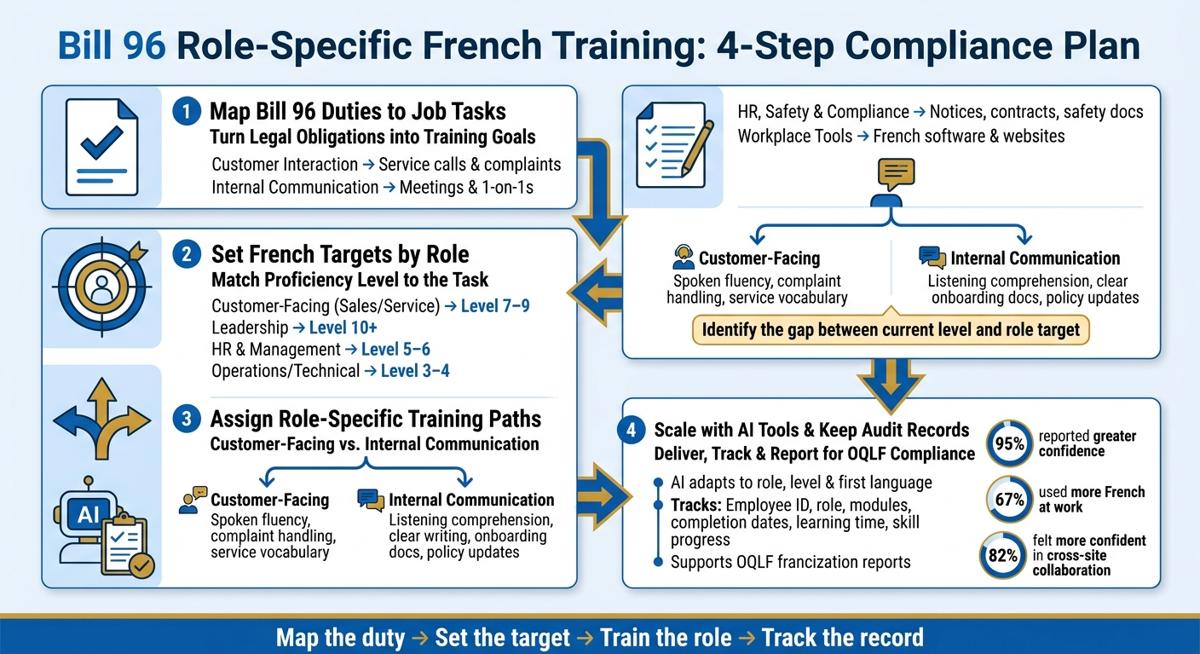
- 95% of GSK pilot participants said they felt more confident after training
- 67% said they used more French at work
- 82% said they felt more confident in cross-site collaboration
What matters most is simple: customer-facing roles need spoken French for service and complaints; managers, HR, and team leads need French for meetings, onboarding, notices, and staff support. I also need one place to track assigned modules, dates, time spent, and progress by role.
A short comparison helps show the split:
| Area | Main focus | Main risk if missed |
|---|---|---|
| Customer-facing roles | Service calls, complaints, sales, returns | OQLF complaints, lost sales, brand harm |
| Internal roles | Meetings, onboarding, notices, coaching | Staff issues, lower output, audit gaps |
So if I’m building a Bill 96 plan, the path is clear: map the duty, set the role target, train by task, and keep the record.
Bill 96 Overview, its objectives, key provisions, and language requirements for businesses
Step 1: Turn Bill 96 duties into clear workplace training goals
Start by turning Bill 96 duties into day-to-day job tasks. Then turn those tasks into training goals. That way, each role gets the French it actually needs, instead of a generic course that misses the mark.
A simple way to do this is to map obligation → task → role.
Build French language training for employees around what people do at work, not around broad French lessons.
Match legal obligations to daily work tasks
The most practical way to set training goals is to connect each Bill 96 duty to the tasks employees handle every day. That makes the training easier to plan and much easier to use on the job.
Here’s what that can look like across four communication categories:
| Communication Category | Training Goal | Why It Matters |
|---|---|---|
| Customer Interaction | Handling service calls and complaints in French | Right of Quebecers to be served in French |
| Internal Communication | Conducting 1-on-1s and team meetings in French | Right to work in French; employee integration |
| HR, Safety, and Compliance | Drafting notices, safety instructions, and contracts | Mandatory French documentation; risk of nullification |
| Workplace Tools | Using software and websites in French | Requirement for French versions of tools/sites |
This kind of map keeps the focus on work that has to get done. If someone answers customer calls, they need the French to solve issues and respond to complaints. If they manage staff, they need the French to lead meetings, give feedback, and handle onboarding without friction.
Prioritize roles with the highest compliance risk
Not every role creates the same level of risk. Customer-facing teams should come first because the OQLF is deploying observers to businesses to monitor the availability of French-language service [2]. After that, focus on managers, HR, and supervisors who write notices, handle onboarding, and lead internal communication.
This role-based map also helps with compliance planning. When language gaps go unchecked, work slows down, rework piles up, and retention can take a hit.
Once you’ve pinpointed the highest-risk roles, the next move is to set French targets for each one.
Step 2: Set French targets by role and identify skill gaps
Once you know which roles carry the most risk, the next move is simple: set a French target for each one.
Not every job needs the same kind of workplace French. A customer service rep doesn’t use the language the same way an operations lead does. So don’t force one standard across the whole company. Match the target to the work.
Define proficiency levels by role type
Set fluency targets based on what each role has to do on the job, not just on a test result.
A customer-facing sales role needs French for pitches, complaint handling, and day-to-day customer questions. An operations lead, on the other hand, needs enough French for shift handovers, safety instructions, and incident reports.
That’s the key idea here: tie the target to the task.
Assess current skills against job requirements
After you’ve set a target for each role, compare that target with each employee’s current level. The gap between those two points shapes the training plan.
Keep the assessment tied to real work. That means looking at tasks like:
- sales calls
- company-wide meetings
- onboarding
- shift handovers
- incident reporting
Use task-based assessments so the results line up with the job and give you audit-ready evidence [2].
Role-to-proficiency reference table
This table gives HR, operations, and compliance teams a practical starting point. You can adjust the role labels to fit your own org chart, but the logic should stay the same: task first, target second, risk third.
| Role Type | Core Communication Tasks | Target French Level (Quebec Scale) | Main Risk if Gap Unaddressed |
|---|---|---|---|
| Customer-Facing (Sales, Service) | Pitching, complaint handling, answering customer questions | Level 7–9 | Brand damage, OQLF fines, lost revenue |
| Leadership | Company-wide meetings, strategic updates, and reporting | Level 10 or higher | Cultural misalignment, legal exposure under Bill 96 |
| HR and Management | Company-wide meetings, one-on-ones, onboarding, cross-site collaboration | Level 5–6 | Employee attrition, reduced productivity |
| Operational/Technical (Engineering, Operations) | Safety instructions, incident reporting, shift handovers | Level 3–4 | Safety incidents, productivity bottlenecks |
Use the gap record to assign the right training path in Step 3.
Step 3: Build training paths for customer-facing and internal communication roles
Use the Step 2 gap records to assign role-specific French training by task. The aim is simple: get people ready to do the job in French. Not generic fluency. Not classroom-style theory. The gap record should shape the training path.
Customer-facing training for service, complaints, and sales
Use the Step 2 gap record to assign spoken French practice for sales, service, returns, and complaints. Customer-facing French needs to be practise-ready, because that’s where language gaps show up fast.
Training should match real interactions. A retail associate should practise handling a return in French, not just memorize a word list. A service rep should work through a complaint call, not recite grammar rules. Start with spoken French, then move to the written follow-up staff use on the job. Service notes and quotes should be practised in French too.
GSK used AI simulations to help an MSL practise understanding French physician presentations [1].
Internal communication training for managers, HR, and team coordination
Internal roles need a different path: meetings, documents, and coaching.
Managers and HR need French for meetings, coaching, onboarding, and policy updates. Focus on listening comprehension and clear writing for meetings, onboarding documents, and policy updates. Those are the two skills staff need most for internal coordination.
The practical result: 82% of employees felt more confident participating in cross-site collaboration after completing targeted role-specific training [1].
Customer-facing vs. internal training comparison table
| Customer-Facing | Internal Communication | |
|---|---|---|
| Roles | Sales, retail, customer service, reception | Managers, HR, operations leads, technical staff |
| Key Tasks | Pitches, complaint handling, service notes, quotes | Meetings, onboarding, policy updates, coaching, 1-on-1s |
| Key Skills | Spoken fluency, service-specific vocabulary | Listening comprehension, clear emails, notices, and policy updates |
| Sample Module | "Handling a retail return in French" | "Running a project sync meeting in French" |
| Bill 96 Requirement Supported | Right of consumers to be informed and served in French | Right of employees to work in French |
Keep these two paths separate, then record completion for audit trail use in Step 4. Once the paths are set, assign them in a system that tracks completion and progress.
Step 4: Scale compliance with AI training tools and team records
Once your training paths are set, the next job is making sure they’re delivered the same way across every role, site, and skill level, without drifting into generic lessons that don’t help on the floor.
Assign role-specific learning paths with adaptive training
Use the Step 3 gap record to assign training by role and task. In plain terms, take the role-by-role gap data from Step 3 and use it to assign training automatically.
AI-powered training adjusts to each employee’s role, current skill level, and first language. That means people practise in workplace situations that look like their actual day-to-day work, like customer calls, team meetings, and safety briefings.
In a 2026 pilot at GSK, 95% of participants reported greater confidence and 67% said they used more French at work [1].
Conversaflex handles this with AI-led conversations, built-in pronunciation feedback, and skill tracking over time. The point is simple: each employee gets a path that fits the job, not just a general language level.
Once training is assigned, the same system should also log completion and progress.
Keep audit-ready learning records
Records show that training was completed and help support OQLF audits. For each employee, track:
- Employee ID
- Role
- Quebec work location
- Assigned modules
- Completion dates
- Learning time
- Skill progress by target
These records support OQLF francization reports and make it easier to spot gaps across the team. A central admin dashboard that logs this data automatically helps keep records current and ready to share when needed.
AI vs. static training comparison table
This gap shows up fast when you need to train a lot of employees without losing job fit.
| Feature | Static Training | AI-Powered Training |
|---|---|---|
| Role and task fit | Generic or consumer-focused content | Adapts to role, level, and job-specific scenarios |
| Scalability | Limited by tutor availability and cost | Scales across teams of any size [1] |
| Feedback quality | Basic or delayed | Instant pronunciation and grammar feedback |
| Audit readiness | Manual and inconsistent | Automated tracking aligned with francization reporting |
Static training often means manual recordkeeping. AI-powered systems log completion automatically.
Conclusion: A practical Bill 96 language training plan
Put together, these steps make Bill 96 feel less like a box-ticking exercise and more like a clear plan your team can use. Compliance starts with role-based French targets, task-based training, and one central place for records tied to OQLF reporting. Map the duty, set the target, train the role, and track the record.
Key points to remember
Customer-facing roles need strong spoken French. Internal roles need enough French for meetings, HR tasks, and day-to-day team coordination.
Keep learning records current and in one central system, including learning time per employee, to support OQLF reporting [1].
Role-specific AI training keeps practice tied to the job, makes progress easier to measure, and helps teams scale compliance without losing focus.
FAQs
How do I set French targets by role?
Managers can use Conversaflex to set and assign French learning goals for each employee based on their role, the terms they use on the job, and their current skill level.
With the admin dashboard, leadership can monitor progress against those goals through reports aligned with the Quebec Francisation Scale (Levels 1 to 12) and CEFR (A1 to C2), helping support Bill 96 compliance.
Which roles should I train first for Bill 96?
Start with customer-facing roles. These employees usually need French most often, and they need to manage professional conversations with confidence, in real time.
You should also put focus on staff who explain technical issues, clarify client requests, or work with industry-specific terms. In those cases, even small communication gaps can affect day-to-day performance. Conversaflex helps by giving teams role-specific, AI-powered practice built around actual workplace language needs.
What records should I keep for an OQLF review?
Keep clear, structured records that show your organization’s commitment to francization and language compliance. That includes employee training hours, compliance reports tied to the Quebec Francisation Scale (levels 1–12), and CEFR standards.
If it fits your process, Conversaflex can help with OQLF-aligned reports and exportable data on individual progress. When audit time comes around, structured, exportable evidence matters more than dashboards alone.




![Cover Image for Corporate Language Training Costs: Conversaflex vs. Tutors, Classes and Apps [2026]](/_next/image?url=%2Fassets%2Fimages%2Fblog%2F68b2425f68bb5e38327dcb5b-1756542781388.jpg&w=3840&q=75)
![Cover Image for Workplace French Training in Canada: Formats, Costs and Funding [Guide 2026]](/_next/image?url=%2Fassets%2Fimages%2Fblog%2Fworkplace-french-training-canada-2026.jpg&w=3840&q=75)
![Cover Image for Best Berlitz Alternatives for Corporate Language Training [2026]](/_next/image?url=%2Fassets%2Fimages%2Fblog%2F6a7bbd11dc1e9c396e6c3412-1786499684881.jpg&w=3840&q=75)