
Language Training ROI: What Progress Data Shows
Hours show activity; proficiency gains, role-task checks, customer impact and Quebec compliance reveal true language training ROI.

If you only track course hours, you still can’t tell if language training is paying off. I’d judge ROI by what people can do at work: handle client calls, speak in meetings, write clear updates, and serve customers in French or English when it counts.
Here’s the short version:
- Attendance is not performance. Finished modules and login time do not show workplace ability.
- Progress data gives a better ROI view. Baseline-to-current scores, job-task checks, and speaking confidence show whether skills are improving.
- Hidden costs matter. Language gaps can lead to rework, slower decisions, missed input, and customer issues.
- The risk is higher in Quebec. Failing to meet standards can lead to Bill 96 non-compliance fines. Training records alone may not satisfy OQLF checks if staff can’t provide service in French in practice.
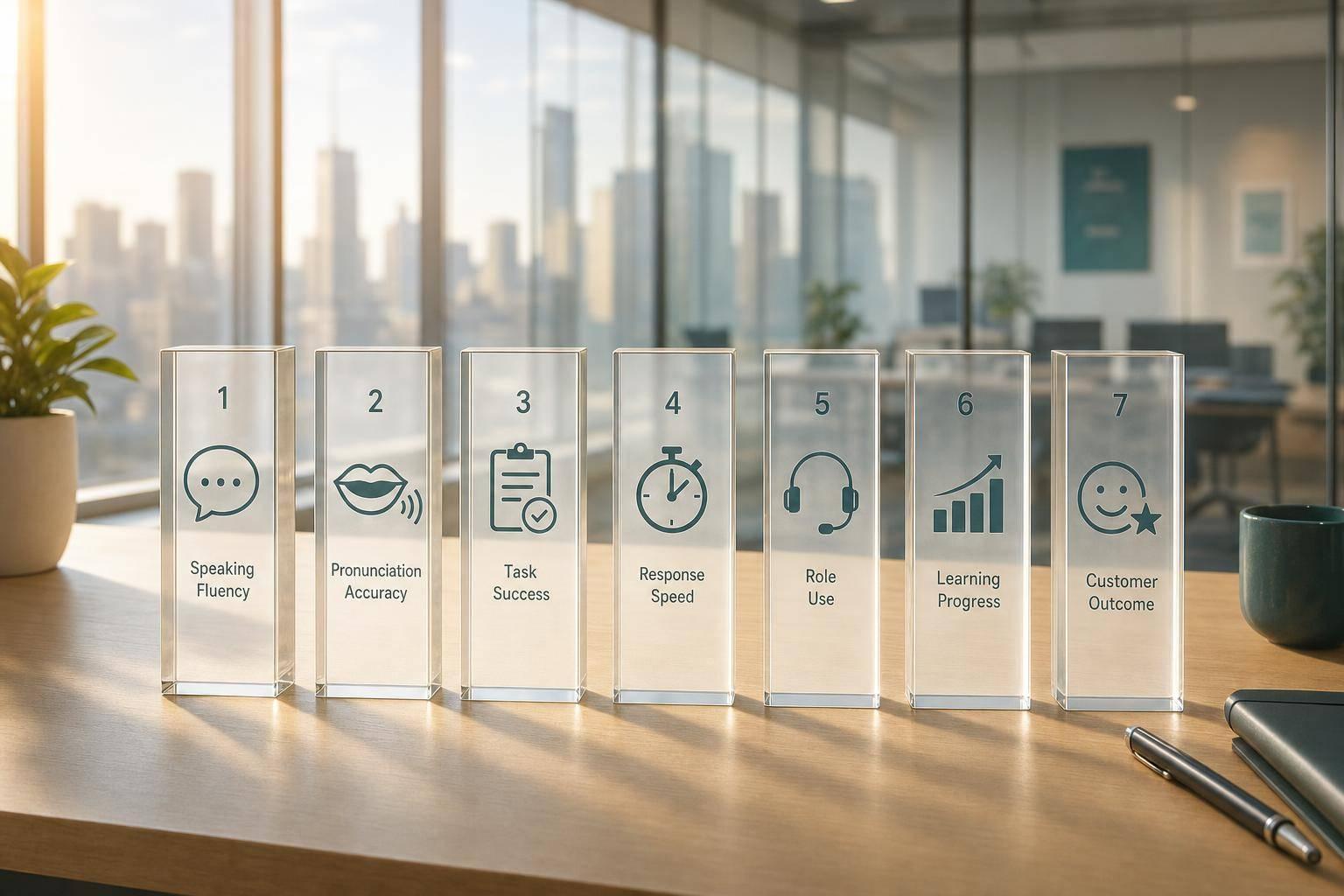
- A simple scorecard works. I’d track total spend in CAD, movement on CEFR or the Francisation Scale, task success rates, customer issue trends, hesitation cost, and audit readiness.
- One stat stands out: 64% of employees say language barriers hurt their job performance.
A simple way to think about it is this: hours show activity; progress shows job impact.
| What I’d Look At | What It Tells Me |
|---|---|
| Training hours | Who attended |
| Baseline vs. current level | Whether skills changed |
| Role-based task checks | Whether staff can use the language on the job |
| Customer and team impact | Whether errors, delays, or missed input dropped |
| Quebec compliance tracking | Whether French service is in place in practice |
If I want a clean ROI report, I wouldn’t ask, “Who finished the course?” I’d ask, “Who can now do the work better?”
What businesses miss when they track only completion
Completion data on its own misses the business signal that matters. A high completion rate may look like progress, but it doesn't tell you whether employees can actually use the language at work.
Skill gains that never appear on standard dashboards
Most training dashboards miss the skills that matter most on the job: speaking confidence, paraphrase recognition, register flexibility, and role-specific performance. Those gaps aren't academic. They shape day-to-day work in ways managers feel, even if the dashboard stays quiet.
Test scores show assessment performance, not workplace readiness. [2]
Business impact that stays invisible
When measurement stops at completion, the downstream costs stay hidden. In customer-facing roles, finishing a course does not mean an employee has the words, confidence, or practice to help a customer in French in the moment. In professional services, a team member who follows the conversation but doesn't speak up can slow decisions and screen out useful input from the team.
Those are the kinds of outcomes progress data can surface. Completion reports can't.
Quebec compliance risk without proof of practical French ability
In Quebec, that same gap can create compliance risk. The Office québécois de la langue française (OQLF) is now deploying observers directly into businesses to verify that French-language service is genuinely available, not just documented on paper. [4] Completion is not enough. Employers need proof of practical French ability, not just training records.
Progress metrics that make ROI measurable
The measurement gap starts to close when you track what employees can do on the job, not just how many training hours they completed.
Measure baseline and post-training language ability
Start with a baseline before training. Then reassess the same skills after training so you can show clear gains in ability. CEFR helps set that starting point, but it doesn't show how someone performs at work.
As Alexa Love-Tremblay, Co-founder of Conversaflex, puts it:
"CEFR tells you what someone can do on a test. Not what they do in a daily standup." [1]
For Quebec employers, the Francisation Scale (Levels 1–12) vs. CEFR adds job-focused context that CEFR on its own can't give. What matters most is simple: are employees getting better at the situations their roles demand?
That means checking progress in the tasks they handle every day, not just in test-style exercises.
Track job-specific performance and customer communication
Leadership reports should stay tied to role-based situations, such as:
- handling a client call in French
- contributing in standups
- writing clear internal updates
You can also track tone adjustment and paraphrase understanding. Those two signals show whether learners can respond to context and follow meaning when something is phrased in a different way. [2]
Practice frequency and consistency matter too. Steady practice tends to predict fluency and retention better than the occasional workshop. [2]
When language affects customer experience or team output, track things like rework, slower decisions, and missed input. That gives you a clearer view of business impact. [3]
In Quebec, these same task checks also serve as proof of practical French ability.
Monitor compliance progress alongside learning progress
In Quebec, compliance reporting should show practical French progress, not just proof that training took place. Useful metrics include movement on the Francisation Scale and role-based readiness for customer-facing communication.
Use ongoing skill tracking and Bill 96-ready reporting.
How to turn progress data into a clear ROI report
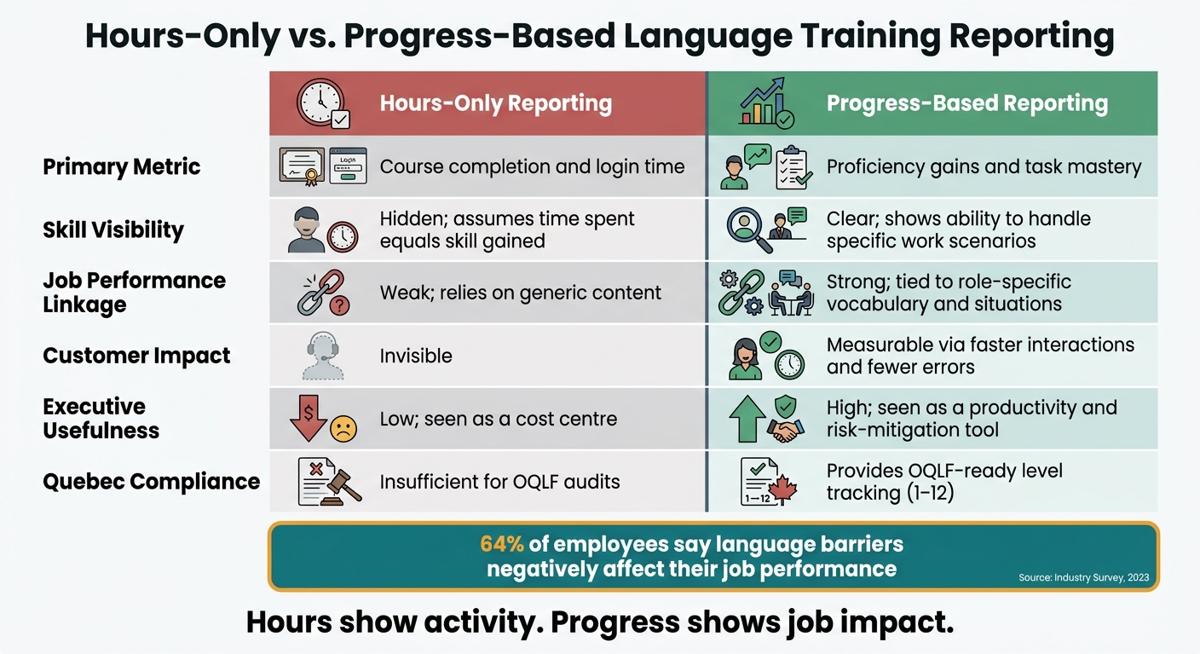
Hours tracked vs. progress tracked: a comparison
Progress data is a lot easier to act on when leaders can scan it in seconds. Hours-only reporting tells you who showed up. Progress-based reporting tells you who can do the work.
| Reporting Factor | Hours-Only Reporting | Progress-Based Reporting |
|---|---|---|
| Primary Metric | Course completion and login time | Proficiency gains and task mastery |
| Skill Visibility | Hidden; assumes time spent equals skill gained | Clear; shows ability to handle specific work scenarios |
| Job Performance Linkage | Weak; relies on generic content | Strong; tied to role-specific vocabulary and situations |
| Customer Impact | Invisible | Measurable via faster interactions and fewer errors |
| Executive Usefulness | Low; seen as a cost centre | High; seen as a productivity and risk-mitigation tool |
| Quebec Compliance | Insufficient for OQLF audits | Provides OQLF-ready level tracking (1–12) |
That difference matters. If a report only shows hours, leaders see a line item. If it shows progress on job tasks, customer communication, and compliance, they can connect training to day-to-day results.
Use that contrast to build a one-page ROI scorecard.
Build an ROI scorecard for leaders
A good scorecard doesn’t need bells and whistles. It just needs to answer one question: is the training paying off?
For many Canadian organizations, that means tracking a small set of measures:
- Training cost (CAD): total spend
- Proficiency gain: movement on the CEFR or Quebec Scale from baseline to current assessment
- Task performance rate: percentage meeting role-specific language benchmarks
- Customer communication: fewer errors and faster resolutions
- Hesitation cost: the cost of slow decisions and missed input
- Compliance indicator: current Francisation level and audit readiness
The hesitation cost piece tends to land fast with leadership. When 64% of employees report that language barriers negatively affect their job performance [5], that delay isn’t abstract. It has a dollar figure behind it. Once you show that number, the conversation shifts from “training expense” to “business risk.”
Set a review rhythm that keeps reporting useful
Once the scorecard is in place, the next step is simple: review it on a fixed schedule. Without that, even a good report can gather dust.
A three-tier cadence works well for most organizations.
Monthly, check individual and team progress against baselines. This helps you spot people or teams that need support before the gap gets bigger.
Quarterly, review business measures. Look at hesitation cost recovery and progress in role-specific scenarios [3][1]. This is also a good point to check Quebec compliance progress and flag any teams that may need added support before an OQLF audit.
Annually, compare training cost in CAD with gains in proficiency, task performance, customer communication, and compliance. That keeps reporting tied to business decisions instead of turning into a stack of old numbers.
Conclusion: What progress data shows that course hours cannot
Course hours show attendance, not improvement. That’s where language training ROI gets lost. The reporting often tracks activity, but not the shift in skill, confidence, or job performance.
In plain terms, the strongest case for ROI comes from progress data. You want to see baseline-to-current skill gains, role-based performance, customer communication, and Quebec compliance progress. Hours alone can’t show any of that. Put those measures together, and language training stops looking like a simple line item. It starts to look like a business decision.
That’s the reporting gap leaders need to close. Ask one direct question: does your reporting show completion, or real workplace ability? If it only shows completion and login time, it misses the outcome that matters.
FAQs
How do I measure language training ROI beyond course hours?
Start with job-related outcomes. That could mean moving employees into client-facing roles or getting ready for an OQLF audit. Then measure progress against those targets.
Track both skill growth and on-the-job readiness by looking at:
- placement and progress data
- speaking confidence in actual work roles
- communication performance in customer-facing situations
- compliance reporting tied to Bill 96
- participation in role-specific vocabulary and scenario practice
This keeps the focus on what matters at work, not just test scores.
Which progress metrics matter most for workplace language skills?
The metrics that matter most go past course completion. What you want to track is job performance in actual work situations: role-based communication, customer interactions, handling difficult feedback, vocabulary growth, practice consistency, and language confidence under pressure.
In Quebec workplaces, progress reporting should also line up with standard frameworks such as the Quebec Francisation Scale. That gives teams a clear way to show skill growth and helps support compliance.
What proof of French ability may Quebec employers need?
In Quebec, employers may need documented proof of an employee’s French proficiency, along with records showing they took part in structured francization programs. That kind of documentation can help support compliance with Bill 96 and OQLF requirements.
Conversaflex can help by providing OQLF-aligned compliance reports that track training hours and learner progress using the Quebec Francisation Scale (Levels 1–12) and the CEFR.


![Cover Image for Corporate Language Training Costs: Conversaflex vs. Tutors, Classes and Apps [2026]](/_next/image?url=%2Fassets%2Fimages%2Fblog%2F68b2425f68bb5e38327dcb5b-1756542781388.jpg&w=3840&q=75)
![Cover Image for Workplace French Training in Canada: Formats, Costs and Funding [Guide 2026]](/_next/image?url=%2Fassets%2Fimages%2Fblog%2Fworkplace-french-training-canada-2026.jpg&w=3840&q=75)
![Cover Image for Best Berlitz Alternatives for Corporate Language Training [2026]](/_next/image?url=%2Fassets%2Fimages%2Fblog%2F6a7bbd11dc1e9c396e6c3412-1786499684881.jpg&w=3840&q=75)