
7 Metrics for Language Progress at Work
Track job-focused language with seven role-based metrics: speaking, pronunciation, task success, response speed and customer outcomes.

If I want to track language progress at work, I should measure job output, not class attendance. The article’s main point is simple: the best signs of progress are whether people can speak clearly, finish role-based tasks, reply fast enough in live conversations, use the right job terms, keep practising, and perform well with customers.
I’d focus on these 7 metrics:
- Speaking scores for job conversations
- Pronunciation clarity for being understood
- Task success rates for role-based scenarios
- Response time in live exchanges
- Role-specific vocabulary use
- Practice and engagement data
- Customer-facing results like resolution or escalation rates
The article also shows why this matters at work: 64% of employees say language barriers hurt job performance, and 67% of executives report inefficiency tied to those barriers. So if I’m reviewing training spend, promotions, or team support, I need numbers tied to work tasks - not just participation records.
Quick comparison
| Metric | What it shows | Best use |
|---|---|---|
| Speaking scores | Can the person handle work conversations? | Readiness for meetings, calls, and internal moves |
| Pronunciation clarity | Can others understand the person clearly? | Client calls, safety talk, team communication |
| Task success | Can the person complete the task in the language? | Training ROI and role readiness |
| Response time | Can the person reply in the moment? | Meetings, support, live conversations |
| Role-specific vocabulary | Does the person use the right job terms? | Sales, tech, service, and frontline roles |
| Engagement data | Is the person practising often enough? | Usage tracking and early support |
| Customer-facing performance | Does language skill improve customer outcomes? | Coaching, service quality, promotion reviews |
In short, I’d use a small set of role-based metrics to track whether language training helps people do their jobs better, speak up more, and make fewer communication errors.
What Makes a Good Workplace Language Metric
A good workplace language metric does one simple job: it shows how well someone can communicate at work.
That means the metric should match day-to-day job tasks, be easy to track the same way over time, and help managers make better decisions. That’s the standard behind the seven metrics below.
In plain terms, measure job performance, not course activity. Attendance tells you someone showed up. It does not tell you whether they can run a meeting, explain a delay to a client, or handle a tense call with a supplier. Task-based metrics do.
The best metrics connect training to work. If a metric helps a manager decide who’s ready for client-facing tasks, who needs coaching, or where support is still needed, it has a clear purpose.
The real measure of training is measurable progress - new workplace tasks employees can now handle. You can usually see that shift in two places: stronger confidence and more language use on the job. These seven metrics make that change easy to spot.
1. Workplace Speaking Proficiency Scores
A workplace speaking proficiency score shows whether someone can handle actual job conversations in the target language, like leading a meeting, explaining a delay, or pushing back on a plan. That’s the key difference from a general language test. This kind of score is about on-the-job readiness, not just test results.
CEFR shows test performance. A workplace score shows job performance. As Alexa Love-Tremblay, Founder, Conversaflex, puts it:
"CEFR tells you what someone can do on a test. Not what they do in a Tuesday morning standup. Those are very different things." [4]
That’s why a role-based assessment often gives HR and managers a better read than a generic language level.
AI-led assessments can run role-based conversations and score key speaking skills, including:
- vocabulary
- grammar
- pronunciation
- fluency
- comprehension
These scores come from job tasks such as client calls or safety briefings, so the result is tied to the work people actually do.
That matters when people decisions are on the line. With 91% of employers saying language fluency is essential for promotion opportunities [2], a score linked to real job tasks gives managers something firmer to work with. For HR, it helps with promotion and internal mobility calls. For team leads, it shows who’s ready for client-facing work. In a 2026 GSK Canada pilot, all participants improved spoken confidence, and 90% reported stronger cross-site collaboration [1].
If someone is understandable but still hard to follow, pronunciation is usually the next metric to review.
2. Pronunciation Clarity and Intelligibility Scores
If speaking scores suggest someone is understandable but still a bit hard to follow, pronunciation is the next thing to check. The question here is simple: Can this person be clearly understood? This metric isn't about sounding polished or losing an accent. It's about whether issues with sounds, stress, or rhythm are getting in the way during actual work conversations.
As Alexa Love-Tremblay, Founder, Conversaflex, puts it:
"I don't think AI vs. traditional language training should be judged by how polished someone sounds. It should be judged by whether they can do their job more effectively in the language." [3]
The best way to track this is through role-specific simulations with AI pronunciation feedback. Think client calls, safety briefings, or team standups. Those settings give the clearest read on how someone will come across on the job.
For HR, clarity scores can help support promotion and mobility decisions in speaking-heavy roles. For team leads, they help show who can handle client calls now and who still needs more practice. And with 91% of employers saying language fluency is essential for promotion opportunities [2], a score tied to intelligibility in actual job situations gives those calls more grounding.
There's also a human side to this. When employees hold back because they worry they'll be misunderstood, participation drops. Good ideas stay unsaid. Calls get avoided. Meetings turn one-sided. Intelligibility scores help spot that gap early, before it settles into a habit. When employees hesitate to speak because they fear being misunderstood, response speed often drops next.
3. Task Completion and Scenario Success Rates
Once employees are easy to understand, the next step is simple: can they finish the task? Clear speech on its own doesn't mean much if the person still can't do the work in the target language.
That's the point of this metric. It shows whether language training is changing day-to-day job performance, not just classroom results.
As Kajepan Nanthakumar puts it:
"There is a big gap between an employee who can technically get by in a second language and one who feels confident enough to challenge a plan, run a client call, or give hard feedback." [2]
A good way to measure this is through role-specific simulations. Score whether employees can complete the kind of work their role calls for. That might include:
- sales pitches
- support tickets
- safety briefings
- instructions
- standups
- reviews
For HR, this helps show who is ready to take on more responsibility. It gives shape to internal mobility and promotion-readiness talks in a way training hours simply can't.
For team leads, it shows where language gaps are slowing work before those issues start to affect delivery.
If task success looks strong but replies still come in slowly, response speed is the next metric to check.
4. Response Speed and Processing Time
When task success is high but replies still lag, speed becomes the bottleneck. At that point, the question isn’t whether someone can do the task. It’s whether they can do it live, in the moment, under pressure.
This metric looks at the time between the prompt and the spoken reply. In plain terms, it shows whether someone can answer a client question or jump into a meeting in real time.
Conversaflex calls that hesitation the "silent tax":
"When multilingual employees hesitate to speak up, good ideas go unheard, decisions slow down, and important feedback never makes it into the room. It isn't a lack of knowledge... they just don't always feel confident entering it. That's the silent tax." [5]
In AI role-play, you can track this by measuring processing time across repeated practice sessions: the gap between a prompt and the learner’s spoken reply [4]. You can also look at how many turns a learner handles within a set period. It’s a simple stand-in for confidence.
For HR, this metric helps separate training completion from live job performance. For team leads, it points to where replies slow down - in meetings, handoffs, or client-facing moments - so coaching can be aimed where it will help most. If replies are fast but still generic, role-specific vocabulary is the next metric.
5. Role-Specific Vocabulary Coverage and Usage
Fast replies can still miss the mark when people don’t have the words their job calls for. That’s why it helps to track whether employees use the terms, phrases, and language functions tied to their role, not just whether they pass a general vocabulary check.
Look at role-specific language in actual work situations, not broad vocabulary quizzes. A customer service rep, engineer, nurse, or site supervisor each needs a different set of words to do the job well.
Sales teams need language for handling objections. Engineering teams need clear project updates. Frontline teams need precise safety or service wording. It’s less about knowing more words and more about knowing the right words at the right time.
For HR, this shifts reporting past attendance or CEFR scores and closer to role readiness: can this person run a call, lead a briefing, or handle a ticket in the target language? For team leads, it shows where missing terms are creating risk, such as a weak sales response, a vague project update, or a safety instruction that gets misunderstood.
Once that vocabulary is there, the next step is simple: are people using it often enough to keep getting better?
6. Learner Activity and Engagement Data
Knowing the right vocabulary isn't enough. Employees still need to practise it on a regular basis. Learner activity and engagement data looks at how often people practise, how long each session lasts, how many conversations they complete, and whether that effort holds steady over time.
That matters because consistency is what moves the needle. For example, 20 minutes of daily practice - about 140 minutes a week - does more to build professional proficiency than occasional, heavy sessions [6]. Engagement data shows whether training is being used or left sitting there. In plain terms, it connects access to training with what happens on the job.
Track engagement alongside performance so you can see whether practice is happening at all.
For HR, this data helps with compliance reporting, including practice hours and participation records for Bill 96 reviews. It also helps spot employees who are beginning to slip before it turns into a visible job-performance problem. If engagement drops across a team all at once, that's often a sign the training doesn't fit into the workday. In those cases, shorter, role-based sessions of 10 to 20 minutes can help rebuild steady practice [1].
For team leads, engagement data helps surface hesitation early. Some employees know the work but still hold back in meetings or on client calls. Regular practice data gives leads a clearer way to step in and support the right people instead of putting the whole team through retraining.
When practice becomes steady, the next step is to see whether that learning shows up in customer-facing work.
7. Customer-Facing Communication Performance
Measure whether employees get the customer result they need in the target language.
Look at outcomes like resolution rates, escalation rates, and customer satisfaction. The main point is the outcome, not grammar. And don’t judge performance from one call. Watch the pattern over time.
For HR, this helps with promotion decisions and internal mobility. With 91% of employers viewing English fluency as a must for promotion opportunities [2], concrete client-facing performance data - not just attendance records - gives talent decisions a much firmer basis.
For team leads, this metric helps show where confidence starts to slip. It brings that gap into view, so you can pinpoint the exact customer interaction that needs coaching. It also needs to be used by role. Customer-facing performance carries more weight in some jobs than in others. The next section breaks down which metrics matter most by role.
Which Metrics Matter Most by Role
The same metric doesn't mean the same thing in every job. A customer support agent and a sales rep may both need strong language skills, but the bar shifts based on what they do all day.
The smart way to assess this is simple: start with the 2 or 3 communication tasks that have the biggest impact on performance in each role. Then map your metrics to those tasks. If you give every metric the same weight across every role, you'll miss what the job actually demands.
| Role | Primary Metric | Secondary Metric | Why It Matters |
|---|---|---|---|
| Customer Support | Pronunciation Clarity | Response Speed | Prevents misunderstandings and supports difficult conversations |
| Sales | Speaking Proficiency | Role-Specific Vocabulary | Supports pitches, negotiations, and client Q&A |
| Operations / Tech | Task Completion | Role-Specific Vocabulary | Supports safety briefings and clear updates |
| People Managers | Learner Engagement | Confidence Scores | Tracks promotion readiness and hesitation |
Put plainly:
- Customer support leans most on clarity and speed
- Sales leans on speaking skill and role vocabulary
- Operations and technical roles lean on task completion and terminology
- People managers lean on engagement and confidence
This is why you shouldn't weight every metric the same way for every role. Match the metrics to the work first, then use that weighting to read the comparison table that follows.
Comparison Table: All 7 Metrics at a Glance
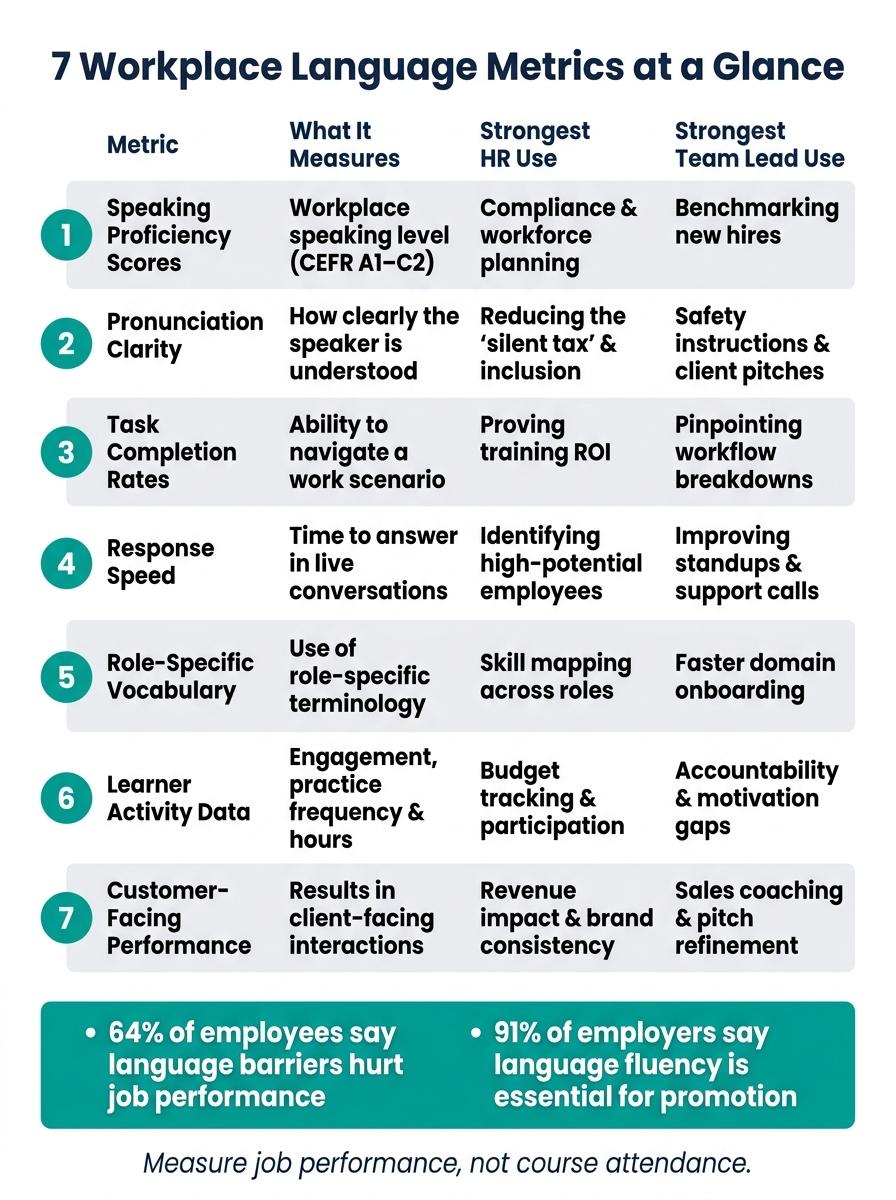
Now that you know which metrics matter most for each role, here’s a simple way to compare them by use case. The table below links each metric to what it measures, where the data comes from, and where it helps most, whether you work in HR or lead a team day to day.
| Metric | What It Measures | Common Data Sources | Strongest HR Use Case | Strongest Team Lead Use Case |
|---|---|---|---|---|
| 1. Speaking Proficiency Scores | Workplace speaking level (CEFR A1–C2 or Québec 1–12) | AI placement tests, OQLF-aligned assessments | Compliance with Bill 96 and workforce planning | Benchmarking new hires against role requirements |
| 2. Pronunciation Clarity | How clearly the speaker is understood | AI audio analysis, speech-to-text accuracy rates | Reducing the silent tax and increasing employee inclusion | Ensuring safety instructions or client pitches are understood |
| 3. Task Completion Rates | Ability to successfully navigate a work scenario | Role-play logs and scenario scores | Proving training ROI by linking language to job function | Pinpointing exactly where a workflow or interaction breaks down |
| 4. Response Speed | Time to answer in live conversations | AI conversation logs, time-to-respond metrics, live meeting audits | Identifying high-potential employees for fast-paced roles | Improving efficiency in daily standups and support calls |
| 5. Role-Specific Vocabulary | Use of role-specific terminology | Custom AI agent logs, vocabulary assessments | Skill mapping across technical, administrative, and client-facing roles | Onboarding new hires into domain-specific conversations faster |
| 6. Learner Activity Data | Engagement, practice frequency, and hours logged | Admin dashboards, usage reports | Budget use and participation tracking | Accountability and identifying motivation gaps |
| 7. Customer-Facing Performance | Results in client-facing interactions | Simulated client calls, supervisor reviews | Revenue impact and brand-voice consistency | Sales coaching and refining pitch delivery |
This table helps match each metric to a workplace need. It also makes two things stand out right away.
For HR, Task Completion Rates give the clearest proof that training changed on-the-job performance. For team leads, Pronunciation Clarity and Response Speed often lead to the fastest coaching gains because they show up right away in meetings, support calls, and day-to-day conversations.
Use the table to decide which metrics should carry the most weight for each role. Then use that short list to choose what to coach, report on, and track first.
How to Turn These Metrics Into Action
Once you know which metrics matter for each role, the next step is simple: turn them into a repeatable review cycle.
Start with a baseline for each group. That could be a CEFR assessment, the Québec Scale, which may require francisation consulting or a role-based scenario simulation. From there, set targets that match the job.
Here are a few practical examples:
| Metric Category | Baseline Method | Role-Based Target Example |
|---|---|---|
| Proficiency | CEFR / Québec Scale placement test | Move to the level required for the role within an agreed review period |
| Task Success | Initial scenario simulation | Successfully lead a weekly team stand-up in the target language |
| Vocabulary | Domain-specific diagnostic | Master key internal product and process terms |
| Engagement | First-week activity data | Keep practice consistent and integrated into the working day |
| Pronunciation Clarity | AI audio analysis | Show measurable improvement in intelligibility on client-facing tasks |
Use the same cycle for the metrics that matter most in each role. That keeps reviews focused and makes it easier to see what’s working.
A good rhythm looks like this:
- Use monthly check-ins to catch drops in practice early.
- Use quarterly reviews to confirm gains in on-the-job tasks.
- Link learning data to business outcomes, with one metric tied to one outcome such as customer satisfaction, productivity, or compliance.
- Use what you find to update coaching and targets for the next review cycle.
Conversaflex supports this workflow with AI-led conversations, job-specific language learning, pronunciation feedback, and continuous skill tracking in one dashboard.
Use each review cycle to adjust coaching, targets, and role readiness.
Conclusion
These seven metrics show whether workplace language training is leading to real performance gains. That gives HR and team leads something practical to work with.
For HR, the metrics replace guesswork with evidence. For team leads, they show who’s ready, who needs support, and where communication risk sits. That helps with budget decisions, training design, and reporting.
Language barriers create inefficiency, and fluency still shapes promotion decisions [2]. Metrics let you act before a performance issue shows up, not after.
When you track the right metrics, language training becomes a performance tool, not just a participation record.
FAQs
How do I choose the right metrics for each role?
Start with the business outcome you need, like passing an OQLF audit, moving employees into client-facing roles, or hitting language milestones within a set timeframe.
Then pick metrics tied to actual job tasks, not broad fluency. That could mean leading meetings, explaining technical issues, or resolving client requests. Conversaflex supports this with personalised objectives and industry-specific scenarios.
What should I measure first if I’m starting from scratch?
Start by defining your business outcomes. That could mean passing a regulatory audit or getting employees ready for client-facing roles. Once that’s clear, track engagement and usage first. That gives you a solid starting point.
To understand where your team stands today, use a scorecard to assess confidence levels or the Silent Tax Calculator to estimate the cost of language insecurity. Conversaflex can also help set a clear baseline with fast CEFR-level placement testing.
How often should workplace language progress be reviewed?
Workplace language progress should be reviewed on a continuous basis, not on a fixed schedule. With live access to dashboards and practice stats, HR and team leads can see progress as it happens.
That makes it easier to track role-specific communication milestones, confidence, and engagement, so employees build the language skills they need for their jobs.



![Cover Image for Corporate Language Training Costs: Conversaflex vs. Tutors, Classes and Apps [2026]](/_next/image?url=%2Fassets%2Fimages%2Fblog%2F68b2425f68bb5e38327dcb5b-1756542781388.jpg&w=3840&q=75)
![Cover Image for Workplace French Training in Canada: Formats, Costs and Funding [Guide 2026]](/_next/image?url=%2Fassets%2Fimages%2Fblog%2Fworkplace-french-training-canada-2026.jpg&w=3840&q=75)
![Cover Image for Best Berlitz Alternatives for Corporate Language Training [2026]](/_next/image?url=%2Fassets%2Fimages%2Fblog%2F6a7bbd11dc1e9c396e6c3412-1786499684881.jpg&w=3840&q=75)