
AI Workplace Language Training: A Guide for HR & L&D Leaders
Generic language training often struggles to translate into workplace performance. Here's how HR and L&D teams can use AI-powered language training to improve employee communication, engagement, and measurable business outcomes.
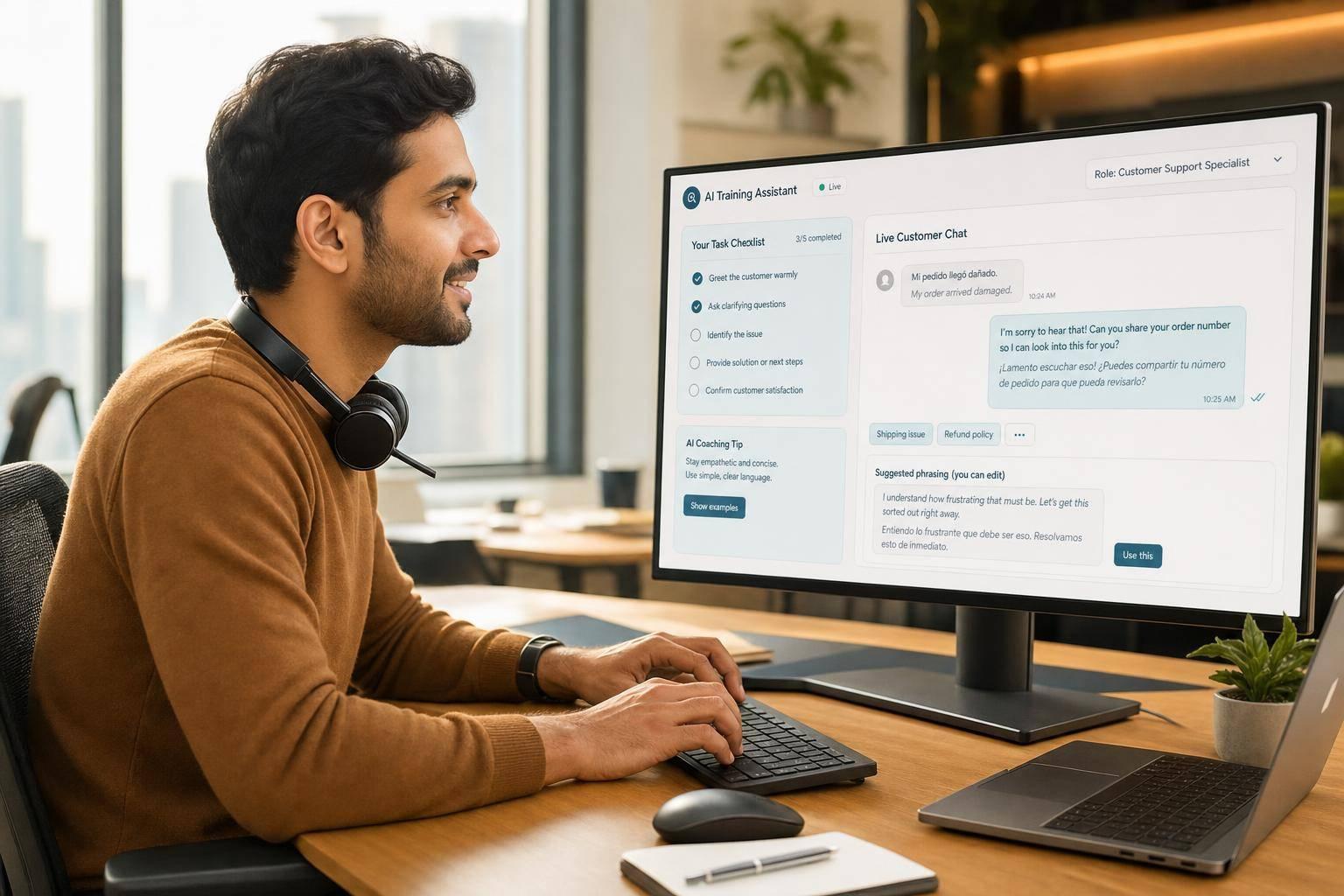
How personalized AI language training can help HR and L&D teams improve employee communication, workplace confidence, and measurable business outcomes.
For HR and L&D leaders managing multilingual teams, providing language training is only part of the challenge. The bigger question is whether employees can actually use that language confidently in the situations their jobs require.
Generic business French or business English courses often struggle to make that connection. Employees may complete lessons and improve test scores without necessarily becoming more comfortable leading meetings, explaining technical information, speaking with customers, or collaborating with colleagues in another language.
AI-powered workplace language training takes a different approach. Training can be personalized around an employee's role, proficiency level, first language, and daily communication tasks. Instead of practising broad language topics, employees can prepare for the conversations they actually need to handle at work.
For Canadian HR and L&D teams, this is particularly relevant for organizations operating across English and French, and for Quebec employers managing language-learning and Bill 96-related requirements.
A few findings illustrate the opportunity:
-
More than 50% of second-language employees say missing job-specific vocabulary is their main communication barrier.
-
In one GSK Canada pilot, 100% of participants said they felt more confident speaking French.
-
90% reported better collaboration across sites.
-
70% said they used more French at work.
For HR and L&D leaders, the takeaway is straightforward:
-
start with job tasks, not generic language lessons
-
use CEFR-based placement so employees begin at the appropriate level
-
track speaking performance and workplace application, not only test scores
-
build reporting processes around relevant Bill 96 and OQLF requirements where applicable
-
connect training outcomes to business priorities such as onboarding, employee participation, collaboration, and client communication
This guide explains how AI workplace language training works, how HR and L&D teams can roll it out, what to consider when evaluating solutions, and how to measure whether training is improving performance on the job.
The Future of Workplace Inclusion: AI, Language Barriers, and Cultural Connection
sbb-itb-7df369b
How Does AI Workplace Language Training Work?
Personalized AI language training starts by understanding the learner. A system can build an employee learning profile using factors such as:
-
current language proficiency
-
job function
-
first language
-
workplace communication needs
-
previous performance
The training experience can then change as the employee progresses rather than following the same fixed curriculum for everyone.
Using Learner Data to Personalize Employee Training
An accurate placement assessment aligned with the Common European Framework of Reference (CEFR) helps establish an appropriate starting point. From there, the system can identify recurring challenges with areas such as pronunciation, grammar, vocabulary, or formality and adjust future practice accordingly.
For L&D teams, this reduces the need to place employees into broad training categories that may not reflect what they actually need at work.
| Input Signal | How Training Adapts | Potential Workplace Benefit |
|---|---|---|
| Role / Function | Selects role-specific scenarios and job vocabulary (for example, nurses practise medical terms; engineers discuss technical specs) | Makes practice more relevant to daily responsibilities |
| Current Proficiency (CEFR) | Sets and adjusts difficulty | Reduces time spent on material that is too easy or too difficult |
| Past Performance | Identifies recurring gaps in pronunciation, grammar, or communication | Focuses practice on areas where the employee still needs support |
| Workplace Tasks | Generates scenarios based on meetings, presentations, onboarding, client conversations, and other responsibilities | Helps employees prepare for situations they encounter on the job |
That adaptability is one of the main differences between personalized AI training and a fixed language curriculum. The learning path changes based on what the employee demonstrates during practice.
Creating More Realistic Speaking Practice
AI-powered speech analysis can provide immediate feedback during speaking practice, including areas such as pronunciation, grammar, fluency, and delivery. Conversational AI can also act as a counterpart during role-specific simulations and adjust the conversation based on the learner's level.
For example, employees could practise:
-
giving a project update
-
explaining a technical issue
-
onboarding a new colleague
-
speaking with a customer
-
leading a team meeting
-
delivering a safety briefing
Generative AI can also turn approved company materials, including websites, presentations, and other business content, into learning activities matched to an employee's proficiency level.
The goal is to shorten the distance between learning the language and using it effectively at work.
How HR and L&D Teams Can Personalize Language Training by Role
One of the most important changes HR and L&D teams can make is starting with what employees need to do in another language rather than simply defining which language they need to study.
Map Communication Tasks to Job Performance
Start by identifying the communication moments where language barriers are most likely to affect performance. Depending on the role, that could include:
-
nurses completing patient handoffs
-
engineers explaining technical specifications
-
managers leading team meetings
-
account managers providing client updates
-
employees presenting project results
-
new hires communicating with colleagues during onboarding
From there, create clear can-do outcomes tied to those responsibilities. Instead of setting a broad objective such as "improve workplace French," an L&D team could define a goal such as:
Lead a weekly team huddle in French without switching languages.
Or:
Deliver a safety briefing in French using the required workplace terminology.
Clearer goals make the training more relevant for employees and give HR and L&D teams something meaningful to measure.
In a 2024–2026 GSK Canada pilot, 100% of participants said they felt more confident speaking French after role-tailored AI practice, while 70% reported using more French at work. The important distinction is that the program measured more than whether employees were completing lessons. It looked at whether they were becoming more comfortable using the language in their workplace.
Support Multilingual Teams More Effectively
Effective employee language training should also consider the learner's first language. Different first-language backgrounds can create different pronunciation, vocabulary, grammar, or communication challenges.
AI training that accounts for those differences can personalize feedback more precisely instead of giving every employee the same learning path. For organizations with multilingual workforces, that allows L&D teams to provide personalized learning at a scale that would be difficult to achieve through a completely manual program.
AI vs. Traditional Workplace Language Training
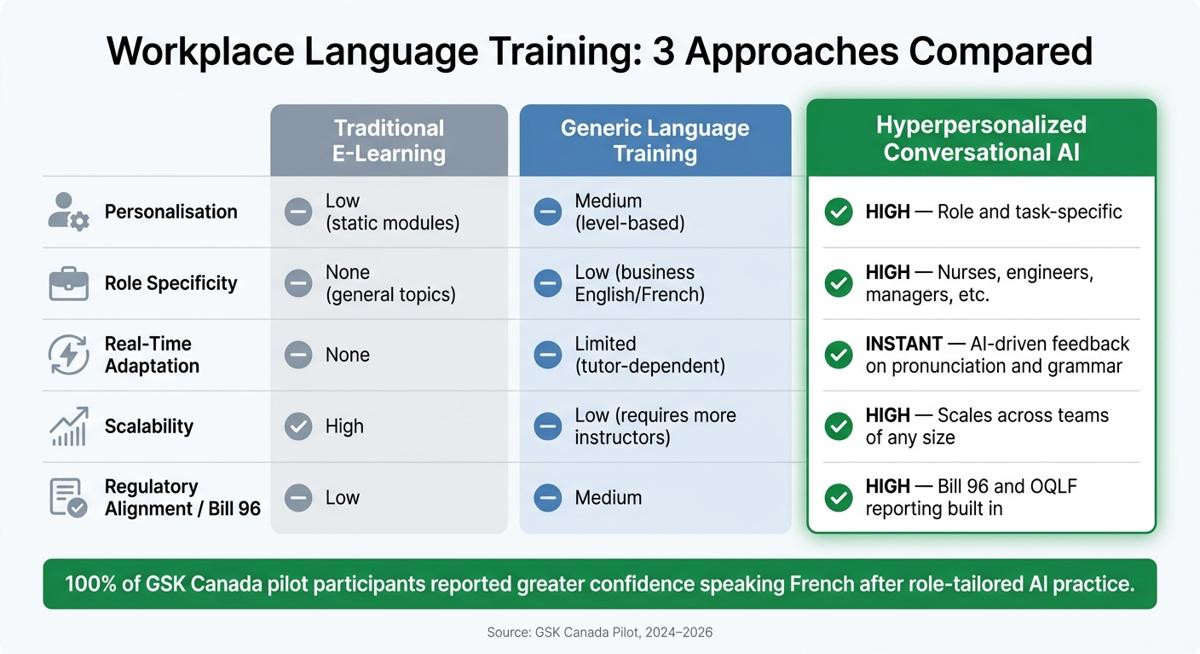
HR and L&D teams evaluating language-learning options generally have several approaches available. The difference becomes clearer when AI and traditional language training are compared side by side.
| Feature | Traditional E-Learning | Generic Language Training | Personalized Conversational AI |
|---|---|---|---|
| Personalization | Low; static modules | Moderate; often level-based | High; can adapt by role, task, level, and performance |
| Role Specificity | Usually limited | Often based on broad business language | Can focus on job-specific situations and vocabulary |
| Real-Time Adaptation | Limited | Depends on instructor availability | Can adjust immediately based on learner performance |
| Speaking Practice | Often limited | Available during scheduled instruction | Can be available on demand |
| Scalability | High | More dependent on instructor capacity | Can scale across larger employee populations |
| Reporting | Usually completion-focused | Varies by provider | Can include proficiency, activity, and task-based progress |
The strongest option will depend on the organization. AI does not necessarily need to replace instructors or existing L&D programs. It can also provide employees with more opportunities to practise speaking between live sessions.
For HR teams, the key question is whether the training model can provide the relevance, accessibility, reporting, and scalability the organization needs. If you are building a shortlist, our comparison of corporate language learning platforms breaks down how the main options are priced and where each one fits.
How to Roll Out AI Language Training Across Your Organization
Introducing a new training platform across an entire workforce immediately can make it difficult to understand what is actually working. A focused pilot gives L&D teams a clearer starting point.
Start With a Pilot and Clear Business Goals
Start with one employee group + one communication need + a small number of measurable outcomes.
For example, an organization could pilot French language training for employees with an engineering team that regularly collaborates with French-speaking colleagues. Instead of measuring only course completion, the organization might track whether employees become more comfortable:
-
participating in bilingual meetings
-
explaining technical information
-
asking follow-up questions
-
presenting project updates in French
Before launching a workplace language program, HR and L&D teams should agree on one or two business outcomes they want the pilot to influence. Connecting learning goals to day-to-day work also makes it easier to explain the value of the program when budget discussions begin, and gives L&D teams clearer evidence to defend and expand training budgets.
Make Training Easy to Fit Into the Workday
Accessibility also matters. Employees are less likely to participate consistently if language training requires them to regularly block large portions of their schedule.
Shorter practice sessions available through desktop or mobile devices can make training easier to fit around normal work responsibilities. For L&D teams, this can help reduce one of the biggest barriers to employee development programs, and one of the most common causes of low training adoption: finding enough time for employees to participate.
Privacy, Fairness, and Compliance in Canadian Workplace Training
Privacy, fairness, and transparency should be considered before introducing any AI training platform. For language learning in particular, organizations should understand how the system evaluates different accents and non-native speech patterns.
If speech-recognition technology consistently misunderstands certain speakers, employees can receive inaccurate feedback and lose confidence in the platform.
HR and L&D teams should therefore ask vendors how speaking data is evaluated, how employee information is handled, and what safeguards are in place around AI-generated feedback.
Supporting Quebec Language Training Requirements
For organizations operating in Quebec, Bill 96 support may also be part of the evaluation process.
Training systems that track employee practice time and progress can make it easier for organizations to maintain the information required for their internal language-learning and francisation processes.
HR teams should determine what information their organization needs to collect and whether the learning platform can support that reporting workflow.
Integrating Language Training With Your LMS or HRIS
Once a pilot grows into a broader rollout, HR and L&D leaders need visibility. Managers should be able to understand more than how many minutes employees spent inside the platform.
Useful reporting can include:
-
participation
-
proficiency progression
-
scenario completion
-
speaking performance
-
role-specific skill development
-
workplace communication outcomes
CEFR scores remain useful, but they do not tell the entire story. An employee can improve a proficiency score while still feeling uncomfortable speaking during a live meeting or customer interaction. Task-based performance data can provide a more complete picture of whether training is translating into everyday work.
For organizations already using HR technology, LMS or HRIS integrations can also reduce administrative work by allowing learning data to connect with the systems HR and L&D teams already check.
Where Conversaflex Fits
Conversaflex is built for workplace English and French language training, with an emphasis on speaking practice for Canadian organizations. Employees practise conversations based on their role, proficiency level, and language background while receiving feedback during speaking activities.
For HR and L&D teams, this means:
-
Role-specific training that can be assigned by team, function, or language need instead of a single generic curriculum
-
Admin visibility into participation, speaking practice, and progress across departments
-
Reporting that covers proficiency progression and workplace-focused outcomes, not only completion rates
-
Scalability from a pilot team to a company-wide rollout without adding instructor capacity for every new group
-
Lower administrative workload, since practice time and progress are tracked automatically rather than collected manually
For organizations managing Quebec language requirements, Conversaflex can also track employee practice and progress to support internal reporting processes.
The goal is not simply to help employees complete more language lessons. It is to give them more opportunities to practise the conversations they need to have at work.
How to Measure the ROI of Workplace Language Training
Once a program is running, the most important question for HR and L&D teams becomes: is the training changing anything at work?
Training metrics generally fall into two categories.
1. Learning and Engagement Signals
These help determine whether employees are participating and developing skills. Examples include:
-
participation rates
-
scenario completion
-
pronunciation progress
-
vocabulary development
-
CEFR progression
-
speaking practice frequency
These metrics matter, but they should not be the end of the measurement strategy.
2. Workplace and Business Outcomes
The next step is evaluating whether employees are applying those skills. That can include:
-
increased second-language participation in meetings
-
greater confidence during workplace conversations
-
faster onboarding
-
improved collaboration across bilingual teams
-
increased internal mobility
-
clearer customer communication
-
fewer communication barriers during important job tasks
For Quebec-based organizations, measurement may also include French learning hours, language progress, and relevant francisation reporting information.
A simple scorecard can keep learning outcomes connected to business priorities.
| Metric Category | What to Track | Why It Matters |
|---|---|---|
| Learner Progress | Scenario completion, pronunciation development, vocabulary mastery | Shows whether employees are developing relevant skills |
| Workplace Application | Second-language use in meetings, handoffs, reports, and client conversations | Shows whether learning is transferring into daily work |
| Business Outcomes | Onboarding, collaboration, internal mobility, customer experience | Helps connect training with organizational priorities |
| Reporting & Compliance | Learning hours, language progress, relevant francisation information | Supports organizational reporting requirements |
Use a Before-and-After Measurement Framework
The easiest way to demonstrate progress is to establish a baseline before training begins. If the organization waits until halfway through a pilot to decide what success means, proving impact becomes much harder.
Choose the metrics first and measure the same outcomes after the pilot. For example:
| Before Training | After Training |
|---|---|
| Employees rarely speak French during team meetings | Employees participate more frequently in French |
| Technical vocabulary creates communication delays | Employees demonstrate stronger role-specific vocabulary |
| Employees avoid customer conversations in their second language | Employees report greater confidence handling those conversations |
| HR sees only course completion | L&D can also track speaking practice and workplace-focused progress |
This creates a clearer story for employees, managers, HR leadership, and anyone responsible for approving future L&D investment.
Key Takeaways for HR and L&D Leaders
Effective workplace language training should start with the job rather than the lesson. The main question is not simply:
What language do our employees need to learn?
It is:
What do our employees need to be able to do in that language?
From there, HR and L&D teams can build training around specific roles, real workplace conversations, employee proficiency, and measurable business goals.
For Canadian organizations, that can mean supporting communication across multilingual teams, strengthening English or French speaking confidence, and accounting for Quebec language requirements where relevant.
AI makes it possible to provide more personalized speaking practice across larger employee populations, but the technology itself should not be the goal. The goal should be better workplace communication.
Set the workplace outcome first. Build the training around it. Then measure whether employee behaviour changes.
Looking to build a more personalized workplace language training program for your team? Conversaflex helps HR and L&D teams provide role-specific English and French speaking practice while tracking employee progress and workplace-focused learning outcomes. Try a free 5-minute conversation with the AI tutor, or talk to our team about a pilot.
FAQs
How is AI workplace language training different from standard corporate language training?
Standard corporate language training often relies on fixed, generic courses and rigid schedules. The problem is simple: that setup often doesn't line up with what employees need at work.
Conversaflex takes a different path. It uses personalized AI to deliver fully vocal, job-specific conversations that shift in real time based on each employee's role, industry, and CEFR level.
That means a sales rep, a nurse, and a hotel manager don't get the same one-size-fits-all lesson. Each person gets practice that fits the way they actually speak on the job.
It also gives employees 24/7 practice, plus immediate pronunciation and grammar feedback. So instead of waiting for the next class or instructor review, they can practise when it suits them and fix mistakes on the spot.
What should HR and L&D teams measure in a pilot?
Measure success with job-related language skills, not just training hours. Start with a placement test to set a clear baseline. Then track progress with dashboards that show practice and growth in work-specific situations.
What matters most is whether employees can do the job in English or French when it counts. Can they lead meetings? Write reports on their own? Handle role-specific conversations without getting stuck?
That's the standard worth tracking.
How does workplace language training support Bill 96 reporting?
Conversaflex supports Bill 96 reporting with centralized admin dashboards that provide OQLF-aligned francisation reports.
It also tracks employee training hours automatically and generates the compliance documents organizations need under Quebec's language law. That makes it easier for businesses to keep accurate records of their language training efforts in one place, right inside the platform.



![Cover Image for Corporate Language Training Costs: Conversaflex vs. Tutors, Classes and Apps [2026]](/_next/image?url=%2Fassets%2Fimages%2Fblog%2F68b2425f68bb5e38327dcb5b-1756542781388.jpg&w=3840&q=75)
![Cover Image for Workplace French Training in Canada: Formats, Costs and Funding [Guide 2026]](/_next/image?url=%2Fassets%2Fimages%2Fblog%2Fworkplace-french-training-canada-2026.jpg&w=3840&q=75)