Why AI Still Struggles With French at Work
French is 1–3% of AI training data, costs up to 58% more to process, and accents double speech errors. What 2024–2026 research shows, and what to ask vendors.
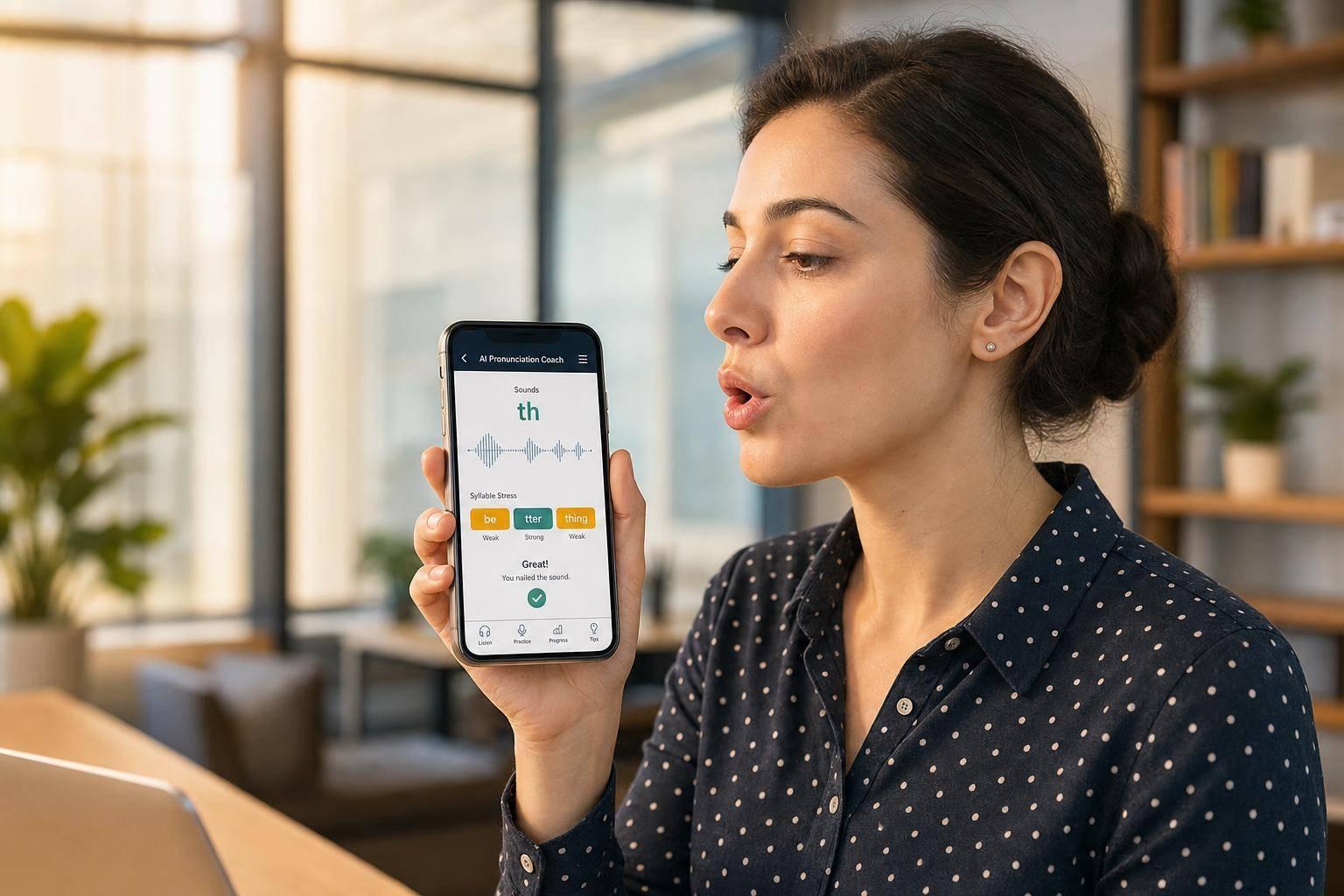
A learner reads one sentence aloud: « Il est crucial de respecter les délais impartis pour livrer ce projet client à temps et sans retard. » Her French is nearly perfect. Three commercial speech-to-text engines hear something else. The first spells out letters. The second hears "Impact Forever". The third writes « LE CRUCIAL DE RESPECTFULLY DE L'IMPACTE FOREVER S'IL-VOUS-PLAÎT ».
She got almost everything right. The machines didn't.
That recording comes from our own review of learner speech, and it isn't a one-off. Research published from 2024 to 2026 points the same way: generative AI learns mostly in English, French costs more to run, and speech recognition is weakest on accented, hesitant and specialized French. That is exactly the French employees speak at work while they are learning it.
What the research shows:
- French is a thin slice of the training data. For recent models it is estimated at 1% to 3% of training text, and the large labs no longer publish the figure.
- French costs more to process. The same request takes 31% to 58% more tokens in French than in English, depending on the model, and AI is billed by the token.
- Big models have nearly caught up in standard French. Small models and Quebec French have not. In a 2026 Université Laval study, two-thirds of 111 models understood Quebec idioms less well than idioms from France.
- Accents still double transcription errors. On the same kind of podcast audio, OpenAI's GPT-4o-transcribe made about 8% errors on French from France, 14% on Canadian French and 17% on West African French.
- Speech engines "fix" learners. Transcription built for clean output smooths away the mistakes and hesitations a tutor needs to hear, and many of the words it gets wrong are work vocabulary.
AI learns mostly in English
Large language models learn from text, and most of that text is English. How much French goes in is now hard to know. OpenAI's GPT-6 Astra system card (September 2026) describes only "diverse datasets". Google's Gemini 4 model card (October 2026) lists types of data but not languages. Mistral's public summary of training content for Mistral Large 4, required under the EU AI Act, says only that the data is multilingual.
Researchers can still estimate it. A tokenizer, the component that splits text into pieces, is trained on a sample of the model's data, and its vocabulary gives the mix away (Hayase et al., NeurIPS 2024). Put those estimates next to the open models that publish their data, and the picture is consistent:
| Model or corpus | Share of French |
|---|---|
| Google Gemini, estimated from the tokenizer it shares with Gemma | 3.0% |
| OpenAI GPT-4o and later models, estimated from their tokenizer | 2.9% |
| SmolLM3, Hugging Face, 2025 | 1.6% |
| FineWeb, the largest open web corpus, 2025 | 1.3% |
| Nemotron-4, NVIDIA, 2024 | 0.6% |
| For contrast: Salamandra, Spain, 2025 | 6.6% |
| For contrast: Lucie-7B, France, 2025 | 32% |
The estimates for OpenAI and Google are a hint, not a disclosure. Still, the direction is clear. English makes up about 70% of SmolLM3's data and 78% of FineWeb. The raw web is 4.7% French (Common Crawl, September 2026), and 396 million people speak French (OIF, 2026).
It is improving. Llama 2, released in 2023, was 0.16% French, ten times less than SmolLM3. But quantity alone doesn't solve the problem: Lucie-7B, trained on 32% French, scores 10% on Quebec idioms, barely better than chance (9.9%). More on that below.
French costs more: the language tax
AI models read and bill text in tokens. A tokenizer built mostly from English splits French words into more pieces, so the same request costs more. A September 2026 preprint measured the ratio for the main tokenizers (Serval, "The Invisible Language Tax"):
| Tokenizer | French tokens for each English token |
|---|---|
| Mistral (Tekken) | 1.31× |
| OpenAI (o200k) | 1.36× |
| Google (Gemma 3) | 1.41× |
| Anthropic (Claude) | 1.45× |
| DeepSeek | 1.55× |
| Qwen3 | 1.56× |
| Meta (Llama 3) | 1.58× |
In plain terms, $100 of AI processing in English costs $131 to $158 in French. More tokens also mean more latency, a context window that fills faster, and long-context price tiers that kick in sooner.
This is improving too. OpenAI's GPT-4 tokenizer needed 1.60 times as many tokens for French as for English (Petrov et al., 2023). The o200k tokenizer used by GPT-4o and later models needs 1.36. A tokenizer designed for French does better still: the study's prototype uses 11.5% fewer tokens than Mistral's. The study is a single-author preprint, and it doesn't cover Quebec French.
Big models nearly caught up. Small models and Quebec French didn't
On standard French, the best models are now close to their English scores. Artificial Analysis has Gemini 3 Pro at 93.7 in English and 93.4 in French. The gap opens in two places.
Smaller models lose more. OpenAI's last published French-versus-English comparison, for the GPT-4.1 family in April 2025, shows the drop growing as the model shrinks (simple-evals):
| Model | French score as a share of the English score |
|---|---|
| GPT-4.1 | 96.5% |
| GPT-4.1 mini | 95.4% |
| GPT-4.1 nano | 92.3% |
That matters for voice. An assistant that has to answer out loud within a few seconds usually runs on a faster, smaller model. Vendors have also stopped publishing French-versus-English results for their newest models, so this is the most recent clean comparison.
Quebec French loses more. Researchers at Université Laval tested how well models understand idioms from Quebec compared with idioms from France (ACL 2026 Findings). Of 111 models, 66% understood Quebec idioms less well, and 9% understood them better. The best models manage it: Claude Opus 4.1 scored 95.4% on Quebec idioms. Smaller models fall further:
| Model family | Large model, Quebec idioms | Small model, Quebec idioms |
|---|---|---|
| OpenAI: GPT-5 and GPT-5-mini | 88% | 77% |
| Anthropic: Claude Opus 4.1 and Haiku 4.5 | 95% | 87% |
| Google: Gemini 2.5 Pro and Flash | 91% | 88% |
GPT-5 loses 9.7 points going from France idioms to Quebec idioms. GPT-5-mini loses 17.2.
The everyday version of this is the autocorrect that turns « je suis tanné » (I'm fed up) into « talentueux » (talented), an example from OBVIA in January 2026.
Is a French model better at Quebec French? Not automatically. Mistral has the cheapest tokenizer for French, but in the Laval study it scored 97% on France idioms and 84% on Quebec idioms, a drop of 12.5 points, against 3.6 for Claude Opus 4.1. On Quebec grammar it is among the best (90.2%), so the gap is in expressions. Models trained mostly on French, such as Lucie, Croissant and Chocolatine, scored 10% to 11% on Quebec idioms, barely above chance. Being French doesn't make a model Québécois. The Mistral version tested probably dates from late 2024, and no results are published yet for Mistral Large 4.
Speech recognition: seven hours of English for each hour of French
Voice adds a second layer. Open speech models publish their training hours, and the imbalance is shrinking:
| Speech model | Hours of English for each hour of French |
|---|---|
| OpenAI Whisper (2022) | 45 |
| OWSM v3.1 (2024) | 29 |
| OWSM v4 (2025) | 8.7 |
| NVIDIA Canary (2025) | 6.9 |
On the standard FLEURS benchmark, French produced about twice as many errors as English in 2022. Today Whisper large-v3 makes 4.0% errors in English and 5.6% in French, and Mistral's Voxtral Mini Transcribe 2 makes 3.3% and 4.3%.
Three caveats. Canary covers only 25 European languages, which inflates the share of French. Closed models such as GPT-4o, Gemini and Voxtral don't publish their hours by language. And none of these corpora counts Quebec French: the Centre de recherche informatique de Montréal (CRIM) estimates it at under 5% of the French hours in Mozilla's Common Voice.
More data is also no longer enough on its own. In 2025, the amount of training data explained only about half of the difference in error rates between languages (OWLS). The real problem is no longer standard French. It's accent.
Accent still doubles the errors
A 2026 Interspeech study kept everything constant except the speaker's dialect: the same kind of podcast audio and the same transcription rules (Nieto et al.). GPT-4o-transcribe made about 8% errors on French from France, 14% on Canadian French and 17% on French from Senegal and Côte d'Ivoire. Whisper large-v3 went from 4.3% on French from France to 6.4% on Canadian French, and the words it dropped most often in Canadian French were everyday markers: « puis », « ben » and « sais ».
The pattern holds elsewhere:
- Standard benchmarks don't predict Quebec results. On spontaneous Quebec French, gpt-4o, the best model on FLEURS, ranked fifth of nine (CRIM, 2025, preprint).
- Second-language speakers fare worse. Even the best systems of 2026 make 1.5 to 2 times more errors on non-native English (Hume AI, July 2026, preprint).
- Learners fare worst. With children learning French, Whisper made 33% errors, against about 5% on the usual benchmarks (Verhelst and Belpaeme, HRI 2025).
- Bigger models don't close the gap by themselves. A study of 16 English speech systems released from 2021 to 2025 found the gap between mainstream US English and minority accents "stubborn, not reliably declining" (Metzger et al., October 2026, preprint).
To be fair to the engines, current systems do well on short sentences read aloud, with 2% to 4% errors (WildASR, 2026, preprint). The gap opens on spontaneous speech, which is how learners talk. We also found no published study that tests current transcription models on adults learning French. That is a gap in the research.
What it sounds like with real learners
In June 2026, we compared three commercial transcription engines on more than 20,000 real learner utterances, recorded with consent. The engines strongly disagreed on 48% of them. When three engines produce three different sentences, at least two of them are wrong.
| What the learner said | What an engine heard |
|---|---|
| « J'aimerais réserver la salle de réunion numéro 3 pour notre session de formation de deux heures jeudi matin. » | « January reserved La Salle, the union number to a four note, session deformation, diddou, or Jody Martin. » |
| « Nous discutons du plan de développement du nouveau médicament. » | « New plan. » |
| échantillons (samples) | « chantiers », « châteaux » |
| médicament (drug) | « américain » |
| fournisseurs (suppliers) | « furniture » |
| serveur (server) | « sauveur » |
| fiable (reliable) | « firewall » |
| essai clinique (clinical trial) | « la sait clinique » |
| « Le problème avec l'emballage est réglé maintenant. » | « The problem of AI. » |
Look at which words fail. A general engine fills gaps with the words it has seen most often. « Échantillons » is rare in its data, « chantiers » isn't. The vocabulary a company needs most is where general-purpose AI is weakest.
Workplaces in Quebec and across Canada are bilingual, so learners also switch languages mid-sentence. « J'ai déjà préparé le report » became « l'offre » for two engines and « l'ordinateur » for the third. One engine answered in English on 3.9% of sentences that were clearly French. Switching languages is normal at work, and a tutor needs to see it, not erase it.
Why a "perfect" transcript is a problem for learners
Mainstream speech recognition is built to recover what you meant. A tutor needs to know what you said.
- Whisper changed young learners' "have" to "has" 23.1% of the time, against 1.5% for a model trained on learner speech (Michot et al., ACL 2024).
- By default, Whisper keeps only 2.5% of filler words such as "um" (McGuire, April 2026), and 2% to 7% of hesitations in second-language English conversations (Husain et al., 2026, preprint).
- Recent models even finish sentences the speaker never finished: "no I can" becomes "no I can't" (WildASR, 2026).
We see the same thing in French. A learner said « Le suivi configuré fonction bien », and two engines wrote « fonctionne ». Another said « Quand les results… », and an engine wrote « résultats ». For a subtitler, that smoothing is a feature. For a tutor, it's a bug: if the machine corrects the mistake, the learner never sees it, and the feedback can't address it.
Do GPT-4o-transcribe or Gemini correct learners' grammar the same way? No published study has measured it yet. Michot's 2024 paper remains the only direct measurement.
What it takes to fix it
Data from people who are learning. The large Quebec speech corpora released recently, CommissionsQC (CRIM, more than 1,000 hours) and CEREALES (UQAM, more than 600 hours), are native speech. They help with accent, but the training data is dominated by native speakers, while a learning product is used by learners.
Synthetic speech helps, but doesn't replace real speech. CRIM tested synthetic Quebec French for training a speech recognizer (Perrin and Boulianne, 2025, preprint). Lower is better:
| Training data | Word error rate |
|---|---|
| 72.7 hours of real speech | 13.6% |
| 90 hours of synthetic speech only | 26.9% |
| 10 hours of real speech only | 80.8% |
| 10 hours of real speech and 710 hours of synthetic speech | 22.8% |
Synthetic data fills a gap when real data is scarce, but it doesn't match real speech. Training carelessly on generated content causes "irreversible defects" and erases the tails of the distribution (Shumailov et al., Nature, 2024), and rare accents live in those tails. Keeping the real data alongside the synthetic data avoids that collapse (Gerstgrasser et al., 2024). Accumulate, don't replace.
Synthetic speech has small traps of its own. In our tests, a synthetic voice asked to read the single word « tu » often said the English "two": it got it right only 5 times out of 12 on its own, and 12 times out of 12 inside the phrase « Le mot : tu. »
Context. A teacher who knows a learner speaks Spanish and works in pharma hears that learner better. Commercial engines get the audio alone. A tutor can give the transcriber the question it just asked, the learner's first language and target language, and the vocabulary of their job, and ask it to keep mistakes, hesitations and language switches word for word.
Not penalizing Quebec French. We had to fix this in our own product. Our AI rated native Quebec speakers at A2 or B1 instead of C1 or C2, until we told it, in November 2025, that « j'suis », « y'a », « t'sais », « chu » and « pis » are normal spoken French, not errors. A broader problem remains: commercial pronunciation-scoring engines rarely support Canadian French, so a learner can hear a Quebec voice and then be scored against the pronunciation of France.
Testing on real learners. Benchmarks such as FLEURS use clear, read speech. A tool for employees who are learning French should be tested on employees who are learning French.
Voice recordings under Law 25
A recorded voice is personal information, and a tutor that learns from recordings touches several parts of Quebec's private-sector privacy act, as amended by Law 25. This is our reading, not legal advice:
| Section | What it requires | What it means for a voice tutor |
|---|---|---|
| 12 | Consent to use personal information for a purpose other than the one it was collected for, with limited exceptions, and express consent for sensitive information, which includes biometric information | Consent before recordings are used to train models, unless an exception applies |
| 17 | A privacy impact assessment before personal information is communicated outside Quebec | An assessment for each AI provider that processes data outside Quebec |
| 8.1 | Informing people when a technology can profile them, which includes analysing their work performance | Progress reports shared with the employer |
| 12.1 | Informing people of a decision based exclusively on automated processing | A level assigned by AI, if it decides something |
| 23 | Anonymizing means irreversibly | Pseudonymized recordings are still personal information |
Transcribing speech is not the same as identifying someone. But if a voice is used to identify or verify a person, it becomes biometric information, with stricter consent rules and a declaration to the Commission d'accès à l'information, and the Commission reads biometrics broadly. Penalties go up to $10 million or 2% of worldwide turnover for administrative penalties, and up to $25 million or 4% for penal fines.
Where data is stored isn't where the model runs. Hosting in Canada answers one question. Where the AI processes the data, known as inference, is another: some AI models aren't yet offered in Canadian cloud regions, so a request can leave the country even when the database doesn't. Who runs the cloud matters too. In June 2025, a French Senate inquiry asked Microsoft France, under oath, whether it could guarantee that French citizens' data held through the state's purchasing agency would never be handed to US authorities under a US injunction without France's explicit agreement. The answer: « Non, je ne peux pas le garantir », adding that it had never happened (Senate record). In August 2025, Ottawa's call for interest for a sovereign public cloud excluded providers subject to foreign laws that allow access to data without Canada's consent.
Quebec is building some of the missing pieces. Cohere and Mila are working together on Quebec French (May 2026), the Quebec government signed an exploratory agreement with Mistral (June 2026), and BAnQ is assembling a cultural databank for AI.
What this means for employers
Language barriers have a cost. In a randomized study of 27 multinationals, managers lost a third of their meeting time to them, and a 48-hour course made their teams 15% faster at a test task (our summary of the study). An AI tool that mishears learners adds to that cost instead of reducing it. Before you buy one, ask:
- Have you tested it on people like ours? Use your employees' accents, your jargon and their real mistakes. Results on FLEURS or other public benchmarks don't predict Quebec French or learner speech.
- Does it transcribe what was said, or what was meant? A tool that silently fixes mistakes can't give feedback on them.
- How does it handle our industry's vocabulary? General engines fail first on job-specific words.
- Which French does it score pronunciation against? The reference should match the workplace. For a team in Montreal or Saguenay, scoring against Paris is the wrong yardstick.
- Where is the data stored, and where does the model run? Those are two different answers, and Law 25 cares about both.
- Who can hear the recordings, and are they used for training? Consent should be explicit, and employees should know what their employer sees.
Where Conversaflex fits
Conversaflex is an AI conversation practice platform for French, English and Spanish at work. Employees speak out loud with Madame AI, an AI language tutor that adapts to their level, their first language and their field, in scenarios built around the meetings, calls and presentations they actually face. We built it around the problems in this article: it is designed to transcribe what the learner said, mistakes and hesitations included, so it can give feedback on them; it treats Quebec spoken forms as normal French; and it practises the vocabulary of each learner's job.
It is not a teacher and is not meant to replace one. Our page on French training for work explains how teams use it, and you can try a limited version yourself.
Frequently asked questions
Does AI understand Quebec French?
Better than it used to, but less well than French from France. In a 2026 Université Laval study, 66% of 111 language models understood Quebec idioms less well than idioms from France. The largest models come close (Claude Opus 4.1 scored 95.4% on Quebec idioms), but smaller models drop further, and models trained mostly on French from France scored barely above chance. Speech recognition shows the same pattern: GPT-4o-transcribe made about 14% errors on Canadian French, against about 8% on French from France.
How much of AI training data is in French?
Roughly 1% to 3% for recent models, based on published training mixes and on estimates drawn from tokenizers. English still makes up about 70% to 80% of open training corpora. OpenAI, Google, Anthropic and Mistral no longer publish the share of each language.
Why does using AI in French cost more?
AI is billed by the token, and tokenizers built mostly from English split French into more pieces. A 2026 preprint found that French needs 1.31 to 1.58 times as many tokens as English, depending on the tokenizer, so $100 of processing in English costs $131 to $158 in French. More tokens also add latency and fill the model's context window faster.
Is speech recognition accurate for people learning French?
Not reliably yet. Errors roughly double with accents and spontaneous speech, and learners are hit hardest: with children learning French, Whisper made 33% errors, against about 5% on standard benchmarks. Mainstream engines also tend to correct learners' mistakes and drop their hesitations, which hides what a learner needs to work on. No published study yet tests current models on adults learning French.
Is a voice recording personal information under Law 25?
Yes. A recording of an identifiable person's voice is personal information under Quebec's private-sector privacy law. Using it for a new purpose, such as training an AI model, generally requires consent, and communicating it outside Quebec requires a privacy impact assessment first. If the voice is used to identify or verify someone, it becomes biometric information, with stricter rules. This is a general reading, not legal advice.
Figures were checked in October 2026, and preprints, which have not yet been peer reviewed, are marked as such. The learner examples come from Conversaflex's internal review of recordings made with learners' consent; the engines are not named because the point is the pattern, not the vendor.