
TCF Speaking Test Format Explained: Structure, Sample Questions & Free AI Practice [2026]
Clear guide to TCF Canada speaking: 3 tasks, timing, scoring, sample prompts and a 7-day AI practice plan to target B2.
![Cover Image for TCF Speaking Test Format Explained: Structure, Sample Questions & Free AI Practice [2026]](/_next/image?url=%2Fassets%2Fimages%2Fblog%2F6a791d2cd642d19a97928472-1786328527129.jpg&w=3840&q=75)
TCF Speaking Test Format Explained: Structure, Sample Questions & Free AI Practice [2026]
If you want a strong TCF Canada speaking score, you need to train for the format, not just your French.
I’d boil the test down like this: you get 3 speaking tasks in about 12 minutes, you need to switch your speaking style for each one, and many people aiming for Canada want around NCLC 7 / CEFR B2. That means I’d focus on short personal answers for Task 1, leading the exchange in Task 2, and giving a clear opinion with reasons in Task 3.
Here’s the article in one quick view:
- Task 1: short interview about you
- Task 2: role-play where you ask questions and move things forward
- Task 3: opinion answer with reasons, an example, and a short closing
- Scoring: examiners look at grammar, vocabulary, fluency, pronunciation, and whether you answer the task properly
- Practice plan: short daily drills, then a full timed mock
- Target level: B2 is often the level many test takers in Canada aim for
Quick comparison
| Task | What you do | Time | Main thing to watch |
|---|---|---|---|
| Task 1 | Answer personal questions | ~2 min | Keep answers clear and connected |
| Task 2 | Handle a role-play | ~3 min 30 sec | Lead the conversation yourself |
| Task 3 | Give your opinion | ~4 min 30 sec | Organize ideas and support them |
A simple way to think about it: this is not just a French chat. It is a short oral test with rules, timing, and scoring points. If I were preparing, I’d practise under the clock from day one.
TCF Canada Speaking Mock Test 2026 | Real Exam Simulation + Examiner Feedback

2026 TCF Canada Speaking Format: 3 Tasks, Timing, and Candidate Instructions
The TCF Canada speaking section includes three tasks and lasts about 12 minutes, including 2 minutes of prep time for Task 2. Depending on the test centre, you may take it in person or through an approved webcam setup. These task types shape the sample prompts and AI practice exercises that follow.
| Task | Type | Prep Time | Speaking Time | Who Leads? |
|---|---|---|---|---|
| Task 1 | Guided interview | None | ~2 minutes | Examiner |
| Task 2 | Role-play | 2 minutes | ~3 minutes 30 seconds | Candidate |
| Task 3 | Opinion task | None | ~4 minutes 30 seconds | Candidate |
Use this breakdown to match your answer style to each task.
Task 1: Guided interview on personal and everyday topics
Task 1 lasts about 2 minutes and gives you no prep time. The examiner asks open-ended questions about your background, work, studies, hobbies, and future plans. Your job is to answer clearly and with enough detail to keep the exchange moving. Aim for natural interaction and pronunciation that the examiner can follow without strain.
Task 2: Role-play where the candidate leads the exchange
Task 2 gives you 2 minutes to prepare, followed by about 3 minutes 30 seconds of speaking time. Here, you lead a simulated everyday interaction. You might need to ask for information, book a service, negotiate, or make a complaint.
This is the key point: you must drive the conversation. If you only react and wait for the examiner to carry the exchange, your score can drop. Use the formal vous register throughout to show that you can manage polite French in everyday situations.
Task 3 is less interactive, but it asks for longer, more organised speech.
Task 3: Opinion task requiring a clear position and supporting reasons
At about 4 minutes 30 seconds, Task 3 is the longest part of the speaking test and asks for the most sustained speech.[1] There is no prep time. You respond to a prompt and give a short, structured mini-presentation with a clear position, supporting reasons, concrete examples, and a brief conclusion.
How the Speaking Section Is Scored: Levels, Criteria, and What a Strong Answer Looks Like
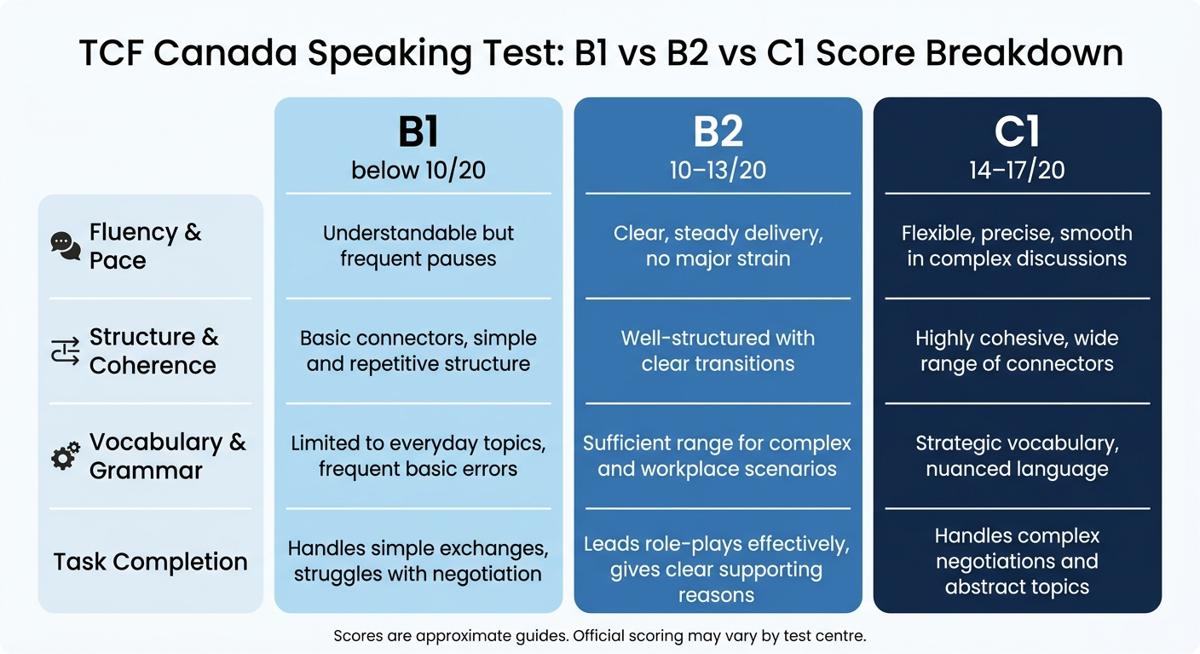
As a rough guide, 10–13/20 lines up with B2, and 14–17/20 lines up with C1. [2]
Across Tasks 1, 2, and 3, examiners use the same scoring lens.
The main criteria examiners use to assess speaking
Examiners score five areas across all three tasks:
- Grammar and vocabulary range - how accurately and broadly you use French structures and words
- Coherence and use of connectors - whether your ideas connect in a logical way with transitions like donc, cependant, or par exemple
- Fluency and pace - how naturally you speak, with few disruptive pauses
- Pronunciation and clarity - whether your speech is easy to follow without effort
- Task fulfilment and register - whether you do what the task asks and match your tone to the situation
These five areas shape whether your answer comes across as B1, B2, or C1 in practice.
What separates B1, B2, and C1 answers in practice
The clearest difference is how hard the examiner has to work to follow you. A B1 answer is understandable, but it often takes more effort to follow. Pauses happen often, connectors stay basic, and vocabulary tends to stick to familiar topics.
A B2 answer is clearer and more controlled. It flows well, uses a broader mix of linkers, and covers the task without extra prompting. A C1 answer goes a step further. It sounds precise and flexible, and it deals with complex or abstract ideas with little trouble.
| Level | Fluency & Pace | Structure & Coherence | Vocabulary & Grammar | Task Completion |
|---|---|---|---|---|
| B1 | Understandable but may have frequent pauses | Uses basic connectors; structure is simple and sometimes repetitive | Limited to everyday topics; frequent basic errors | Handles simple exchanges but struggles with negotiation |
| B2 | Clear, steady delivery with no major strain | Well-structured with clear transitions; able to organise thoughts logically | Sufficient range to describe complex situations and workplace scenarios | Leads the exchange effectively in role-plays; provides clear supporting reasons |
| C1 | Flexible, precise, and smooth in complex discussions | Highly cohesive; uses a wide range of connectors and organisational patterns | Uses strategic vocabulary and nuanced language | Handles complex negotiations and abstract topics |
Use these benchmarks to judge the sample answers below.
sbb-itb-7df369b
Sample TCF Speaking Questions and Response Examples for Each Task
The prompts below are realistic examples based on the exam format. They are not official live questions, but they reflect the kinds of situations and topics you’re likely to face.
Task 1 question types: work, studies, routine, and future plans
Use these Task 1 prompts to practise short, natural answers about work, study, daily routine, and future plans.
Typical prompts focus on your current job, why you’re learning French, your daily routine, past studies, and your plans in Canada. A stronger answer does three simple things: it stays within 3–5 connected sentences, includes at least one concrete detail, and links ideas with words like parce que, donc, or ensuite. For example:
Je travaille dans un environnement où le français est utile. J'apprends le français parce que je veux mieux communiquer au travail, donc je le pratique régulièrement. À l'avenir, je veux utiliser le français plus souvent au Canada.
This answer pattern helps you build speed before moving on to the longer role-play and opinion tasks.
Task 2 scenarios: information requests, scheduling, negotiation, and complaints
Here, you move from short personal answers to role-play prompts where you need to lead the conversation. The scenario may ask you to ask about a job training course, reschedule a workplace meeting or service appointment, clarify your duties in a new role, or deal with a customer service or workplace problem.
Match your practice to the function of the scenario:
| Scenario Type | Example Situation | Functions to practise |
|---|---|---|
| Information Request | Inquiring about a professional training course | Asking for details, clarifying costs and dates |
| Scheduling | Rescheduling a workplace meeting or service appointment | Proposing alternatives, confirming conditions |
| Negotiation | Clarifying or adjusting job responsibilities | Persuading, justifying a position |
| Complaints | Resolving a customer service or workplace issue | Expressing dissatisfaction politely, seeking solutions |
For a complaint scenario, be polite but direct. State the problem clearly, then ask for another option or a solution. That balance shows control of the exchange and the right register.
Task 3 prompts: workplace topics and broader social issues
Use these prompts to practise structured opinion answers. Common themes include remote work, employee training, digital tools in the workplace, public transit, and health habits.
A strong response follows five steps: state your opinion clearly → give your first reason → give your second reason → add one concrete example → add one counterpoint → close with a short conclusion. On remote work, you could open with Je pense que le télétravail améliore la productivité, à condition d'être bien encadré, then add two reasons, one example, one counterpoint, and a brief conclusion.
Use these prompt types in timed AI voice agent drills before moving to the practice plan below.
How to Prepare with Free AI Practice and a Simple 2026 Study Plan
Using Conversaflex to practise all 3 TCF speaking tasks
Once you understand the three tasks, the next step is simple: practise them in short bursts and do it under time pressure.
Conversaflex has a free AI examiner that simulates the TCF speaking section in exam-style conditions. After each session, it gives feedback on fluency, vocabulary, grammar, and pronunciation, and it flags mispronunciations as you speak. [2] It runs in your browser, works on any device, and doesn't need a download. The simulator is available 24/7, and you can retry it as many times as you want for free. [1]
That matters because the TCF speaking test is not long. You don't need endless study sessions. You need focused reps that help you get used to the pace, the prompt style, and the pressure.
A weekly practice routine to follow before test day
A seven-day cycle works well if you can't study for hours at a time. Each day has one job. That keeps practice clean and helps you avoid burnout.
| Day | Focus | What to do |
|---|---|---|
| Day 1 | Task 1 drills | Answer personal prompts in one take |
| Day 2 | Task 2 question-building | Lead short role-plays and ask follow-up questions |
| Day 3 | Task 3 monologue structure | Deliver a 60-second opinion response with two reasons and one example |
| Day 4 | Pronunciation & fluency review | Review AI feedback reports; repeat flagged words and hesitation patterns |
| Day 5 | Full mock exam | Complete all three tasks in one sitting (~12 minutes) under timed conditions [1] |
| Day 6 | Error correction | Retry the task with your lowest score; focus on the fluency, vocabulary, grammar, or pronunciation criterion that cost you the most |
| Day 7 | Rest & light review | Skim common TCF prompts or job-specific vocabulary without intensive speaking |
By Day 7, the goal is simple: give faster, better-structured answers without freezing when the clock is running.
Conclusion: Key points to remember about the 2026 TCF Speaking test
The speaking section is short - about 12 minutes across three tasks [1] - but each task checks a different skill. Task 1 asks you to speak naturally about yourself. Task 2 tests whether you can lead a real exchange. Task 3 asks for a clear opinion backed by reasons.
In other words, your French level matters, but so does your approach. If you answer every task the same way, you'll leave marks on the table. Matching your response style to the task format is a big part of doing well.
Targeted AI practice with lifelike prompts and instant feedback is a smart way to work on that before test day.
FAQs
What score do I need for NCLC 7?
The information here does not include NCLC 7 score requirements or TCF score benchmarks.
For the exact NCLC language level needed, check the official IRCC documentation.
Can I take notes during Task 2 prep time?
The available information does not say whether note-taking is allowed during Task 2 preparation time in the TCF Speaking test.
Put simply, this point is not specified in the provided sources.
How can I improve quickly for Task 3?
To improve fast for TCF Speaking Task 3, use conversational AI tools that simulate exam-style exchanges and give instant, objective feedback. Daily, targeted practice matters.
Spend 10 to 15 minutes a day reviewing vocabulary, practising spontaneous answers, and looking at how you performed. That short routine can help you sharpen pronunciation, rhythm, intonation, grammar, and vocabulary, while also building fluency and confidence for unplanned prompts.




![Cover Image for Corporate Language Training Costs: Conversaflex vs. Tutors, Classes and Apps [2026]](/_next/image?url=%2Fassets%2Fimages%2Fblog%2F68b2425f68bb5e38327dcb5b-1756542781388.jpg&w=3840&q=75)
![Cover Image for Workplace French Training in Canada: Formats, Costs and Funding [Guide 2026]](/_next/image?url=%2Fassets%2Fimages%2Fblog%2Fworkplace-french-training-canada-2026.jpg&w=3840&q=75)