Quebec French Levels Explained: Francisation Scale 1-12 vs CEFR (A1-C2) — 2026 Guide
Complete guide to Quebec French proficiency levels. Compare the Francisation Scale (1-12) with CEFR (A1-C2), see what each level means for work, immigration, OQLF compliance, and Bill 96 — with a free placement test.
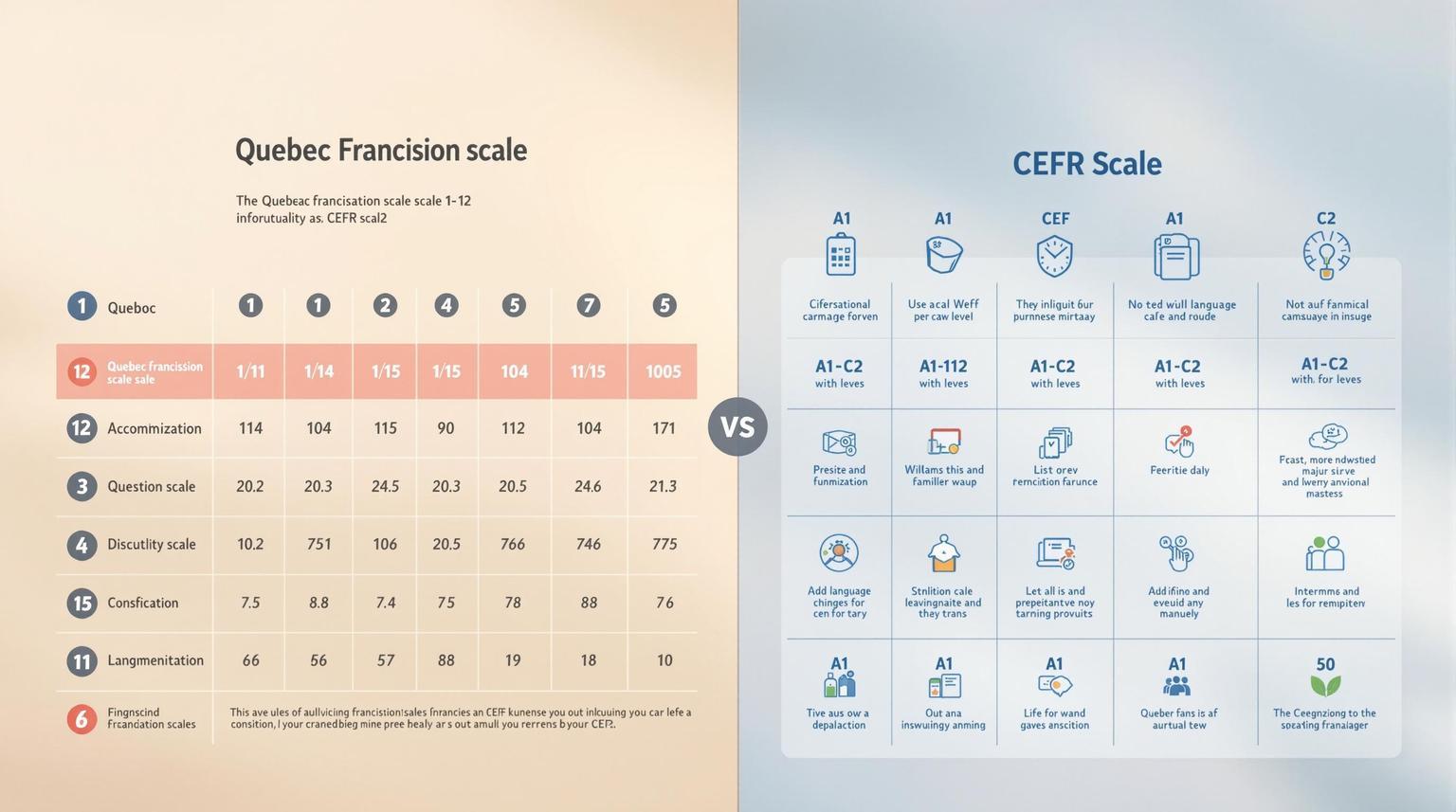
Quebec French Levels Explained: Francisation Scale (1-12) vs CEFR (A1-C2)
Need to know what your French level means in Quebec — for work, immigration, or Bill 96 compliance? This guide explains both scales, shows how they map to each other, and gives you a free way to find your level.
TL;DR — The Quick Comparison
| Criteria | Quebec Francisation Scale | CEFR Scale |
|---|---|---|
| Levels | 12 (1–12) | 6 (A1–C2) |
| Focus | Quebec-specific needs | International standard |
| Usage | Immigration, workplace, OQLF compliance | Education, global certification |
| Beginner Range | Levels 1–4 | A1–A2 |
| Intermediate Range | Levels 5–8 | B1–B2 |
| Advanced Range | Levels 9–12 | C1–C2 |
| Common workplace minimum | Level 7 | B2 |
Not sure which level you're at? Take our free French placement test — get your CEFR + Quebec level in 10 minutes.
In short: the Quebec Francisation Scale (1–12) is used in Quebec for education, immigration, and workplace compliance. Levels split into Beginner (1–4), Intermediate (5–8), and Advanced (9–12) across speaking, listening, reading, and writing. The CEFR Scale (A1–C2) is the global standard, ranging from Basic User (A1–A2) to Proficient User (C1–C2).
Employers in Quebec typically use the Quebec Scale for local compliance and the CEFR for international candidates — the two scales complement each other.
Quebec Francisation Scale: Levels 1-12
How the 12 Levels Work
The Quebec Francisation Scale categorizes French language skills into 12 levels, each building on the last with specific linguistic criteria. Click any level below to jump to its description, or use our free placement test to find yours.
Level-by-Level Breakdown
Each level below links to a dedicated guide with examples, CEFR equivalence, and jobs that typically require it.
Level 1 — Absolute Beginner (CEFR pre-A1)
Recognizes isolated French words and basic greetings. Cannot yet form independent sentences.
Level 2 — Beginner (CEFR A1)
Uses simple memorized phrases for routine survival situations: greetings, numbers, ordering food.
Level 3 — Elementary Beginner (CEFR A1+)
Forms short sentences for very basic daily exchanges. Limited vocabulary, frequent pauses.
Level 4 — Functional Beginner (CEFR A2)
Handles basic workplace vocabulary and simple sentence construction. Level 4 is often required for entry-level roles in Quebec.
Level 5 — Lower Intermediate (CEFR A2+)
More connected speech with an expanding vocabulary. Can describe routine work tasks.
Level 6 — Intermediate (CEFR B1)
Uses complex sentences and can express opinions. Comfortable in predictable workplace conversations.
Level 7 — Strong Intermediate (CEFR B1+ / B2)
Level 7 is the most common minimum for client-facing roles in Quebec. Broader vocabulary including abstract terms; participates in professional discussions with natural conversational flow.
Level 8 — Upper Intermediate (CEFR B2)
Strong control of complex grammar and professional vocabulary. Required for many regulated professions.
Level 9 — Advanced (CEFR B2+ / C1)
Smooth, near-fluent professional communication. Often required for management roles in Quebec.
Level 10 — Professional Advanced (CEFR C1)
Mastery of professional-level language across most contexts.
Level 11 — Highly Advanced (CEFR C1+ / C2)
Fluency in idiomatic expressions, nuance, and register-switching.
Level 12 — Native-Equivalent (CEFR C2)
Communication skills comparable to educated native speakers across all professional and personal domains.
CEFR Levels for French (Detailed Guides)
If you've taken a CEFR-aligned exam (DELF, DALF, TCF, TEF) or you're learning French outside a Quebec context, these guides explain each CEFR level with concrete examples:
- A1 French — beginner: survival phrases
- A2 French — elementary: basic everyday tasks
- B1 French — intermediate: routine workplace and travel
- B2 French — upper intermediate: professional fluency
- C1 French — advanced: nuanced professional & academic use
- C2 French — mastery: near-native
This structured approach ensures consistency in language assessments across Quebec, serving as a standard for both education and workplace settings.
Want to know your level right now? Take the free French placement test — get your CEFR + Quebec score in 10 minutes.
Using the Scale in Quebec
The scale plays a key role in supporting Quebec's focus on maintaining French as the primary workplace language. It guides assessments and integration efforts in different contexts:
Workplace Assessments:
- Evaluate employees' language proficiency.
- Identify specific training needs.
- Define language requirements for various job roles.
Immigration and Integration:
- Used by immigration officials to assess language skills.
- Helps newcomers identify their current proficiency level.
- Assists educational institutions in designing tailored programs.
In professional settings, Level 7 is often the minimum required for roles involving regular client interaction. Positions that demand more complex communication, such as management roles, may require Level 9 or higher.
The scale works seamlessly with Quebec's francisation programs, enabling organizations to monitor progress and meet provincial language standards. This approach ensures workplaces align with Quebec's French-language requirements while offering clear pathways for skill development.
CEFR Scale: A1 to C2
Understanding CEFR Levels
The CEFR framework measures language proficiency across six levels, focusing on what learners can achieve at each stage.
It categorizes skills into three main groups:
Basic User (A1-A2)
- A1: Can use simple phrases to handle everyday needs.
- A2: Can exchange basic information on familiar topics like work or family.
Independent User (B1-B2)
- B1: Can navigate routine situations while travelling and discuss familiar subjects.
- B2: Can understand detailed texts and communicate fluently with native speakers.
Proficient User (C1-C2)
- C1: Can communicate effectively in professional and academic settings.
- C2: Demonstrates mastery, using language with precision and nuance.
The CEFR evaluates four key activities:
- Reception: Reading and listening.
- Production: Writing and speaking.
- Interaction: Engaging in conversations.
- Mediation: Interpreting and translating.
Thanks to its structured levels, the CEFR framework is widely used in both education and professional environments.
Where CEFR is Used
The CEFR is applied in various contexts, including:
Educational Settings
- Universities assess international students using CEFR levels.
- Language schools design curricula based on CEFR standards.
- Teaching materials and textbooks often reference these levels.
Professional Contexts
- Employers use CEFR levels to evaluate job candidates' language skills.
- Certifications for specific professions align with CEFR benchmarks.
- International organizations rely on CEFR to assess staff language proficiency.
This framework’s focus on practical language use makes it a trusted global benchmark. It complements Quebec's local assessments, enabling a detailed level-by-level comparison.
CEFR Language Levels Explained: What is A1, A2, B1, B2, C1 ...
Comparing Both Scales
This comparison outlines how each scale is tailored to meet different assessment needs.
Level-by-Level Comparison
The Quebec Francisation Scale and CEFR both provide benchmarks for assessing French proficiency, but their structures differ. The Quebec scale divides proficiency into three stages: Beginner (levels 1–4), Intermediate (levels 5–8), and Advanced (levels 9–12). It evaluates four core skills: oral comprehension, oral production, written comprehension, and written production [1]. These clearly defined levels make it easier to compare the specific strengths and weaknesses of each framework.
Benefits and Limits
Both scales have their own strengths and are suited to different contexts:
-
Quebec Francisation Scale:
- Tailored to assess French proficiency specifically in Quebec
- Provides a detailed progression through 12 levels, grouped into three stages
-
CEFR:
- Recognized internationally as a standard for language proficiency
- Commonly used in both educational and professional environments
- Offers broad benchmarks for comparing language skills
The Quebec Francisation Scale is highly detailed and well-suited to its local context but may not fully address international standards. Its three-stage structure helps learners and employers set realistic goals and serves as a useful complement to the CEFR framework.
Cross-Scale Conversion: Quebec, CEFR, TEFAQ, TCF, DELF/DALF
If you've taken — or need to take — an official French exam (TEFAQ, TCF Québec, DELF, DALF), here's how the scores map to the Quebec Francisation Scale and CEFR:
| Quebec Level | CEFR | TEFAQ (oral) | TCF Québec (oral) | DELF / DALF |
|---|---|---|---|---|
| 1–2 | pre-A1 / A1 | 1–3 | 1–3 | DELF A1 |
| 3–4 | A1+ / A2 | 4–6 | 4–6 | DELF A2 |
| 5–6 | A2+ / B1 | 7 | 7 | DELF B1 |
| 7–8 | B1+ / B2 | 8–9 | 8–10 | DELF B2 |
| 9–10 | B2+ / C1 | 10 | 11–14 | DALF C1 |
| 11–12 | C1+ / C2 | — | 15–19 | DALF C2 |
Sources: TEFAQ scoring, TCF Québec, DELF/DALF mapping.
Guide for Quebec Employers
This guide helps Quebec employers navigate workplace language proficiency requirements, building on the assessment frameworks discussed earlier.
Workplace Language Assessment
Quebec employers rely on the Quebec Francisation Scale to evaluate employee French skills systematically. Both new hires and current staff are assessed across four key areas: oral comprehension, written comprehension, oral production, and written production.
The scale divides proficiency into three categories:
- Beginner (Levels 1–4): Basic communication skills
- Intermediate (Levels 5–8): Moderate proficiency for more interactive roles
- Advanced (Levels 9–12): High-level skills suitable for complex tasks and leadership
These levels are matched to job requirements, ensuring employees meet the necessary language standards for their roles.
Managing International Staff
Employers often deal with international candidates who hold CEFR certifications (A1–C2). Since the CEFR is widely recognized, it’s important to convert these ratings into Quebec Francisation Scale levels for consistency.
| Job Category | Quebec Levels | CEFR Equivalent | Typical Role Requirements |
|---|---|---|---|
| Entry-Level | 1–4 | A1–A2 | Basic communication and routine tasks |
| Customer-Facing/Office | 5–8 | B1–B2 | Team collaboration and customer interaction |
| Management/Professional | 9–12 | C1–C2 | Leadership and strategic communication |
Conversaflex for Workplace French Training
To support employee development under Bill 96, Conversaflex offers AI-powered French learning tailored to workplace needs. The platform adjusts to each employee's proficiency level, starting at Quebec Level 1.
Key features include:
- Custom learning paths based on placement test results
- Progress tracking aligned with the Quebec Francisation Scale
- Reports designed for OQLF certification purposes
- Flexible scheduling to fit varying work shifts
- Scalable options for teams of all sizes
This approach not only supports Quebec's language standards but also improves communication across the workforce. See how it works →
Summary
This section highlights the main points for managing language skills effectively. By understanding both the Quebec Francisation Scale and the CEFR, organizations can simplify compliance and track language proficiency. The Quebec scale focuses on workplace-specific needs, while the CEFR provides an internationally standardized framework.
Making the Most of Both Scales
To manage language assessments efficiently, consider the following:
| Assessment Need | Recommended Scale | Advantages |
|---|---|---|
| Local Compliance | Quebec Francisation Scale | - Matches OQLF standards - Workplace-focused evaluations - Recognized by Quebec government programs |
| International Transfers | CEFR | - Globally accepted - Standardized framework - Simplifies credential transfers |
| Training Programs | Combined Approach | - Holistic skill evaluation - Tracks progress effectively - Aligns with Bill 96 requirements |
For HR teams, this means:
- Using the Quebec Scale for internal assessments and regulatory compliance.
- Applying the CEFR to evaluate international candidates.
- Tracking training progress with both scales.
- Focusing on practical communication skills for workplace success.
The Ministère de l'Immigration, de la Francisation et de l'Intégration (MIFI) advises structuring training programs around the Quebec scale's three levels: Beginner (1-4), Intermediate (5-8), and Advanced (9-12). This ensures employees gain the specific language skills needed for their jobs while staying compliant with regulations.
AI-powered platforms can help organizations track progress across both scales, ensuring compliance and improving workplace communication.
Frequently Asked Questions
What level of French do I need to work in Quebec?
It depends on the role. Entry-level positions typically require Level 4 (CEFR A2). Most client-facing or office roles require Level 7 (CEFR B1+/B2). Management, regulated professions, and roles requiring complex written communication usually require Level 9 or higher (CEFR C1).
Is CEFR B2 the same as Quebec Level 7 or Level 8?
CEFR B2 maps roughly to Quebec Level 7–8. Level 7 corresponds to the lower end of B2, and Level 8 to the upper end. Quebec's scale is more granular than CEFR, so a single CEFR level often spans two Quebec levels.
What is Level 4 French in Quebec?
Level 4 is the top of the Beginner range. At Level 4 you can handle basic workplace vocabulary and form simple sentences, equivalent to CEFR A2. It's commonly required for entry-level roles in Quebec.
What is Level 7 French in Quebec equivalent to?
Level 7 is the most common workplace minimum in Quebec, equivalent to CEFR B1+ to B2. At this level you can hold professional conversations, follow workplace meetings, and handle most routine work tasks in French.
How is the Quebec Francisation Scale used by the OQLF?
The OQLF references the Quebec Francisation Scale in its francization programs and audits. Employers under Bill 96 use it to demonstrate that staff meet language requirements, especially for businesses with 25+ employees that must hold a francization certificate.
Where can I take an official Quebec Francisation Scale test?
Official assessments are typically administered through OQLF-recognized providers, francization centres run by the Quebec government, or certified language schools. For an instant unofficial estimate, take our free placement test — it gives you both your CEFR level and the corresponding Quebec range.

![Cover Image for Corporate Language Training Costs: Conversaflex vs. Tutors, Classes and Apps [2026]](/_next/image?url=%2Fassets%2Fimages%2Fblog%2F68b2425f68bb5e38327dcb5b-1756542781388.jpg&w=3840&q=75)
![Cover Image for Free French Level Tests Compared: Which Online Test Should You Take? [2026]](/_next/image?url=%2Fassets%2Fimages%2Fblog%2F6a6becec2f6aeb480bfeb3ba-1785462442187.jpg&w=3840&q=75)
![Cover Image for How Many Levels Are There in French? CEFR A1–C2, Quebec 1–12 & DELF Explained [2026 Guide]](/_next/image?url=%2Fassets%2Fimages%2Fblog%2F6a6947cb2f6aeb480bfe8ceb-1785289880998.jpg&w=3840&q=75)