Bill 90 in Quebec - complete guide of learning within your company
Practical guide to Bill 96 workplace compliance: registration, francisation training, documentation, and audit-ready tracking for Quebec employers.
Bill 90 in Quebec - complete guide of learning within your company
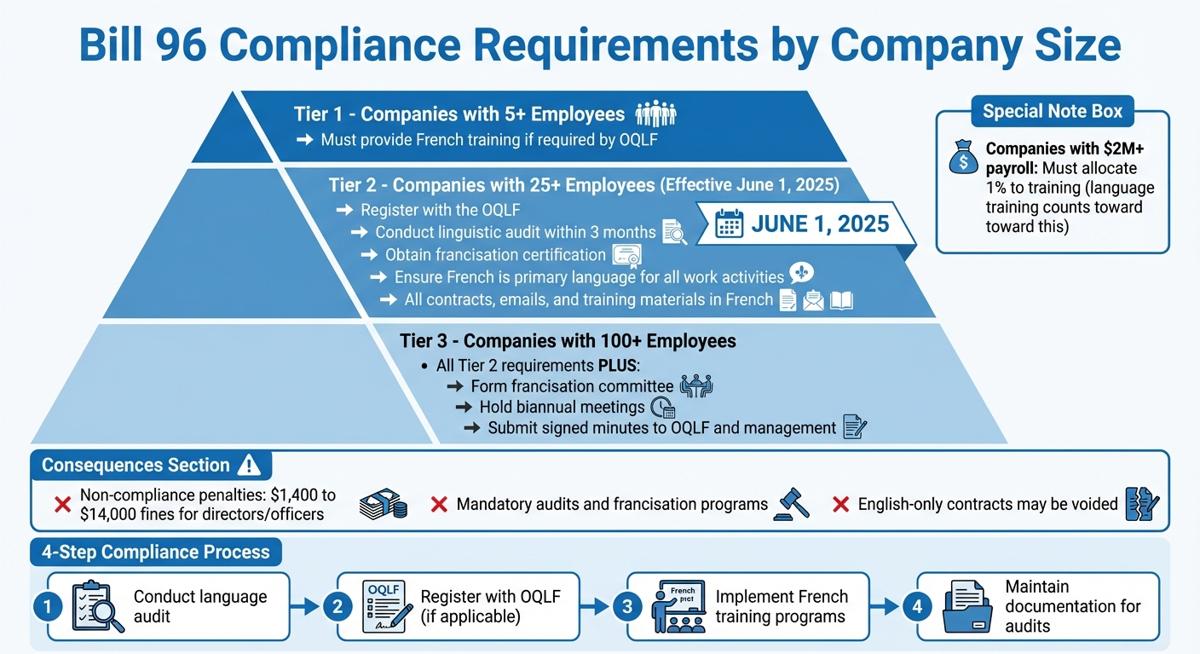
Quebec's Bill 96 (or Bill 90) enforces new workplace language rules. Starting June 1, 2025, companies with 25+ employees must ensure French is the primary language for all work activities, including emails, contracts, and training materials. Non-compliance could lead to audits, mandatory francisation programs, and fines. Key points include:
- Businesses with 5+ employees: Must provide French training if required by the OQLF.
- 25+ employees: Must register with the OQLF, conduct a linguistic audit, and get francisation certification.
- 100+ employees: Must form a francisation committee to monitor French usage.
Employers must also provide training for employees to meet these standards, especially for professional licensing and workplace communication. Companies with payrolls over $2M can count language training toward the mandatory 1% training allocation.
To comply, businesses should:
- Conduct a language audit.
- Register with the OQLF (if applicable).
- Implement tailored French training programs.
- Maintain thorough documentation for audits.
Bill 96 impacts hiring, contracts, signage, and daily operations, making preparation essential for smooth compliance.
::: @figure
Common Challenges When Implementing Workplace Francisation
Assessing Employee French Language Skills
Figuring out where employees stand with their French skills can be tricky. Some might be fluent, while others may barely know the basics. The challenge is designing an assessment that accurately reflects these differences, so training programs can be tailored to fit everyone - without overwhelming beginners or boring those who are already advanced.
This task becomes even more complicated under Bill 96, which introduces a three-criteria test for language requirements. Before hiring someone who needs English for their role, employers must prove three things: they've assessed the actual language needs of the role, verified that current staff can't meet those needs, and minimized the number of positions requiring non-French skills [5]. As Olivier Lamoureux from Gowling WLG puts it:
"The employer must indeed communicate with stakeholders located outside the province of Quebec that are exclusively English-speaking... but it would probably be unreasonable to require this from every single floor employee" [5].
This means your assessment process has to go beyond just evaluating skills. You'll need to document which roles require specific language skills and keep those records ready in case the OQLF comes knocking.
On top of that, finding time for training without disrupting daily operations adds another layer of difficulty.
Managing Work Schedules and Training Time
Balancing language training with day-to-day operations can be a logistical nightmare. Employers must juggle operational needs with legal obligations, like compensating employees for training hours. In some cases, this even includes a three-hour minimum indemnity for off-hour sessions [4]. So, the cost of training isn't just about the program itself - you're also paying for the time employees spend learning instead of working.
If your company's payroll exceeds $2 million, you're already required to allocate 1% of that payroll for training under Bill 90 [2]. The good news? Language training for francisation counts toward this requirement, helping you hit two targets at once. To make it work, some businesses stagger training across shifts, while others turn to AI-driven platforms that let employees learn during quieter times or outside peak hours. Just keep in mind, mandated training still means paying employees for those hours.
And then there's the mountain of legal and administrative requirements to navigate.
Meeting Legal and Administrative Requirements
If your company has 25 or more employees, you must register with the OQLF, submit a linguistic analysis within three months, and implement a francisation program if French isn't widely used [1][3]. For businesses with over 100 employees, you'll also need to form a joint francisation committee, hold biannual meetings, and submit signed minutes to both management and the OQLF.
Additionally, all employment contracts, forms, policies, and handbooks must be available in French. For critical contracts, the French version must be presented first before offering any other language version. Getting the initial assessments and scheduling right is crucial because detailed records are your best defence during OQLF audits. Failing to meet these requirements can lead to serious consequences, including personal fines for directors and officers ranging from $1,400 to $14,000 [6][7]. Contracts written only in English could even be challenged or voided. Keeping thorough documentation of your efforts to avoid making English a job requirement is not just smart - it's necessary for compliance [5].
Bill 96: What Changed This Year?
How to Implement Workplace Learning Programs
Building on earlier discussions about scheduling and compliance challenges, the strategies below combine AI tools and workplace initiatives to create effective learning environments.
Using AI-Powered Language Learning Platforms
Francoflex's AI-driven platform tackles scheduling conflicts by offering personalized French training sessions that last 20–30 minutes and fit seamlessly into a workday. These sessions, accessible 24/7, adapt to each employee's skill level, making it easy for workers to learn during breaks or slower periods without interrupting key operations.
One standout feature is its automatic compliance tracking. Francoflex generates audit-ready progress reports and certificates, logging every training hour and skill improvement. For businesses with annual payrolls exceeding $2 million, the platform's cost - typically $5–15 CAD per user per month - can count toward the mandatory 1% training allocation, with training time qualifying as an eligible expense. Plus, AI analytics show that employees using such platforms can reach proficiency 25–40% faster compared to traditional methods [9][10].
That said, technology alone isn't enough - creating a supportive environment is just as important.
Building a Workplace Culture That Supports Learning
While AI simplifies training delivery, a workplace culture that encourages learning ensures its success. Simple initiatives like "French Fridays", where team meetings or casual chats are conducted in French, can help employees feel more comfortable using the language. Pairing less proficient employees with bilingual mentors also fosters a supportive atmosphere. According to Quebec HR experts, when leadership actively uses French, participation in language programs can increase by around 30%.
Acknowledging progress is another key motivator. Recognizing achievements through company newsletters, awarding badges, or tying language milestones to performance reviews can inspire employees to stay engaged. For example, one Montreal company achieved an 85% completion rate by offering small incentives and creating dedicated learning spaces [9][10].
These cultural initiatives lay the groundwork for scalable training solutions.
Setting Up Training Programs That Scale
Begin by conducting baseline French assessments to group employees by skill level. From there, roll out hybrid training programs, combining online modules with live sessions, tailored to each department. Self-paced modules work well for smaller teams, while larger organizations benefit from a hybrid model that includes cohort-based live training from accredited providers.
For example, a Quebec retailer successfully scaled its program from 200 to 2,000 participants within a year, achieving 90% compliance by implementing training in phases. Keeping detailed records - such as attendance logs, skill certifications, and training hours - is crucial for audits. Integrating the training platform with HR software further simplifies administration by automating reminders and generating reports [9][10].
These steps ensure that workplace learning programs are both effective and sustainable.
sbb-itb-d43bb17
Steps to Ensure Bill 96 Compliance
Once effective training programs are in place, the next priority is ensuring ongoing compliance with Bill 96. Digital tools and certified providers can simplify the process, but staying compliant requires consistent tracking, thorough documentation, and regular updates to policies. Below are the steps to help businesses remain audit-ready while keeping operations running smoothly.
Tracking and Documenting Employee Progress
Using a Learning Management System (LMS) can make compliance simpler. For instance, Francoflex's AI-powered platform automatically tracks participation, course duration, and completion. It also generates real-time, OQLF-ready progress reports, documenting improvements in pronunciation, grammar, and overall proficiency - no manual effort required.
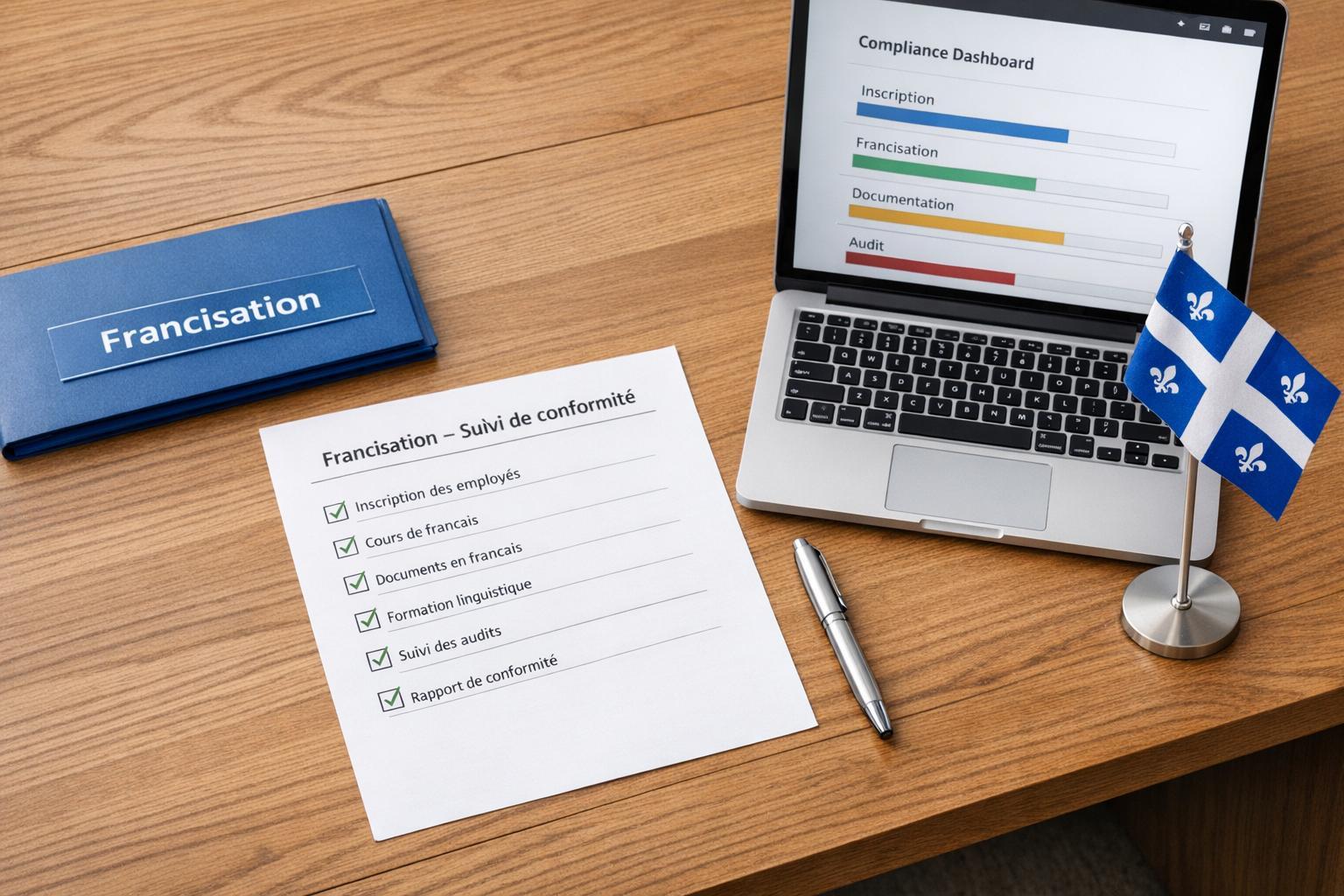
It's essential to maintain detailed records, including attendance logs with dates, times, and digital signatures, as well as certificates of completion showing employee names, course titles, and dates. Additionally, keep payroll registers with hourly rates for trainees and trainers, along with receipts for external training costs, travel, and materials. These structured tracking measures not only boost productivity but also help retain employees.
Don't forget to submit your annual declaration by May 31, detailing your total training expenditures on the Relevé 1 Summary. If your training investments exceed the required 1% of payroll, document the surplus to carry it forward to the next year.
| Document Type | Purpose for Compliance | Key Details to Include |
|---|---|---|
| Training Plan | Proves organized learning | Objectives, duration, trainer name, and evaluation method |
| Attendance Record | Proof of participation | Dates, times, and signatures or digital logs of attendees |
| Payroll Register | Financial documentation | Hourly rates of trainees and trainers to calculate eligible salary costs |
| Certificate of Completion | Verification of success | Employee name, course title, date, and recognized provider |
| Progress Report | OQLF/Audit readiness | Metrics on skill improvement and total minutes of training completed |
These records don't just meet audit requirements - they also set the stage for staying ahead of future compliance needs.
Working with Certified Language Training Providers
In addition to internal tracking, collaborating with certified providers ensures training meets official standards. Recognized platforms simplify compliance reporting and guarantee high-quality instruction. As José, a small business owner, shared:
"This will help my business grow as I'll be able to send my workers to client's homes knowing they can communicate properly in French" [11].
For businesses with payrolls exceeding $2 million, training costs typically count toward the mandatory 1% training allocation. Several funding options can help offset these costs, including:
- The Workforce Training Measure: Covers up to $25,000 for materials and $75,000 for wages.
- Government Programs: Reimburse 50–75% of eligible costs for OQLF-registered businesses.
- Tax Credits: Offer up to $75,000 when expense documentation and attendance records are properly maintained.
Updating Your Compliance Policies
Regularly reviewing your policies is key to staying aligned with Bill 96. Ensure all communications, contracts, and training materials are primarily in French. Recruitment and anti-discrimination policies should also reflect these requirements. For roles where non-French skills are necessary, adjust documentation accordingly. Employment contracts, handbooks, benefit plans, and training materials must all be provided in French, with any alternative language versions offering terms just as favourable. A two-column format for contracts - presenting both languages side by side - can be a practical solution [6].
As Dasha Peregoudova, Partner at Aird & Berlis, explained:
"Effective June 1, 2022, Bill 96 requires that French become the main language for all employment matters in the workplace" [12].
Looking ahead, remember that as of June 1, 2025, the mandatory francisation registration threshold will drop from 50 employees to 25. Businesses nearing this size should start preparing now.
Conclusion: Meeting Bill 96 Requirements in Your Workplace
Pulling together the strategies outlined earlier, this section highlights key points and practical steps to help ensure your workplace meets Bill 96 requirements.
Key Points for Employers
Complying with Bill 96 doesn't have to mean disrupting your operations or stretching your budget thin. The secret lies in combining structured documentation, certified training providers, and smart tools that cater to your team's needs. For example, Francoflex simplifies compliance by automating progress tracking, generating OQLF-ready reports, and offering 24/7 access to learning resources. As Stéphane, Président, shared:
"Francoflex ensures I stay compliant at a small cost" [8].
Beyond avoiding penalties, workplace francisation offers real benefits. Employees who gain confidence in French tend to integrate more seamlessly, stay with the company longer, and provide better service to French-speaking customers. For temporary foreign workers, French proficiency is now essential for work permit renewals, making language training a critical priority.
These points provide a strong foundation for action.
Next Steps for Workplace Francisation
Start by performing a language audit to pinpoint areas needing improvement, such as signage, contracts, or internal communications. If your company has 25 or more employees, register with the OQLF before 1 June 2025, complete a linguistic assessment, and explore funding programs that can cover 50% to 75% of training costs.
Choose a training solution that scales with your team, fits into their schedules, and tracks progress automatically. Keep detailed records, including attendance logs, completion certificates, and payroll registers. Make sure to submit your annual declaration by 31 May and review your policies quarterly to maintain French as the primary workplace language.
Businesses that embrace francisation as an investment in their workforce - not just a regulatory task - are the ones that will thrive under Bill 96. With the right tools and a clear plan, you can meet every requirement while empowering your team to succeed.
FAQs
How can companies in Quebec prepare for Bill 96 compliance by 2025?
To get ready for Bill 96 compliance by 2025, businesses in Quebec should focus on a few essential steps.
Start with a language audit to pinpoint areas where French needs to take precedence. This could include contracts, training materials, and workplace signage. A thorough review will help ensure that both internal and external communications align with the required standards.
Next, consider offering French language training for employees. Tools like Francoflex can help boost language skills and ensure compliance with the new rules. To offset costs, explore options like government funding, tax credits, or allocations from mandatory training budgets.
Lastly, keep a close eye on legal requirements, such as the mandatory use of French in employment agreements and public-facing materials. Make sure all necessary documentation is completed well before the June 1, 2025, deadline. Taking a proactive approach and using AI tools where possible can simplify the process and help avoid potential penalties.
How can companies in Quebec integrate French language training into daily operations without disrupting productivity?
To integrate French language training into daily operations effectively, businesses in Quebec can use practical and adaptable strategies that align with Bill 90 requirements. AI-driven platforms like Francoflex offer employees personalized, work-specific training to improve their French communication skills without significantly disrupting their regular tasks.
Short, focused sessions - whether daily or weekly - can fit seamlessly into employees' schedules, promoting consistent progress without adding to their workload. Additionally, businesses can take advantage of government funding, tax credits, and mandatory training budgets to help cover costs and simplify the process.
By weaving language training into everyday workflows with tailored tools and thoughtful planning, companies can stay productive while meeting Quebec's legislative obligations.
What are the consequences of not complying with Bill 96 in Quebec?
Failing to follow Bill 96 in Quebec can result in serious consequences. Financial penalties include fines between $700 and $30,000 for individuals and $3,000 to $30,000 per offence for businesses. For repeat offences, the fines can increase, and companies may face lawsuits, the loss of permits, or even public sanctions. On top of the monetary costs, non-compliance can damage a company's reputation and erode trust among employees.

![Cover Image for Corporate Language Training Costs: Conversaflex vs. Tutors, Classes and Apps [2026]](/_next/image?url=%2Fassets%2Fimages%2Fblog%2F68b2425f68bb5e38327dcb5b-1756542781388.jpg&w=3840&q=75)
![Cover Image for Free French Level Tests Compared: Which Online Test Should You Take? [2026]](/_next/image?url=%2Fassets%2Fimages%2Fblog%2F6a6becec2f6aeb480bfeb3ba-1785462442187.jpg&w=3840&q=75)
![Cover Image for How Many Levels Are There in French? CEFR A1–C2, Quebec 1–12 & DELF Explained [2026 Guide]](/_next/image?url=%2Fassets%2Fimages%2Fblog%2F6a6947cb2f6aeb480bfe8ceb-1785289880998.jpg&w=3840&q=75)