Preply pricing (comparison with other AI options like Conversaflex)
Compare Preply's human-tutor costs and flexibility with Conversaflex's AI scalability, unlimited practice and OQLF-compliant reporting.

Preply pricing (comparison with other AI options like Conversaflex)
Choosing between Preply and Conversaflex for workplace French training depends on your goals: personalized learning or compliance-focused solutions.
- Preply: Offers human tutors with rates from $5 to $100 CAD per hour. It’s great for personalized, one-on-one coaching but can be expensive for larger teams. Compliance tracking is available but lacks automated, OQLF-specific reporting.
- Conversaflex: Uses AI for unlimited, 24/7 practice at a fixed cost after an initial setup fee. It’s tailored for Quebec’s Bill 96 compliance with automated OQLF-aligned reports, making it scalable for large workforces. However, it doesn’t provide human interaction.
Quick Comparison
| Feature | Preply | Conversaflex |
|---|---|---|
| Method | Human tutoring | AI-powered conversations |
| Pricing | $5–$100/hour | Fixed cost, unlimited access |
| Compliance Tracking | Basic | Automated OQLF-aligned reports |
| Scalability | Limited to tutor availability | 1 to 50,000+ employees |
| Availability | Scheduled sessions | 24/7 access |
If you need personalized coaching, Preply works well. For large-scale compliance and cost predictability, Conversaflex is the better fit.
::: @figure

1. Preply
Pricing Models
Preply offers flexible pricing tailored to both individuals and businesses. For individual learners, subscriptions range from one to five classes per week, billed every 28 days. Hourly rates for tutors vary between $5 and $50 CAD, with native speakers typically charging around $30 CAD per hour, while specialized tutors can go up to $100 CAD [8][10].
For businesses, Preply Business provides customized pricing based on factors like the number of learners and the scope of the training program. This is billed as a single monthly payment, and detailed quotes are available through consultations or demos [3][4][7].
These pricing structures are designed to accommodate diverse needs while incorporating features that support compliance initiatives.
Features for Workplace Francisation
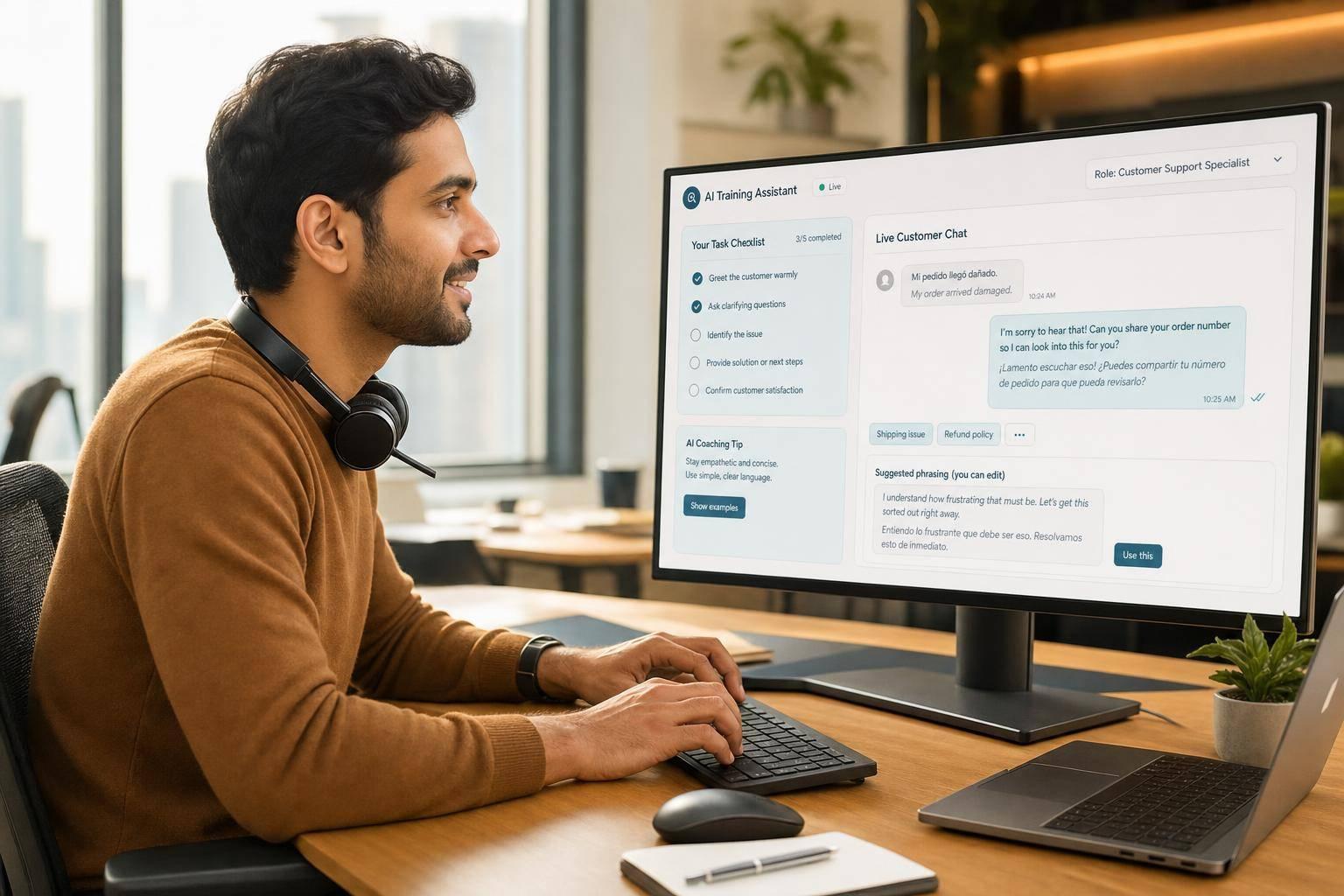
Preply’s "Francization for businesses" program is specifically tailored to help Quebec companies meet the requirements of Bill 101 and Bill 96 [3]. The platform connects businesses with over 40,000 tutors, including certified experts in business French. These tutors craft lessons focused on professional roles and industry-specific language [3][4]. Training sessions emphasize practical workplace tasks like writing reports, conducting client calls, and managing technical discussions, ensuring employees can apply their skills immediately while supporting compliance with Bill 96 [4][9].
The platform includes an administrative dashboard that tracks lesson hours, attendance, and progress according to CEFR levels. This feature helps businesses document their "reasonable and ongoing efforts" toward francisation, as required by law. Managers can easily export this data for OQLF reporting [3][4]. Additionally, AI tools on the platform create automated exercises and lesson summaries, reinforcing vocabulary and fluency [9].
Cost-Effectiveness and ROI
Preply demonstrates strong results in workplace language training. According to the platform, 92% of learners report improved work performance, and 89% of business students note enhanced job performance following their French training [4][9]. The one-on-one format boosts engagement, achieving a 3.5x increase compared to group classes. Students also see a 35% improvement in language proficiency compared to group-based learning [7].
"For us, it's a great advantage to offer personalized training in both English and French without losing in quality." – Anna, HR Director, BNP Paribas [6]
The platform’s flexibility is another major benefit, especially for organizations with distributed teams. Managers can use a centralized dashboard to track engagement and reallocate training seats as needed, reducing administrative workload [6][7].
Advantages and Disadvantages
Preply’s strengths lie in its personalized approach and access to skilled tutors. Native-speaking tutors bring industry-specific expertise, adapting lessons in real time. After completing 24 or more lessons, 91% of clients report feeling confident speaking French [6]. The platform also holds a 4.4/5 rating on GetApp Canada, with users highlighting its scheduling flexibility and the wide variety of tutors available [7].
However, the platform does have drawbacks. The cost can be steep, especially for larger teams. With hourly rates ranging from $5 to $100 CAD, training a group of 25 employees could quickly become expensive [8]. Some users have also experienced issues like tutor cancellations and challenges with billing for fluctuating team sizes [7][8]. While Preply’s dashboard supports compliance tracking, it lacks the specialized OQLF report generation offered by some Quebec-specific platforms.
The next section will explore Conversaflex’s offerings to provide a detailed pricing comparison.
sbb-itb-d43bb17
2. Conversaflex

Pricing Models
Conversaflex takes a different route compared to Preply's subscription-based pricing. Instead of charging hourly rates, it requires an initial setup fee and then offers unlimited practice sessions without ongoing per-hour costs [12]. This model is particularly appealing for businesses needing to provide francisation training on a large scale, whether for a handful of employees or a workforce exceeding 50,000 [1][13]. Pricing is tailored based on the size of the company and the scope of training, making it easier to budget for large-scale compliance needs [12][13].
Unlike Preply, where tutors set their own rates (ranging from $10 to $40 CAD per hour), Conversaflex removes the hassle of variable costs and commissions [11]. Employees can access training anytime, 24/7, without worrying about scheduling sessions or running out of prepaid hours [12]. This predictable pricing structure makes it easier for companies to manage their training budgets while preparing for full compliance with francisation requirements.
Features for Workplace Francisation
Conversaflex was designed with Quebec's Bill 96 in mind. It generates automated francisation reports that align with OQLF requirements, tracking each employee's learning time and documenting the "reasonable and ongoing efforts" businesses need to demonstrate [1][12]. The AI tutor, Madame AI, provides daily lessons tailored to an employee's role, industry, mother tongue, and proficiency level (A1–C2). Companies can also customize training to include technical terms and workplace-specific scenarios, such as retail interactions or healthcare communications [1][12].
The platform offers instant feedback on pronunciation and grammar during spoken exercises, simulating real-life conversations [13]. For HR teams, the admin dashboard provides an overview of participation, progress, and areas where employees may struggle. This centralized reporting is especially useful for companies preparing for the June 1, 2025, deadline, which mandates that businesses with 25 or more employees ensure French is the primary workplace language. These tools make Conversaflex a practical choice for meeting compliance deadlines.
Cost‑Effectiveness and ROI
The unlimited practice model offered by Conversaflex ensures predictable costs, which can be more budget-friendly than hourly billing, especially when training large teams. The setup fee, combined with unlimited access, often proves more economical than paying $10 to $40 CAD per hour per employee [11][12].
"AI tools, on the other hand, involve an initial setup cost but then offer unlimited practice sessions without additional fees. This makes them a smart investment, especially when weighed against the potential costs of non‑compliance with Bill 96." – Conversaflex [12]
The platform's flexibility is a significant advantage for shift workers and remote teams who may not be able to commit to fixed lesson times [11][12]. Employees can practise during breaks, before shifts, or even on weekends without having to coordinate with a tutor's schedule. The scalability of the platform also makes it easy to onboard new employees without renegotiating contracts or seeking additional tutors.
Advantages and Disadvantages
Conversaflex's standout feature is its focus on Quebec-specific compliance. The automated OQLF reporting and Bill 96-aligned tracking tools address regulatory needs that general language platforms overlook [1][12]. Its unlimited practice model removes the financial stress of hourly billing, encouraging employees to practise more frequently.
However, the platform does have its limitations. It lacks the human interaction that some learners prefer. While the AI provides immediate feedback, it can't match the cultural nuances or adaptability of a native-speaking tutor. For very small businesses, the initial setup cost might feel like a hurdle, although users like Stéphane see it as a worthwhile investment:
"The new language laws are really affecting my small business. Conversaflex ensures I stay compliant at a small cost." – Stéphane, Président [1]
Additionally, the platform's speech-to-text model is effective at understanding strong accents, which benefits diverse workplaces. However, organizations that value a mix of AI-driven practice and human tutoring might consider supplementing Conversaflex with other resources to achieve a balanced approach.
Can You Really Learn a Language on Preply? AI vs Human Tutors Test!
Pros and Cons Comparison
Choosing between Preply and Conversaflex comes down to your organization's priorities: do you value personalized, human-led teaching, or do you need a scalable, compliance-focused solution? Preply offers customized lessons with experienced tutors, but the quality heavily depends on the individual tutor, and it doesn’t include a standardized curriculum. It also lacks OQLF-aligned progress reports and automated francisation tracking, which are essential for meeting Bill 96 requirements[1].
Conversaflex, on the other hand, is built specifically to address compliance needs. It provides automated francisation reports aligned with OQLF standards and tracks progress on the Quebec Francisation Scale (1–12)[1]. Designed for scalability, it can handle anywhere from a single user to 50,000 employees, eliminating the scheduling challenges that come with human tutoring. This makes Conversaflex particularly appealing for organizations navigating strict Bill 96 regulations. For example, during a 2025–2026 pilot program with pharmaceutical company GSK, 70% of participants reported increased French usage at work, while 90% felt more confident collaborating across sites[5]. However, its AI-driven approach may not capture the deep cultural nuances that a native-speaking tutor can provide. Still, it’s an excellent choice for organizations needing rapid and scalable solutions for francisation compliance.
Here’s a quick side-by-side comparison to highlight the differences:
| Feature | Preply | Conversaflex |
|---|---|---|
| Primary Method | One-on-one Tutoring | AI-Powered Conversations |
| Compliance Focus | General language learning | Tailored for Bill 96 and OQLF standards |
| Reporting | Basic progress tracking | Automated OQLF-compliant reports |
| Curriculum | Tutor-dependent, unstructured | Job-specific and proficiency-based (A1–C2) |
| Scalability | Limited by tutor availability | High (1 to 50,000+ employees) |
| Feedback | Real-time human feedback | Instant AI pronunciation feedback |
| Availability | Scheduled sessions | 24/7 access |
Budgeting is another factor to consider. Preply’s hourly rates, as mentioned earlier, can make cost forecasting tricky for larger teams. Conversely, Conversaflex offers a subscription-based model with monthly and yearly plans, providing unlimited practice sessions and predictable pricing. For organizations training large workforces to meet Bill 96 compliance, this approach often proves more cost-effective.
Both platforms have received strong user feedback. Preply boasts a 4.5/5 rating for its personalized learning, with 92% of HR leaders recommending its business solution[6]. Meanwhile, Conversaflex’s compliance-oriented design has shown measurable success in improving workplace French proficiency and confidence. If your organization values culturally rich, human-led instruction, Preply is likely the better option. But if meeting francisation deadlines with a large workforce is your priority, Conversaflex is the more practical choice.
Conclusion
Looking at the pricing and features of these platforms highlights clear options tailored to different organizational needs.
Preply is ideal for smaller teams or executives seeking one-on-one coaching. Its personalized approach is effective for targeted language improvement. However, Preply lacks a standardized curriculum and automated OQLF-compliant reporting, which makes it less suitable for companies working under tight Bill 96 compliance deadlines.
Conversaflex, on the other hand, is specifically designed to meet Quebec’s regulatory requirements. It offers automated francisation reports, tracks progress on the Quebec Francisation Scale, and scales effortlessly for teams ranging from one to 50,000 employees [1]. This scalability, combined with available government funding, makes it a cost-effective solution for large organizations. Its AI-powered platform ensures 24/7 access and job-specific training, eliminating scheduling conflicts.
For businesses focused on compliance and scalability, Conversaflex is the logical choice. Meanwhile, Preply remains a strong option for providing in-depth, personalized coaching to select employees - especially when you consider that Canadian tutors on Preply are rated an impressive 4.93 out of 5 stars by verified students [14]. A combined strategy might also work well: using Conversaflex for large-scale training while leveraging Preply for advanced coaching needs.
With Bill 96 fines ranging from $3,000 to $30,000 CAD for first offences [2], the cost of non-compliance far outweighs the investment in training. The right choice depends on your team’s size, budget, and regulatory requirements. Make sure your solution aligns with these factors to meet Bill 96 standards effectively.
FAQs
Which option is cheaper for a team of 25+ employees?
For teams with 25 or more employees, Preply often proves to be a more budget-friendly option. Individual lessons start as low as $3/hour, with average rates ranging from $25–$26/hour, depending on the tutor. While Preply doesn’t explicitly advertise bulk discounts, it’s worth noting that rates are often negotiable.
On the other hand, Conversaflex doesn’t provide clear pricing details for team packages. However, Preply’s flexible pay-per-lesson structure generally results in lower costs per employee, making it a practical choice for larger teams.
Will this help with Bill 96 and OQLF reporting?
Francoflex's AI-powered French language training is designed to support compliance with Bill 96 and OQLF reporting requirements. It helps employees achieve the necessary French proficiency standards while offering tools to create documentation and reports needed for audits. This simplifies meeting workplace language regulations and ensures all reporting obligations are met efficiently.
Can we combine AI practice with human tutoring?
Yes, mixing AI tools with human tutoring is not only possible but also becoming more popular. AI tools provide personalized, on-demand practice to help learners refine pronunciation, improve fluency, and expand their vocabulary. Meanwhile, human tutors bring a level of detailed feedback, contextual understanding, and customized teaching that AI alone can't match. This combination offers both flexibility and expert guidance, creating a well-rounded and effective way to learn a language.

![Cover Image for Corporate Language Training Costs: Conversaflex vs. Tutors, Classes and Apps [2026]](/_next/image?url=%2Fassets%2Fimages%2Fblog%2F68b2425f68bb5e38327dcb5b-1756542781388.jpg&w=3840&q=75)
![Cover Image for Free French Level Tests Compared: Which Online Test Should You Take? [2026]](/_next/image?url=%2Fassets%2Fimages%2Fblog%2F6a6becec2f6aeb480bfeb3ba-1785462442187.jpg&w=3840&q=75)
![Cover Image for How Many Levels Are There in French? CEFR A1–C2, Quebec 1–12 & DELF Explained [2026 Guide]](/_next/image?url=%2Fassets%2Fimages%2Fblog%2F6a6947cb2f6aeb480bfe8ceb-1785289880998.jpg&w=3840&q=75)