Francisation References Explained: OQLF, MIFI, TEFAQ, TCF, DELF [2026 Guide]
Confused about Quebec's francisation references? This guide explains the OQLF, MIFI, TEFAQ, TCF Québec, DELF/DALF — and how each one maps to the Quebec Francisation Scale and CEFR.
![Cover Image for Francisation References Explained: OQLF, MIFI, TEFAQ, TCF, DELF [2026 Guide]](/_next/image?url=%2Fassets%2Fimages%2Fblog%2F67c26c8fd8e4215290f226ee-1740801411255.jpg&w=3840&q=75)
Francisation References Explained: OQLF, MIFI, TEFAQ, TCF, DELF
If you're navigating Quebec's francisation system — for compliance, immigration, or workplace training — you'll quickly run into a thicket of acronyms. This guide explains the official references Quebec uses to assess French proficiency, what each one is for, and how their scores map to the Quebec Francisation Scale and CEFR.
Need to know your team's French level? Take our free French placement test — get CEFR + Quebec scores in 10 minutes.
The Two Quebec Government Bodies
OQLF — Office québécois de la langue française
The OQLF enforces the Charter of the French Language and Bill 96. Businesses with 25+ employees must register with the OQLF and obtain a francization certificate, demonstrating that French is the working language. The OQLF references the Quebec Francisation Scale when assessing employee proficiency in audits.
MIFI — Ministère de l'Immigration, de la Francisation et de l'Intégration
The MIFI runs Quebec's francization programs for immigrants and newcomers. It publishes the official reference documents for francization partners, defining the Quebec Francisation Scale and how it's used in government-funded language programs.
The Two Major Reference Frameworks
Quebec Francisation Scale (Échelle québécoise des niveaux de compétence en français)
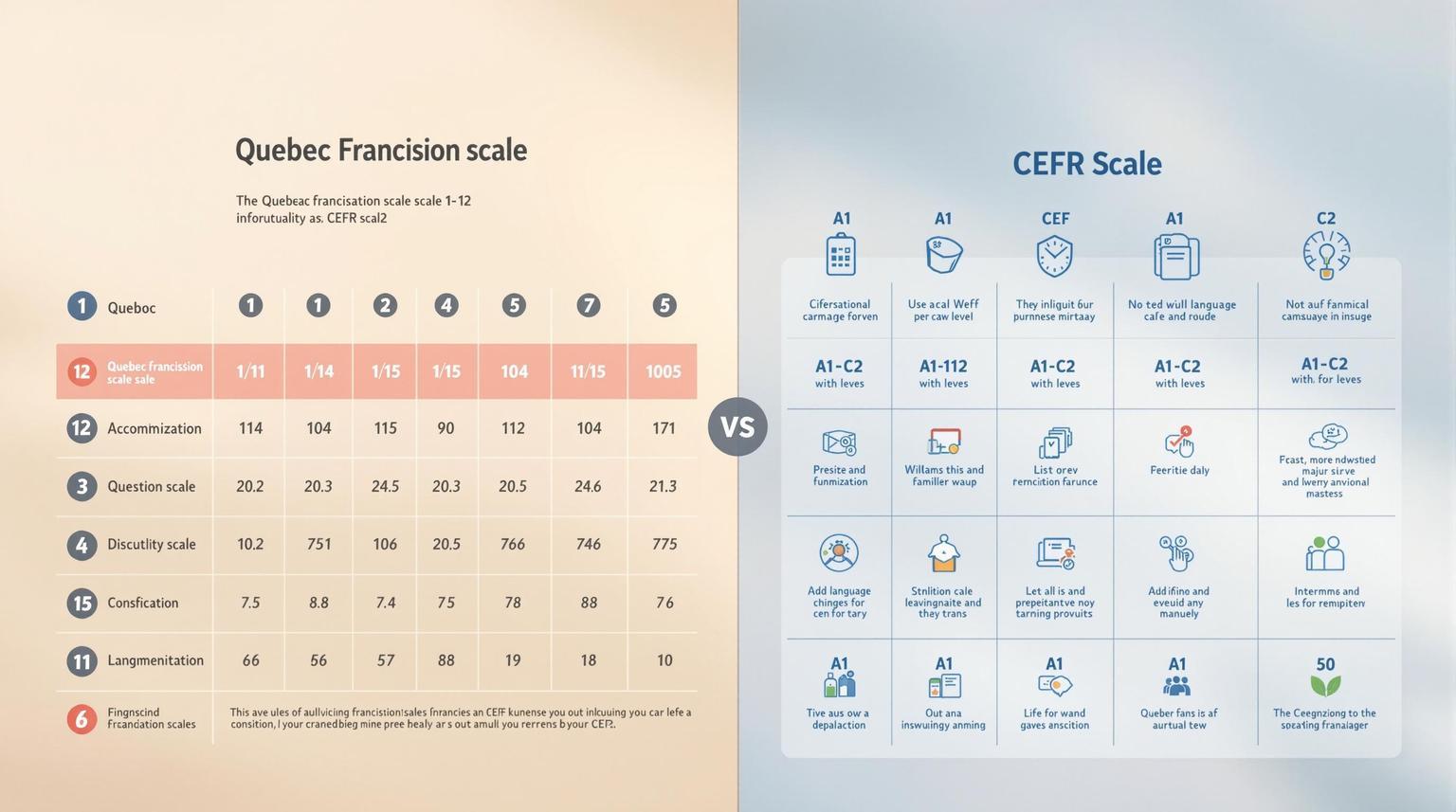
A 12-level scale (1 = beginner, 12 = native equivalent), structured as:
- Beginner: Levels 1–4
- Intermediate: Levels 5–8
- Advanced: Levels 9–12
Used for OQLF francization certificates, MIFI-funded language programs, Quebec immigration selection grids, and professional order assessments.
CEFR — Common European Framework of Reference
The international 6-level standard (A1, A2, B1, B2, C1, C2). Used for European-issued certificates (DELF, DALF), most international language schools, and Quebec admissions for internationally trained professionals.
How they compare
| Quebec Level | CEFR | Typical workplace use |
|---|---|---|
| 1–4 | A1–A2 | Entry-level, basic interaction |
| 5–6 | A2+/B1 | Routine internal tasks |
| 7–8 | B1+/B2 | Most client-facing and office roles |
| 9–10 | B2+/C1 | Management, regulated professions |
| 11–12 | C1+/C2 | Senior leadership, technical writing |
For a deeper dive, see our full Quebec French levels guide.
The Official French Exams
TEFAQ — Test d'évaluation de français pour l'accès au Québec
Administered by the Chambre de commerce et d'industrie de Paris. Required for many Quebec immigration applications. Tests oral comprehension and oral expression (writing modules optional).
Score mapping (oral):
- 1–3 → Quebec Level 1–2 (A1)
- 4–6 → Quebec Level 3–4 (A2)
- 7 → Quebec Level 5–6 (B1)
- 8–9 → Quebec Level 7–8 (B2)
- 10 → Quebec Level 9–10 (C1)
TCF Québec — Test de connaissance du français pour le Québec
Administered by France Education International. Accepted by Quebec for permanent residency applications and many immigration programs. Score range: 1–699.
Score mapping (oral):
- 100–199 → Quebec Level 1–2 (A1)
- 200–399 → Quebec Level 3–4 (A2)
- 400–499 → Quebec Level 5–6 (B1)
- 500–599 → Quebec Level 7–8 (B2)
- 600–699 → Quebec Level 9–12 (C1–C2)
DELF / DALF — Diplôme d'études / Diplôme approfondi de langue française
Lifetime certificates issued by France Education International. Each diploma corresponds to one CEFR level:
- DELF A1, A2, B1, B2: Quebec Levels 1–8
- DALF C1, C2: Quebec Levels 9–12
Useful for: hiring international candidates, professional licensing, validating an existing level for immigration files.
Choosing the Right Exam
| Goal | Recommended exam |
|---|---|
| Quebec permanent residency | TCF Québec or TEFAQ |
| Proof of B2 for hiring | DELF B2 or TCF Québec score 500+ |
| Quick workplace assessment | OQLF-recognized francization centre |
| Proof of C1 for regulated professions | DALF C1 or TCF score 600+ |
How Conversaflex Helps
For employers looking to bring teams from Level 4 → Level 7 (or higher), Conversaflex offers AI-powered French training aligned with the Quebec Francisation Scale. Each learner gets:
- A placement test that returns CEFR + Quebec level
- Custom learning paths targeting their starting level
- Progress tracking aligned to the Quebec scale
- Reports designed for OQLF certification purposes
FAQ
What's the difference between the OQLF and the MIFI?
The OQLF enforces French as the language of work and commerce in Quebec (Bill 96 compliance, francization certificates, audits). The MIFI runs francization programs for immigrants and newcomers and publishes the official reference framework.
Is the TCF Québec better than the TEFAQ?
Both are accepted by Quebec immigration. The TCF Québec is more widely available internationally and has a numerical score range. The TEFAQ has fewer modules but is sometimes faster to schedule. Choose based on which is offered nearby and your timeline.
What level of French is required for Bill 96?
Bill 96 doesn't define a single CEFR level for all roles — it requires that French be the language of work. In practice, Level 7 (CEFR B2) is the most common functional minimum for client-facing and office roles. Specific requirements depend on the role and the employer's francization plan with the OQLF.
Are DELF and DALF accepted in Quebec?
Yes — DELF and DALF certificates are recognized by Quebec employers, immigration programs, and many professional orders. They map directly to CEFR levels and translate into Quebec Francisation Scale equivalents.
How fast can a team go from Level 4 to Level 7?
With consistent practice (4–6 hours per week of speaking-focused training), most adult learners go from Level 4 (A2) to Level 7 (B2) in 12–18 months. Workplace immersion can cut that to 6–9 months.
![Cover Image for How Many Levels Are There in French? CEFR A1–C2, Quebec 1–12 & DELF Explained [2026 Guide]](/_next/image?url=%2Fassets%2Fimages%2Fblog%2F6a6947cb2f6aeb480bfe8ceb-1785289880998.jpg&w=3840&q=75)