
How Many Levels Are There in French? CEFR A1–C2, Quebec 1–12 & DELF Explained [2026 Guide]
Compare CEFR A1–C2, Quebec 1–12 and DELF/DALF exams to pick the right benchmark for study, work, or Quebec immigration.
![Cover Image for How Many Levels Are There in French? CEFR A1–C2, Quebec 1–12 & DELF Explained [2026 Guide]](/_next/image?url=%2Fassets%2Fimages%2Fblog%2F6a6947cb2f6aeb480bfe8ceb-1785289880998.jpg&w=3840&q=75)
How Many Levels Are There in French? CEFR A1–C2, Quebec 1–12 & DELF Explained [2026 Guide]
There isn’t just one French level system. There are three you’ll see most often: CEFR (6 levels), Quebec’s scale (12 levels), and DELF/DALF diplomas.
If I want the short answer, it’s this:
- CEFR runs from A1 to C2
- Quebec uses levels 1 to 12
- DELF/DALF are exams tied to CEFR:
- DELF: A1 to B2
- DALF: C1 to C2
For most people, B2 is the point where French starts to work well for study, many jobs, and many immigration paths. In Quebec, that often lines up with about levels 7–8. And if I need paper proof, I’m not just looking at a level system - I’m looking at an official exam.
Here’s the fast breakdown:
- Use CEFR if I want to track learning
- Use Quebec 1–12 if I’m dealing with Quebec work or immigration (and how it affects visa renewals)
- Use DELF/DALF if I need a diploma that stays valid for life
- Expect exam fees from about $200 CAD to $385 CAD
- Passing DELF/DALF means at least 50/100
Not sure which level you're at? Take our free French placement test — you speak with an AI examiner for 10 minutes and get your CEFR level (A1–C2), free.
::: @figure
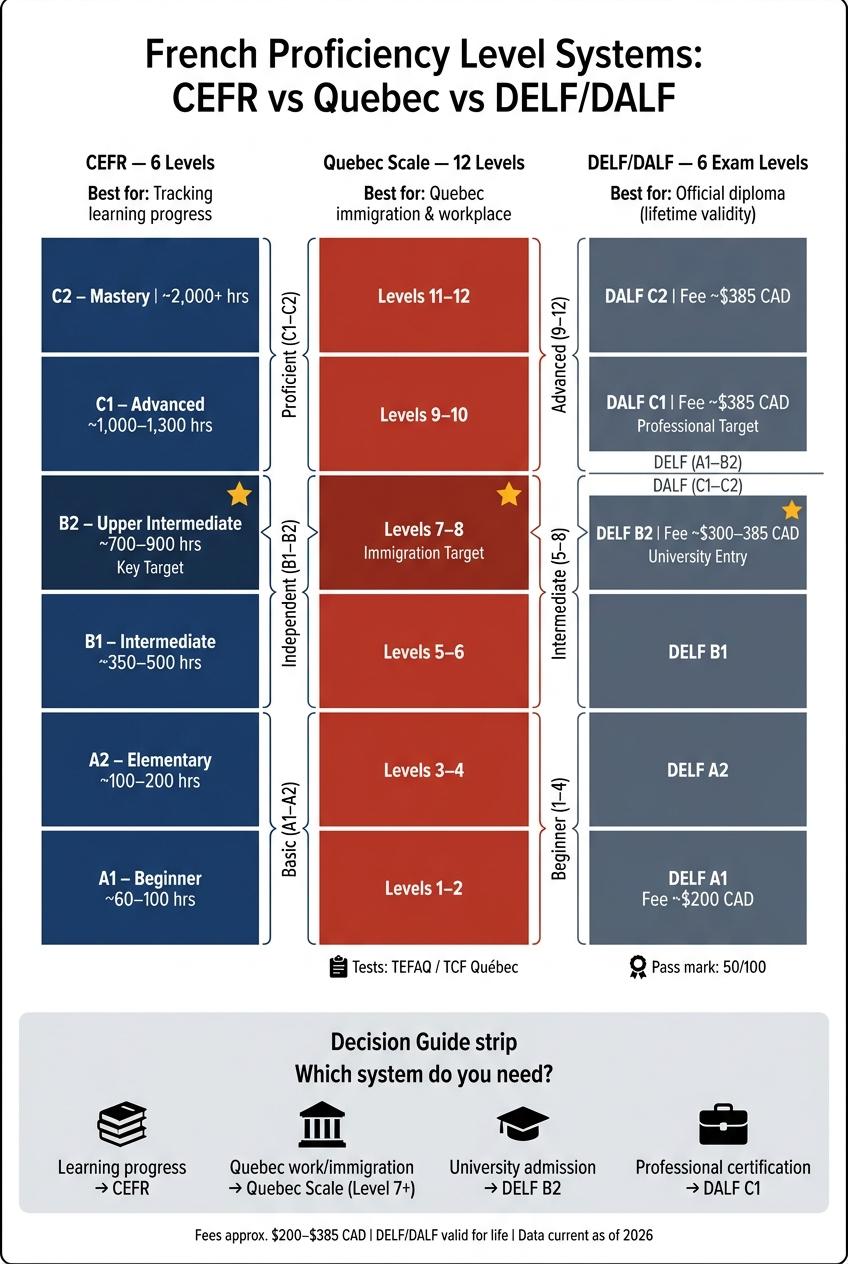
A1, A2, B1, B2, C1, C2... What do these levels mean for French language learners?
Before diving into the details, you can take our free French placement test to see where you currently stand, or read more about how French proficiency tests work.
sbb-itb-7df369b
Quick Comparison
| System | Number of Levels | Main Use | Common Target |
|---|---|---|---|
| CEFR | 6 | Learning and general assessment | B2 |
| Quebec scale | 12 | Quebec immigration and local workplace use | Level 7+ |
| DELF/DALF | 6 exam levels tied to CEFR | Official proof for school or work | DELF B2 / DALF C1 |
So if you’re asking, “What level is my French?”, the better question is: Which system does my next step require?
1. CEFR A1–C2
CEFR has six levels, from A1 to C2, split into three tiers: Basic User (A1–A2), Independent User (B1–B2), and Proficient User (C1–C2). Here’s the ladder in plain terms.
| CEFR Level | Tier | Can Do | Approx. Hours |
|---|---|---|---|
| A1 – Beginner | Basic | Greet people, introduce yourself, and answer simple personal questions | 60–100 hrs |
| A2 – Elementary | Basic | Handle simple daily tasks, describe your background, and manage short conversations | 100–200 hrs |
| B1 – Intermediate | Independent | Manage most travel situations, discuss familiar topics, and write simple texts | 350–500 hrs |
| B2 – Upper Intermediate | Independent | Hold fluent conversations with native speakers and defend viewpoints on complex topics | 700–900 hrs |
| C1 – Advanced | Proficient | Understand implicit meaning in complex texts and speak fluently in professional, social, or academic settings | 1,000–1,300 hrs |
| C2 – Mastery | Proficient | Understand almost everything and express subtle meaning fluently | 2,000+ hrs |
For most adult learners, B2 is the level that makes the biggest difference. It’s often enough for university entry, many Quebec immigration pathways, and everyday communication at work. In plain English, B2 usually means you can function with confidence, not just get by.
C1 is a stronger mark if you’re aiming for professional training or a French-speaking workplace [4][7]. C2, on the other hand, is a much longer road. It asks for near-complete control of the language, including nuance, tone, and subtle meaning.
Next, see how Quebec's 1–12 scale maps onto these CEFR bands.
2. Quebec French Proficiency Scale 1–12
Quebec uses the Échelle québécoise des niveaux de compétence en français, a 1–12 scale split into three bands: Beginner (1–4), Intermediate (5–8), and Advanced (9–12) [8]. If you're planning for work or immigration in Quebec, this is the scale that matters most on the ground.
At the Beginner stage, the goal is simple day-to-day communication. By Level 4, a learner can manage short conversations about routine activities, like reporting a routine problem or following a simple explanation [8]. In some permanent selection applications, spouses need at least Level 4 oral French [8].
The Intermediate stage is where French starts to matter more at work. Level 5 includes basic written tasks, like emailing a colleague or reading a lease [8]. By Level 7, a learner can work with more independence: they can read reports, sort facts from opinions, and explain their position to colleagues [8]. Level 7 also shows up in 2026 Quebec immigration programs [9].
| Quebec Level | CEFR Equivalent | What You Can Do |
|---|---|---|
| 1–2 | A1 | Basic survival phrases |
| 3–4 | A2 | Functional daily tasks; explain simple problems |
| 5–6 | B1 | Write professional emails; understand a lease |
| 7–8 | B2 | Workplace autonomy; explain pros and cons; understand economic reports |
| 9–10 | C1 | Complete professional independence; complex technical texts and implied meaning |
| 11–12 | C2 | Near-native mastery |
For Quebec immigration, the tests most often referenced are TEFAQ and TCF Québec. The standard TCF Canada is often not accepted for Quebec-specific streams [9].
Since the oral section is where most candidates lose points, it's worth rehearsing it before you book a seat. You can practise the TCF oral exam free with an AI examiner as many times as you want.
Next, compare Quebec levels with DELF and DALF, the official diplomas used to certify French proficiency.
3. DELF/DALF
CEFR tells you what level you have, and Quebec has its own scale. DELF/DALF is different: it gives you a formal diploma.
DELF and DALF are official French diplomas issued by France Éducation International. DELF covers A1 to B2, while DALF covers C1 to C2, and both stay valid for life [1][10][11]. That makes them a solid way to show proof of French for school or work.
Both exams test the four core skills:
- listening
- speaking
- reading
- writing
You need 50/100 to pass [1][10][11]. There’s one detail that trips people up: if you take the B2 exam and don’t pass, you do not automatically get a B1 diploma [1]. You either pass the level you registered for, or you get no diploma.
For most adults, DELF B2 is the best goal. It’s the common university entry level and lines up with many workplace needs [4][2]. DALF C1 is the next step if you need stronger French for work [4]. These diplomas can also help with federal hiring applications [7].
Pros and Cons of Each French Level Framework
Each framework does a different job.
The table below shows where each one fits best.
| Framework | Main Strengths | Main Drawbacks | Best Use Case |
|---|---|---|---|
| CEFR (A1–C2) | Shared international standard; clear progression milestones [4][2] | Self-assessment can be subjective; no official diploma without a formal exam [2] | Internal employee assessment and upskilling roadmaps |
| Quebec 1–12 | Tailored to local usage and workplace norms [4][5] | Limited recognition outside Quebec; fewer resources than standard French [4][5] | Recruitment for Quebec-based roles and local integration |
| DELF/DALF | Lifetime validity; high prestige; recognized by universities and employers worldwide [6][4] | Expensive; single-sitting exam; requires attending an accredited testing centre [6] | Formal certification for professional roles and university admission |
In day-to-day use, the split is pretty simple. CEFR works well for internal training because it gives teams a shared progress scale without making staff sit an exam. Quebec's scale makes more sense for Quebec-based hiring and integration, where local usage and workplace expectations matter most. DELF/DALF is the one to use when you need a permanent credential with strong recognition for university admission or professional roles.
Cost is part of the decision too. Exam fees range from about $200 CAD at the A1/A2 level to $385 CAD for DALF C1 [6].
That trade-off leads to the final question: which benchmark should you use?
Which French Benchmark Should You Use?
Choose the benchmark that fits the result you need: tracking your progress, getting a credential, meeting Quebec rules, or applying for immigration. While you can compare the Quebec scale and CEFR, these systems are not identical. So the best move is to pick the one tied to your next step, not just the level you think you’re at right now.
| Your Goal | Best Benchmark | Typical Target |
|---|---|---|
| Track personal learning progress | CEFR (A1–C2) | Your current level |
| Apply to a francophone university | DELF | B2 |
| Use French professionally | DELF B2 or DALF C1 | B2–C1 |
| Quebec immigration or workplace requirements | Quebec Scale (1–12) | Level 7+ |
| Apply for Canadian PR | TEF / TCF Canada (mapped to CEFR) | B2 (CLB 7+) [5][3] |
| Federal government roles | CEFR | B2 minimum [3] |
Here’s the simple way to think about it. If you’re learning French and want a clear way to measure growth over time, start with CEFR. If you’re dealing with hiring, workplace rules, or immigration in Quebec, the Quebec Scale is usually the better fit. And if you need proof in the form of a formal diploma or test result, DELF/DALF or a Quebec-specific test makes more sense.
Put another way: CEFR helps you track learning, Quebec’s scale fits local rules, and DELF/DALF gives you formal certification. So the choice doesn’t have to be complicated. Match the benchmark to the thing you need it for in the near term.
Whichever benchmark you land on, the first step is the same: find out where you actually stand. Our free French placement test gives you a CEFR level in about 10 minutes by having you speak, and our free TCF oral practice lets you rehearse the exam format before you pay for a seat.
FAQs
How do I know which French level system I should use?
Start with your goal: immigration, university admission, or workplace requirements. CEFR (A1–C2) is the standard most official bodies and academic institutions use.
If you’re not sure where you stand, take a placement test to get a general benchmark. For official use, choose recognised exams such as DELF, DALF, TEF, or TCF. Then double-check the exact level the organisation asks for.
Is B2 enough for work or immigration in Quebec?
Yes. B2 is generally the level required for work immigration in Quebec.
For the Programme de l'expérience québécoise (PEQ) and other skilled worker streams, this usually means oral French at level 7 on the Échelle québécoise, which matches B2. As of 2026, this standard is strictly enforced.
Should I take DELF/DALF or a Quebec-specific French test?
It depends on your main goal.
Choose DELF/DALF if you need French for francophone university admission or an official international certification. These diplomas are valid for life.
Choose TEF Canada, TCF Canada, TEFAQ, or TCFQ if you're applying for immigration to Canada or Quebec. These tests are used for residency and citizenship applications, and their results are valid for two years.

![Cover Image for Corporate Language Training Costs: Conversaflex vs. Tutors, Classes and Apps [2026]](/_next/image?url=%2Fassets%2Fimages%2Fblog%2F68b2425f68bb5e38327dcb5b-1756542781388.jpg&w=3840&q=75)
![Cover Image for Free French Level Tests Compared: Which Online Test Should You Take? [2026]](/_next/image?url=%2Fassets%2Fimages%2Fblog%2F6a6becec2f6aeb480bfeb3ba-1785462442187.jpg&w=3840&q=75)



![Cover Image for CEFR A1 French Explained: What Beginners Can Do [2026 Guide]](/_next/image?url=%2Fassets%2Fimages%2Fblog%2F67e6cd20283d21cbd6790208-1743180073529.jpg&w=3840&q=75)