AI vs. Traditional Language Training for Teams
AI training outperforms traditional classes for scalable, cost‑effective French compliance, while instructors add cultural nuance — a hybrid approach works best.
AI vs. Traditional Language Training for Teams
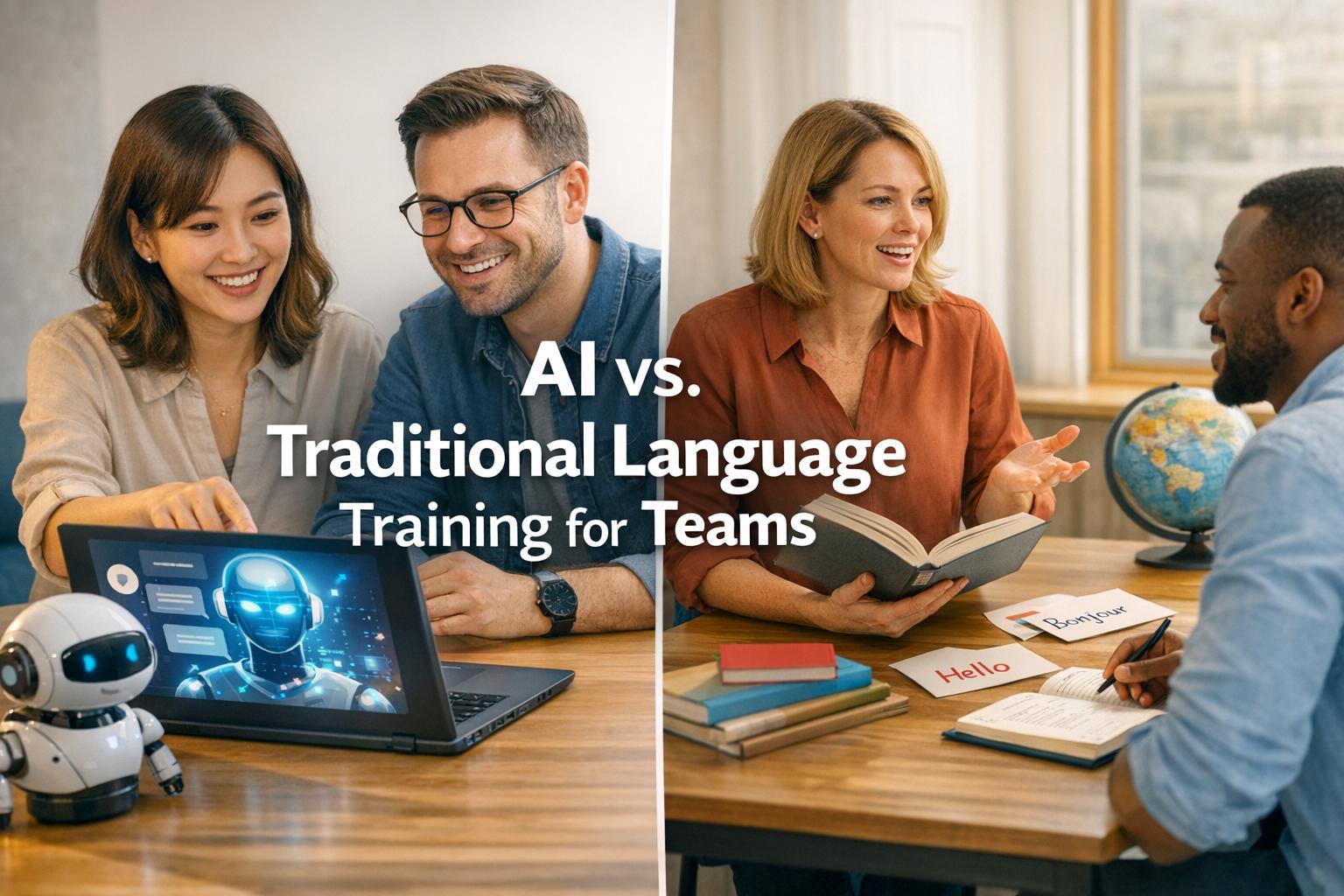
AI-powered language training is reshaping how teams in Quebec meet strict French-language requirements under Bill 96. With businesses required to ensure employees learn French within six months, organizations face a choice: AI-driven tools or instructor-led programs. Both have strengths, but their effectiveness depends on your team's needs.
Here's the quick takeaway:
- AI tools like Francoflex offer 24/7 access, personalized lessons, and cost-effective scalability. They're great for quick compliance, unlimited practice, and tailored learning.
- Instructor-led programs offer human interaction, group activities, and nuanced feedback, helping employees grasp complex social and workplace communication.
Key Differences:
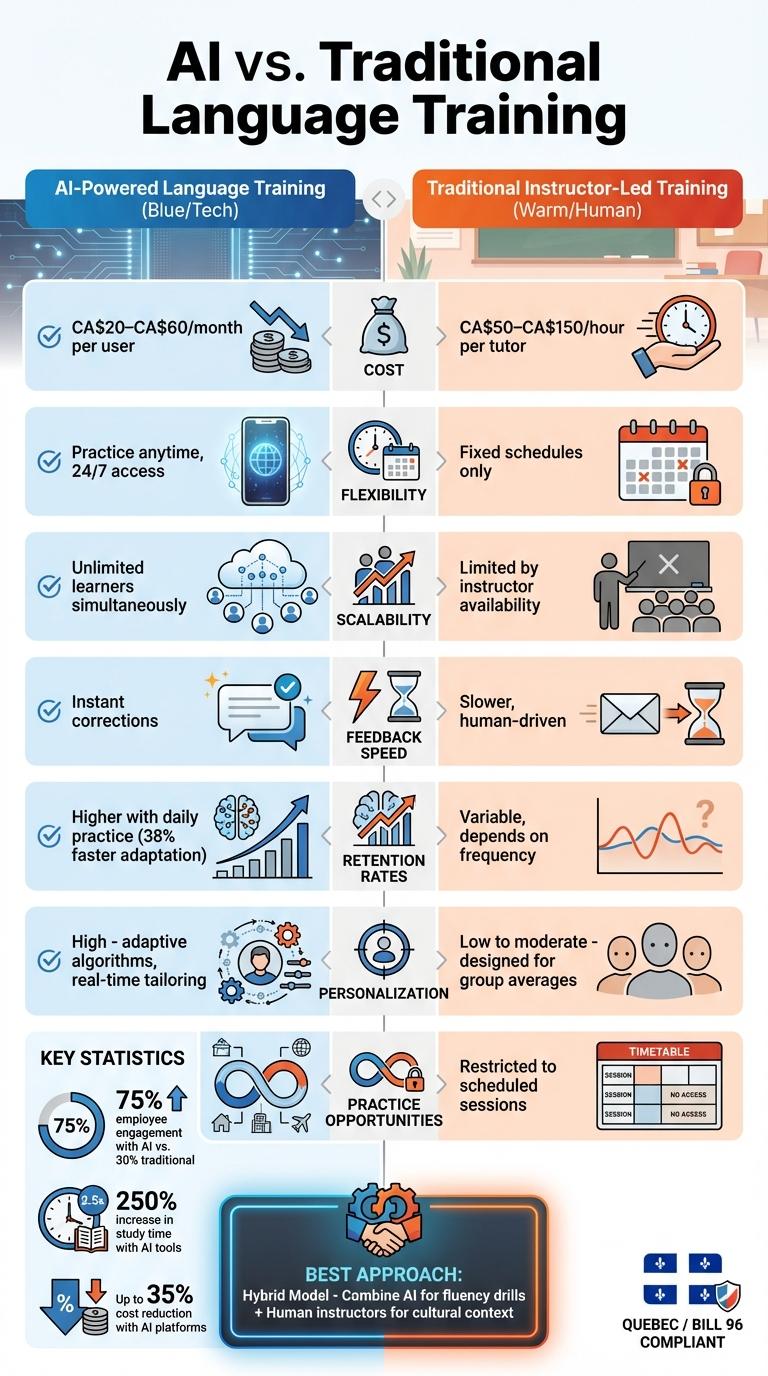
- Cost: AI is more affordable (CA$20–CA$60/month vs. CA$50–CA$150/hour for tutors).
- Flexibility: AI allows anytime practice; in-person training is limited to scheduled sessions.
- Scalability: AI supports large teams easily; instructor availability limits class size.
- Feedback: AI provides instant corrections; instructors offer deeper, contextual guidance.
- Retention: AI's daily practice boosts outcomes; in-person sessions may see slower progress.
Quick Comparison Table
| Feature | AI-Powered Training | Instructor-Led Training |
|---|---|---|
| Cost | CA$20–CA$60/month per user | CA$50–CA$150/hour per tutor |
| Flexibility | Practice anytime | Fixed schedules |
| Scalability | Unlimited learners | Limited by instructors |
| Feedback Speed | Instant | Slower, human-driven |
| Retention Rates | Higher with daily practice | Variable, depends on frequency |
For most businesses, combining both approaches works best. Use AI for fluency-building drills and compliance tracking, while relying on instructors for deeper insights and group learning. This hybrid method ensures employees meet language requirements efficiently while gaining workplace communication skills.
::: @figure
The Future of Workplace Inclusion: AI, Language Barriers, and Cultural Connection
Benefits of AI-Powered Language Training for Teams
AI-powered language training platforms solve the long-standing challenges of traditional training methods, particularly when it comes to scalability. These tools remove the need for travel, rigid schedules, and physical infrastructure, making them a flexible solution that aligns with the requirements of Bill 96 [1].
24/7 Access and Flexible Scheduling
One of the biggest drawbacks of traditional training is that it forces employees to choose between staying productive at work and dedicating time to language learning. AI tools eliminate this dilemma by enabling micro-learning sessions that employees can seamlessly fit into their workday [1][2].
Take EF Corporate Learning, for example. In October 2025, they reported that their AI-powered assistant, Addi, was helping more than 4,000,000 learners worldwide. Companies using their AI Conversations tool saw a 250% increase in study time, as employees embraced the opportunity for unlimited, low-pressure speaking practice [2]. Dr. Christopher McCormick, Chief Academic Officer at EF Corporate Learning, highlighted the transformation:
"AI does not change what works in language learning – it makes proven methods scalable, personal, and measurable for every learner." [2]
A survey of 1,300 training decision-makers at global companies ranked "24/7 access and flexibility" as the third most important feature of a language programme [2]. Platforms like Francoflex meet this demand by offering daily AI conversations that employees can access anytime - whether during a quick lunch break or after work hours.
Personalized Learning and Team Scalability
While one-on-one tutoring is highly effective, it's often too expensive for most organizations to implement at scale. AI bridges this gap by addressing what researchers call "Bloom's 2 Sigma Problem", which refers to the difficulty of providing personalized instruction to large groups [2]. With AI, every employee - whether entry-level or senior management - receives tailored learning experiences.
AI tools analyze an individual's study history to deliver real-time corrections on pronunciation and fluency, often with greater precision than human instructors [2]. A meta-analysis of 61 studies involving 8,282 learners revealed that AI-guided personalized learning achieves a significant effect size of d = 1.18 for language development [3]. What's more, these systems can scale effortlessly, supporting both small teams and massive organizations with tens of thousands of employees, without compromising quality [2].
Francoflex is a prime example of this scalability. It adapts to each employee's skill level, job context, and native language, while also offering role-specific training. For instance, customer service representatives can practise handling client calls, while technical writers focus on scenarios relevant to their work. This ensures employees develop skills they can immediately apply in their day-to-day tasks [6].
Improved Retention Through Unlimited Practice
Consistent practice is key to mastering a language, and AI tools provide opportunities for private, unlimited speaking practice. This helps employees build confidence before they face high-stakes workplace situations [2]. Unlike traditional classrooms, where speaking in front of peers can feel intimidating, AI creates a low-pressure environment for continuous improvement.
The impact on learning outcomes is clear. Research shows that AI-driven instruction leads to better results in grammar, vocabulary, reading comprehension, and writing compared to traditional classroom methods [4]. A 2023 study involving 93 Chinese EFL students found that those using AI-based tools with natural language processing and speech recognition made greater progress in speaking skills and reported higher levels of self-regulation [5].
AI-powered tools also excel at reinforcing learning. Unlike traditional methods, which often leave long gaps between practice sessions, AI enables daily interaction. For example, Francoflex users can practise French conversations every day, building fluency through repetition rather than waiting weeks between lessons [7].
These advantages of AI-powered language training set the stage for a clear comparison with traditional methods, highlighting why more organizations are making the switch.
Benefits of Traditional Language Training
Traditional instructor-led training brings unique advantages to workplace learning. Human instructors offer more than just corrections; they provide context and insights that help employees genuinely understand their progress, going beyond mere numerical scores [11].
Instructor Feedback and Cultural Context
While AI can deliver instant corrections, it often misses the subtleties of human interaction. Human instructors, on the other hand, can interpret non-verbal cues like facial expressions, body language, and hesitation - signals that indicate whether someone truly grasps the material or is just nodding along [12]. Dr. William D. Lopez highlighted this challenge in online teaching:
"I've had to adapt my approach in online classes because I rely on interpersonal cues" [12].
Instructors also offer actionable advice, such as alternative phrases, grammar tips, and cultural nuances, which learners can apply immediately [9][10]. This personalised feedback helps employees feel encouraged to experiment with new language forms without fear of making mistakes. As Langton Chikaka, Head of Zimuto RCZ High School, aptly put it:
"Feedback can be considered as a gift. It helps a person learn, grow and becomes their best selves" [9].
The pacing provided by human instructors is another critical factor. Instead of overwhelming learners with excessive information, they assess current proficiency levels and tailor strategies to help learners progress without frustration [8]. This is especially important for meeting professional certification benchmarks. For example, achieving Level B proficiency typically requires 48 weeks of full-time training (35 hours per week), while Level C demands an additional 24 weeks [13].
These one-on-one interactions naturally extend into group learning environments.
Group Activities and Team Building
Traditional classroom settings also excel at fostering group engagement. In-person training sessions encourage accountability and collaboration. Nadia Helal, an English teacher and pedagogical counsellor, summed it up well:
"There's nothing quite like being in a room full of people determined to learn the same language as you" [17].
Group settings boost what researchers call "Willingness to Communicate", a motivational factor closely tied to learner confidence [16]. Live interactions with peers and instructors allow for immediate feedback during conversations, giving employees the chance to practise pronunciation, grammar, and vocabulary in real time. This collaborative atmosphere mirrors workplace dynamics, where employees must navigate conversations with colleagues, clients, and stakeholders.
The emotional support found in traditional classrooms further enhances the learning experience. Unlike AI, which provides a neutral space for practice, group activities help employees tackle social anxiety by working through real-world scenarios with peers who face similar challenges [17]. This creates a relational learning experience that AI has yet to replicate [15].
Structured Classroom Environment
The structured nature of traditional training is another key advantage. Fixed schedules and formal settings help maintain focus and motivation [18][13]. These programs often include clear objectives, specific learning outcomes, and defined course lengths - essential components for meeting professional certification and organisational compliance requirements [18][13].
This structure also promotes linguistic security, where employees feel confident and comfortable using their second language in professional settings [18]. The Government of Canada describes this as a vital goal:
"Linguistic security is when a person feels confident and at ease when using a language" [18].
In structured environments, instructors can focus on teaching complex social cues and workplace communication, while repetitive practice is left to other methods [2]. This alignment of language training with organisational goals supports talent development and succession planning [18].
AI vs. Traditional Language Training: Side-by-Side Comparison
Each approach brings its own advantages, and understanding their strengths can help organizations make smarter decisions about language training investments. The differences become especially clear when considering factors like cost, scalability, and how learners engage with the material.
Feature Comparison Table
| Feature | AI-Powered Training | Traditional Instruction |
|---|---|---|
| Cost | CA$20–CA$60 per month per learner; requires an upfront tech investment but offers lower costs per user as it scales [20] [2] | CA$50–CA$150 per hour for tutors; involves ongoing expenses like salaries, materials, and travel [20] [1] |
| Personalization | High; uses adaptive algorithms to tailor lessons to individual progress in real time [15] | Low to moderate; typically designed for group learning averages [20] |
| Practice Opportunities | Unlimited access to speaking and writing exercises anytime, anywhere [2] | Restricted to scheduled classroom sessions [20] |
| Scalability | Extremely scalable; supports thousands of learners at once [2] | Limited by instructor availability and physical space constraints [1] |
| Feedback Speed | Instant; provides real-time corrections on grammar, pronunciation, and vocabulary [19] | Delayed; depends on instructor availability and class size [19] |
| Retention Rates | Higher outcomes in areas like grammar and vocabulary; adapts learner progress 38% faster [4] [20] | Variable; often hindered by infrequent practice sessions [2] |
This table highlights how AI-powered and traditional methods differ in cost, flexibility, and feedback. It's clear that the right choice depends on the specific needs and goals of the organization.
AI stands out for its ability to offer personalized, round-the-clock practice and instant feedback. On the other hand, traditional methods excel in delivering a structured classroom experience and providing cultural insights that are harder to replicate with technology. Dr. Christopher McCormick, Chief Academic Officer at EF Corporate Learning, encapsulates this shift well:
"AI does not change what works in language learning – it makes proven methods scalable, personal, and measurable for every learner" [2].
To get the best of both worlds, organizations should combine AI's efficiency in fluency-building drills with the cultural and nuanced feedback that human instructors provide. AI is perfect for repetitive practice and immediate corrections, while human instructors bring the depth and context needed for real-world workplace communication. This hybrid strategy addresses a critical gap: fewer than 33% of global organizations currently offer highly personalized language training, even though HR leaders consistently rank it as a top priority [2].
How AI Language Training Works in the Workplace
AI language platforms address everyday workplace challenges by tailoring training to specific contexts and compliance demands. This targeted approach not only supports adherence to regulations but also ensures smooth team integration. Such flexibility is especially important for meeting strict legal standards.
Meeting Bill 96 Requirements and Certification
Starting 1 June 2025, Quebec's Bill 96 will extend francisation requirements to all businesses with 25 or more employees. Non-compliance comes with hefty fines ranging from CA$3,000 to CA$30,000 per day, with penalties doubling or tripling for repeat violations. In fact, the Office québécois de la langue française (OQLF) saw a 33% rise in language-related complaints in 2023–2024, with 9,125 cases reported [23].
Francoflex helps businesses stay ahead of these requirements by offering tools like automated progress tracking and tailored reports to meet OQLF certification standards. As Sonia B., Director of Human Resources, puts it:
"Je ne veux pas que mes employés soient sur une liste d'attente de Francisation Québec pendant des mois" [21].
This immediate access allows businesses to achieve certification faster and avoid costly delays.
Role-Specific and Industry-Specific Training
AI-powered platforms customize training to align with an employee's specific job duties, native language, and skill level [21][22]. Companies can also upload internal terminology and documents, ensuring that employees learn the vocabulary and scenarios relevant to their roles. This is particularly beneficial for industries like healthcare, engineering, and technology, where specialized language is essential. José, a small business owner, shares:
"This will help my business grow as I'll be able to send my workers to client's homes knowing they can communicate properly in French" [21].
The platform's AI agent provides daily, personalized conversations based on each employee's progress, ensuring that the training is practical and directly tied to their tasks.
On top of tailored content, the cost savings make these AI solutions even more appealing.
Cost-Effective Solutions for Any Team Size
AI language training can cut corporate training costs by up to 35%, making it a budget-friendly option for businesses of all sizes. Stéphane, Président, highlights:
"Francoflex ensures I stay compliant at a small cost" [21].
With 24/7 availability, employees can complete quick 10–15 minute sessions during breaks, seamlessly fitting training into their busy workdays. This flexibility ensures that businesses can scale training programs efficiently, regardless of team size.
Conclusion: Choosing the Right Language Training for Your Team
Deciding between AI-powered and traditional language training comes down to your business needs and priorities. Traditional classroom training is great for teaching cultural nuances and building team connections through group activities. However, it often struggles with rapid knowledge loss and requires significant administrative effort to manage [24].
AI platforms like Francoflex tackle these challenges head-on. With round-the-clock availability and personalized learning paths, employees can practise whenever it suits them - even during short breaks. These platforms can scale without needing extra instructors or physical classrooms, which is especially useful for businesses navigating Bill 96 compliance. Automated progress tracking also simplifies the documentation process for OQLF certification, reducing the administrative workload.
Beyond operational ease, AI platforms create a more engaging learning experience. The numbers speak for themselves: 75% of employees feel engaged in personalized AI learning environments, compared to just 30% in traditional settings [14]. Francoflex's AI agent tailors daily conversations to each employee's role, native language, and progress, helping them focus on job-specific vocabulary.
Cost is another critical factor. While human tutors typically charge between CA$50 and CA$150 per hour [20], AI platforms are far more affordable, ranging from CA$20 to CA$60 per month per user [20]. As José, a small business owner, puts it:
"This will help my business grow as I'll be able to send my workers to client's homes knowing they can communicate properly in French" [21].
When you combine these advantages, AI-powered solutions emerge as an effective alternative to traditional methods. For businesses in French-speaking regions, platforms like Francoflex provide the tools to meet regulatory demands while keeping costs in check. The non-judgmental environment encourages consistent practice, and features like instant feedback on pronunciation and grammar speed up the learning process, making it a smart choice for teams of any size.
FAQs
How does AI-based language training help teams retain what they learn better than traditional methods?
AI-powered language training improves retention by delivering customized learning experiences that cater to each individual's unique needs. This method not only keeps learners more engaged but also helps them understand and retain concepts more effectively, supporting better long-term memory.
Unlike conventional approaches, AI tools adapt in real-time to a learner's progress. They offer targeted exercises and instant feedback, creating a dynamic learning environment. This flexibility keeps employees motivated and continuously developing their skills, making it particularly useful in team environments where learning speeds can vary widely.
What are the cost advantages of using AI-powered language training for large teams?
AI-powered language training can be a game-changer for large teams, especially when it comes to cutting costs. By moving away from traditional in-person classes, printed materials, and tedious administrative tasks, businesses can save a lot. Platforms like Francoflex make this even easier by offering scalable solutions that let companies train numerous employees at the same time - without sacrificing quality.
Another big advantage? Flexibility. AI-driven tools let employees learn at their own pace and on their own schedules. That means less disruption to daily work and fewer requests for time off. Not only does this keep direct training expenses down, but it also boosts overall efficiency. For large teams, this approach can translate into major savings and smarter use of resources.
Can AI tools teach cultural and contextual language skills as effectively as human instructors?
AI tools can offer helpful insights into language use by considering cultural and contextual factors, though they don't quite reach the depth that human instructors can provide. These advanced systems excel at simulating practical scenarios, delivering customized feedback, and adjusting to individual learning needs. This makes them a strong resource for grasping language in different settings.
That said, understanding subtle cultural nuances and interpreting social cues often calls for human judgement, empathy, and lived experience - areas where AI still has limitations. As a result, AI works best as a support to traditional instruction, especially for businesses aiming to provide scalable and personalized language learning options.

![Cover Image for Corporate Language Training Costs: Conversaflex vs. Tutors, Classes and Apps [2026]](/_next/image?url=%2Fassets%2Fimages%2Fblog%2F68b2425f68bb5e38327dcb5b-1756542781388.jpg&w=3840&q=75)
![Cover Image for Free French Level Tests Compared: Which Online Test Should You Take? [2026]](/_next/image?url=%2Fassets%2Fimages%2Fblog%2F6a6becec2f6aeb480bfeb3ba-1785462442187.jpg&w=3840&q=75)
![Cover Image for How Many Levels Are There in French? CEFR A1–C2, Quebec 1–12 & DELF Explained [2026 Guide]](/_next/image?url=%2Fassets%2Fimages%2Fblog%2F6a6947cb2f6aeb480bfe8ceb-1785289880998.jpg&w=3840&q=75)