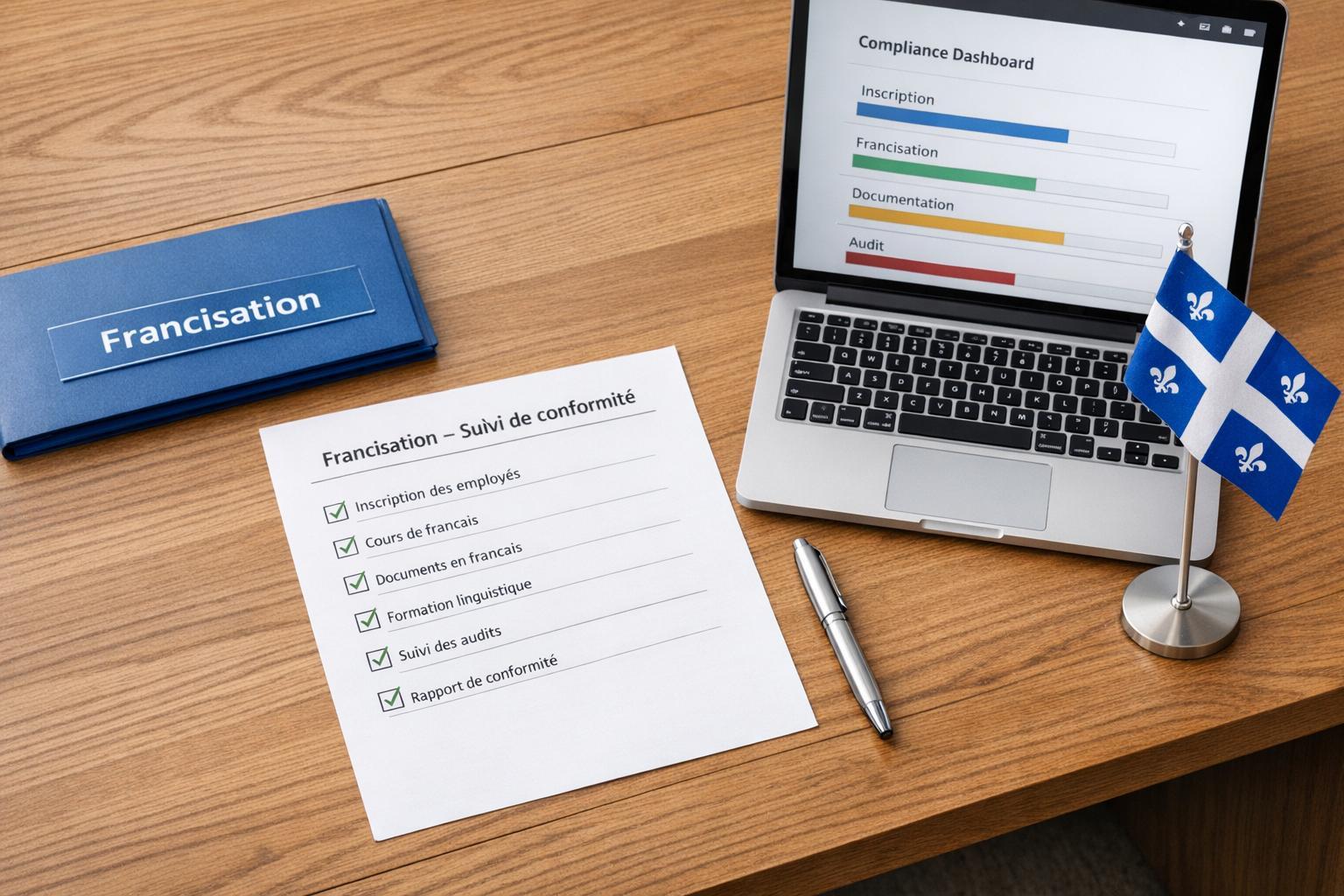
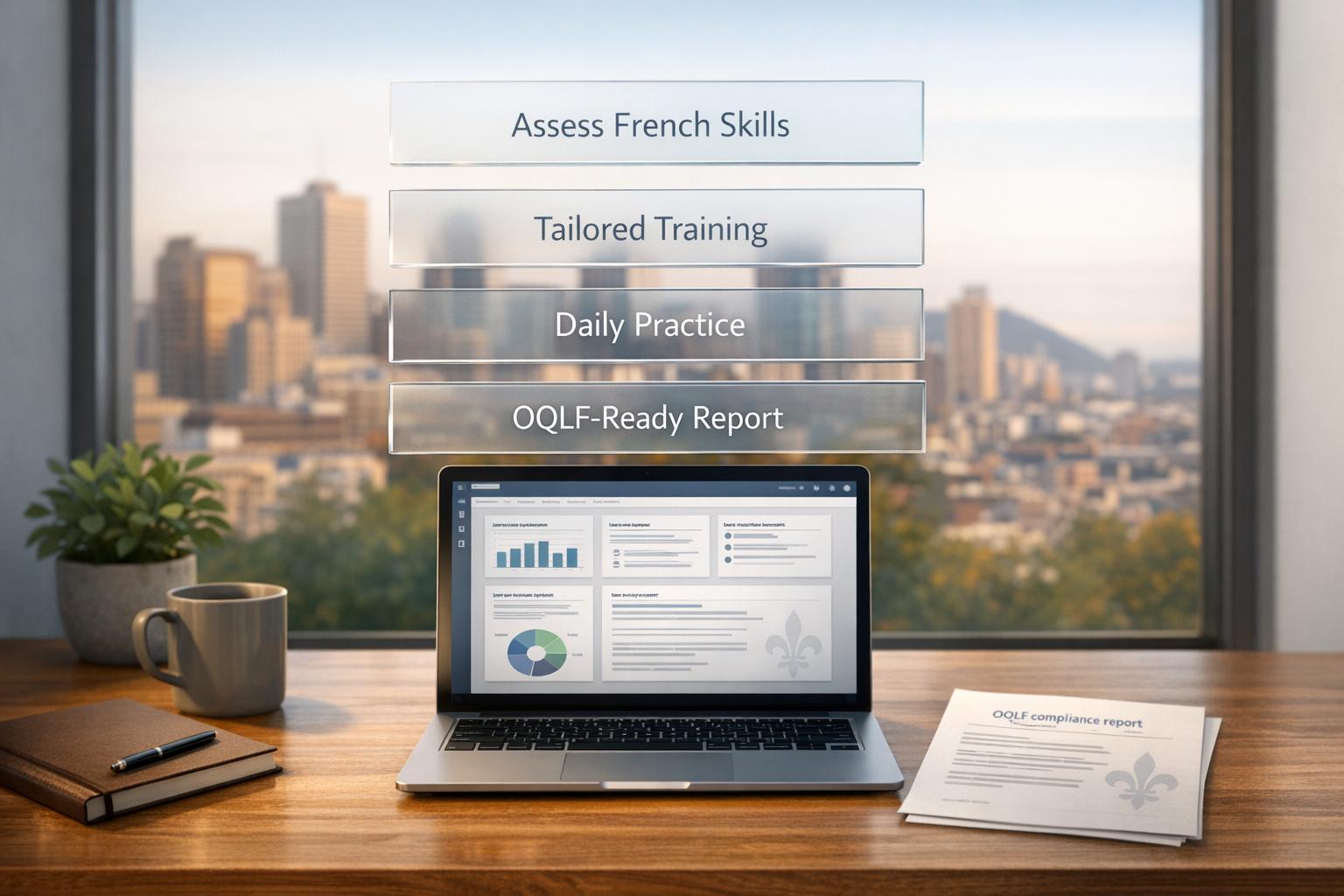
Using your L&D budget towards language learning (Canada)
Guide for Quebec employers on allocating L&D budgets to French training, using provincial funding and AI tools to meet Bill 96, CAQ and LMIA rules.
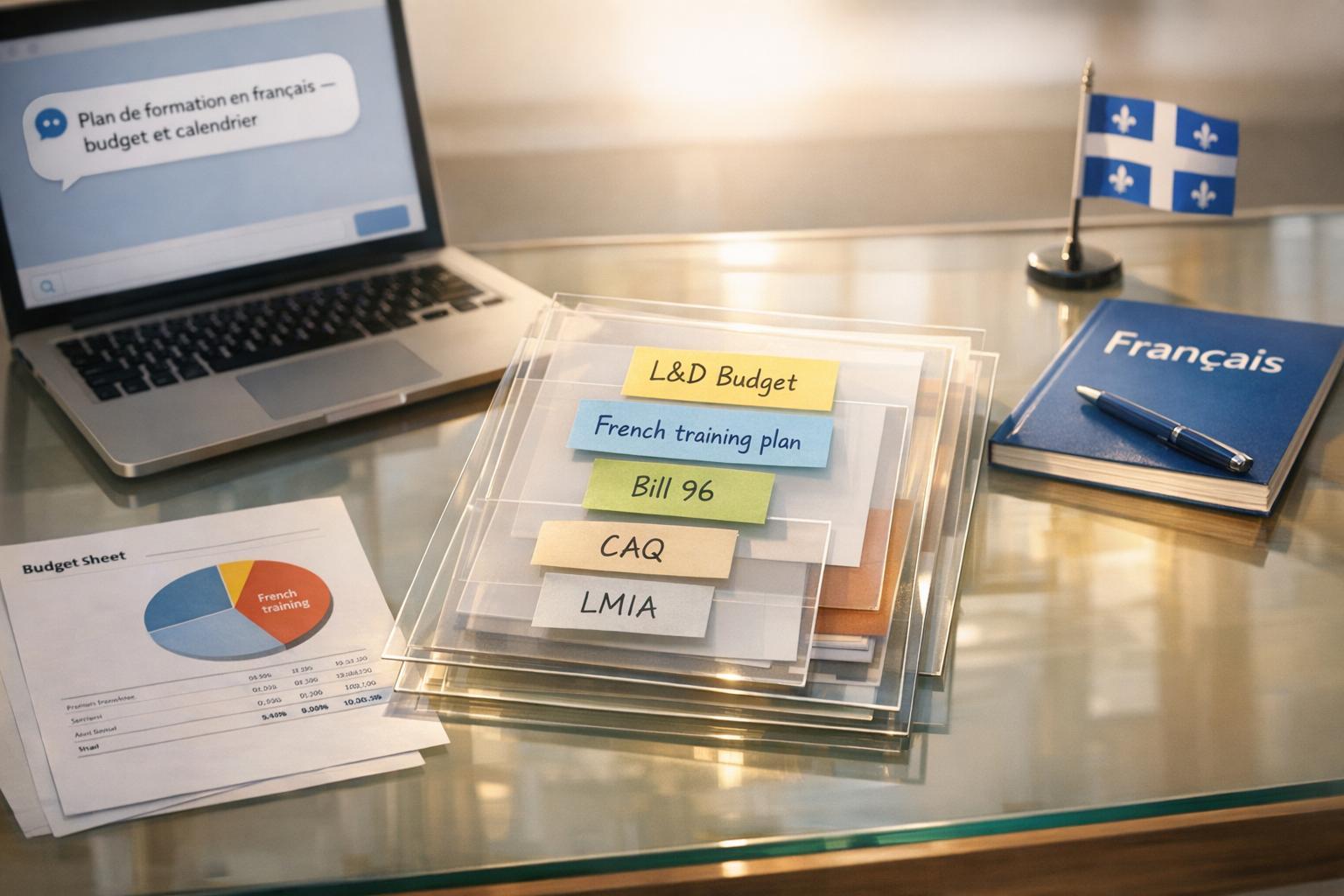
Quebec’s new language laws mean businesses must prioritize French training. With Bill 96 in effect, companies with 25+ employees are now required to operate primarily in French. Temporary foreign workers (TFWs) must also meet specific language requirements to renew work permits. Non-compliance can result in fines of up to CAD $700,000.
Here’s why investing in French training makes sense:
- Improves employee retention by 25–35% for bilingual roles.
- Simplifies compliance with labour laws like LMIA and CAQ renewals.
- Aligns with government funding opportunities, such as Quebec’s Workforce Training Measure, which covers up to 75% of training costs.
AI-powered tools like Conversaflex offer flexible, job-specific language training, helping employees meet proficiency standards (Level 4/B2) while reducing disruptions to daily operations. Early investment in language learning not only ensures compliance but also strengthens workforce integration and reduces turnover costs.
Start by auditing your team’s current French skills, then combine free provincial programs with AI-driven platforms for tailored, cost-effective training.
Get paid $230 a week for free for learning this.....
sbb-itb-d43bb17
Quebec's French Language Compliance Requirements
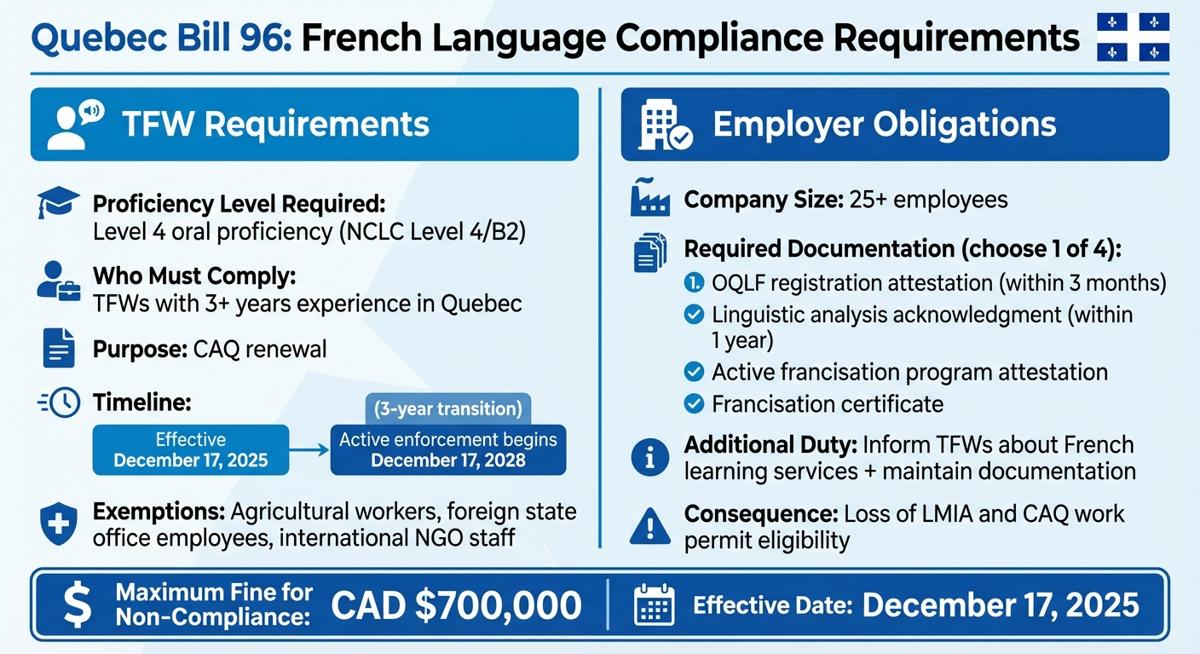
Quebec introduced stricter rules for workplace francisation on December 17, 2025. Companies with 25 or more employees must now follow specific steps when hiring temporary foreign workers (TFWs). Workers themselves are also required to meet particular French proficiency levels to maintain their work permits. These measures are essential for securing Labour Market Impact Assessments (LMIAs) and renewing Quebec Acceptance Certificates (CAQs). Here's a breakdown of what's required for both TFWs and employers.
French Proficiency Requirements for Temporary Foreign Workers
Temporary foreign workers with three or more years of experience in Quebec must now demonstrate Level 4 oral proficiency (equivalent to NCLC Level 4/B2) to renew their CAQ. According to the regulation, "Level 4 doesn't require absolute proficiency. Rather, this level represents basic functional oral skills. This includes the ability to understand safety instructions, communicate basic workplace needs, and exercise their rights as workers" [4].
Although these rules came into effect in December 2025, there’s a three-year transition period. Active verification of compliance will only begin on December 17, 2028. This gives current workers time to meet the required language level. Employers, however, should act now by offering language training to TFWs whose assignments are likely to last beyond three years. It’s worth noting that certain groups, such as agricultural workers, employees of foreign state offices, and staff of international NGOs, are exempt from this requirement.
Employer Compliance Obligations
Employers also have a set of responsibilities under these new regulations. Since December 17, 2025, companies with 25 or more employees must include proof of francisation compliance with every LMIA application. This proof can take one of four forms:
- An attestation of OQLF registration (issued within the last three months)
- An acknowledgment of receipt for a linguistic analysis (issued within the last year)
- An attestation of an active francisation program
- A francisation certificate
Additionally, employers must inform newly hired TFWs about the availability of French-language learning services. Documentation of this disclosure must be kept for audit purposes. According to Fakhoury Law Group, failing to meet these requirements could lead to the loss of eligibility to obtain LMIA- and CAQ-based work permits [3].
These changes underscore the importance of investing in French language training as part of workforce development. It’s not just about compliance - it’s also a step toward smoother integration of workers into Quebec’s labour market.
How to Allocate L&D Budgets for Language Training
Evaluating Workforce Language Needs
Start by identifying which employees require French training to meet compliance standards and ensure smooth communication. Conduct an internal audit to evaluate the current French proficiency levels within your workforce. Take note of hire dates, the duration of assignments, and existing language skills to create a well-structured training timeline. Don't limit this assessment to roles with explicit regulatory requirements - also consider employees who frequently interact with French-speaking colleagues, clients, or rely on French-language safety materials. This focused strategy ensures your training budget is directed where it will have the greatest impact on compliance and operations. Use this data to choose training methods that best fit your team's needs.
Combining Free and Paid Training Resources
Free provincial francisation programs can be a great starting point for building foundational French skills. However, these programs often come with fixed schedules and waiting lists, which may not suit all employees. To stretch your L&D budget further, consider a blended approach: use these free programs for general language instruction and invest in paid, AI-driven platforms for job-specific vocabulary and flexible, on-demand practice.
There are also funding options to help offset the costs of paid training. For instance, Quebec’s Workforce Training Measure can cover 50–75% of training expenses if you use approved providers. Businesses with payrolls over $2 million can allocate 1% of their training budget for this purpose, and tax credits may reimburse up to $75,000 for documented francisation efforts. Additionally, Digital Literacy Grants can cover up to 100% of certain training costs, including salaries up to $25 per hour. By combining free and paid resources, you can make the most of your training budget while ensuring employees receive tailored and effective language support.
The Business Case for Early Investment
Postponing francisation training can lead to serious challenges. Delays may result in non-compliance, expensive recruitment processes, and the loss of valuable institutional knowledge. Starting training early gives employees the time they need to meet proficiency requirements, aligning with your broader compliance strategy.
Beyond compliance, early investment in language training can also improve employee retention. Workers who feel supported in their language development are more likely to feel connected to Quebec’s workplace environment, which can lower turnover rates. Losing a trained employee often costs far more than investing in proactive language training, making early action a wise financial and strategic decision for your organization.
AI-Powered Tools for Workplace Francisation
AI-driven platforms like Conversaflex are transforming how Canadian organizations tackle workplace francisation. These tools offer flexible, budget-friendly solutions that integrate seamlessly into existing learning and development (L&D) programs, helping businesses meet Bill 96 compliance requirements without straining resources. With the ability to support anywhere from a few employees to over 50,000, Conversaflex eliminates the need for additional instructors or physical space. This makes it especially valuable for companies operating across multiple locations with varied language needs. Beyond scalability, the platform provides customized learning experiences tailored to employees' specific job roles.
Job-Specific Language Training
Standard French lessons often miss the mark when it comes to workplace needs. Conversaflex addresses this gap by offering training tailored to the unique demands of each role. Whether your team is in healthcare, manufacturing, or professional services, the platform adapts to deliver the vocabulary and language skills relevant to their daily tasks. For instance, a warehouse supervisor will learn entirely different terminology compared to a customer service representative. This focused approach ensures employees spend their time learning what they need, improving both compliance efforts and operational efficiency.
24/7 Spoken French Practice
One standout feature of AI-based tools is round-the-clock access to spoken French practice. Conversaflex’s voice-only AI agent, Madame AI, creates a supportive space for employees to work on pronunciation and conversational skills whenever it suits them. Using advanced speech recognition designed to understand accents, the platform provides real-time feedback and grammar tips. Employees can squeeze in 10–15 minute practice sessions during breaks, before their shifts, or after work, making consistent learning more manageable. By enabling continuous practice, Conversaflex not only solidifies early language training but also supports ongoing skill development. Research highlights that 72% of employees find AI-powered language tools more engaging than traditional classroom settings, leading to better retention and faster progress.
Tracking Progress Toward Level 4 Proficiency
To comply with OQLF requirements, organizations must track employees' progress toward specific proficiency levels. This alignment is crucial as the latest OQLF linguistic data shows evolving trends in workplace language use. Conversaflex simplifies this process with automated enterprise reporting that monitors individual and team advancements toward Level 4 proficiency - a critical benchmark for workplace integration and CAQ renewals. These reports align directly with OQLF francisation plans, giving companies the documentation they need to prove compliance efforts. Managers can easily identify employees who are on track, those who need extra support, and areas where resources should be focused for maximum results. This ensures companies stay within the six-month francisation timeline mandated by law.
The table below highlights how Conversaflex supports both compliance and workplace efficiency goals:
| Outcome Category | Measurable Metric | AI Platform Feature |
|---|---|---|
| Compliance | OQLF Certification Status | Automated progress & milestone reporting |
| Productivity | Issue Resolution Speed | Job-specific vocabulary & 24/7 practice |
| Retention | Employee Turnover Rate | Career advancement through language proficiency |
| Proficiency | Standardized Level Benchmarks | Real-time speech recognition & assessments |
Language Learning as Part of Workforce Development
Expanding on AI-driven compliance tools, strategic language training plays a key role in workforce development, offering benefits that go beyond mere compliance.
Employee Retention and Career Advancement
Language training isn’t just a checkmark for compliance - it’s a smart way to keep top talent engaged. For non-native French speakers, becoming proficient often leads to feeling more included at work. This sense of belonging can boost retention rates by up to 25%, as bilingual employees tend to report higher job satisfaction[2]. Considering that replacing an employee can cost 1.5 to 2 times their annual salary, language training becomes a cost-effective way to retain staff[2].
Take Desjardins in Quebec, for example. Their francisation programs helped employees earn promotions 15% faster, while also improving internal mobility[5]. Multinational companies in Montreal have followed suit, tying French proficiency to leadership opportunities. These initiatives create clear paths for career growth, making employees more likely to stay long-term[5]. When workers see language skills as a stepping stone to advancement, they are more committed to their roles, which benefits both their careers and the organization’s regulatory compliance efforts.
Planning for CAQ Renewals
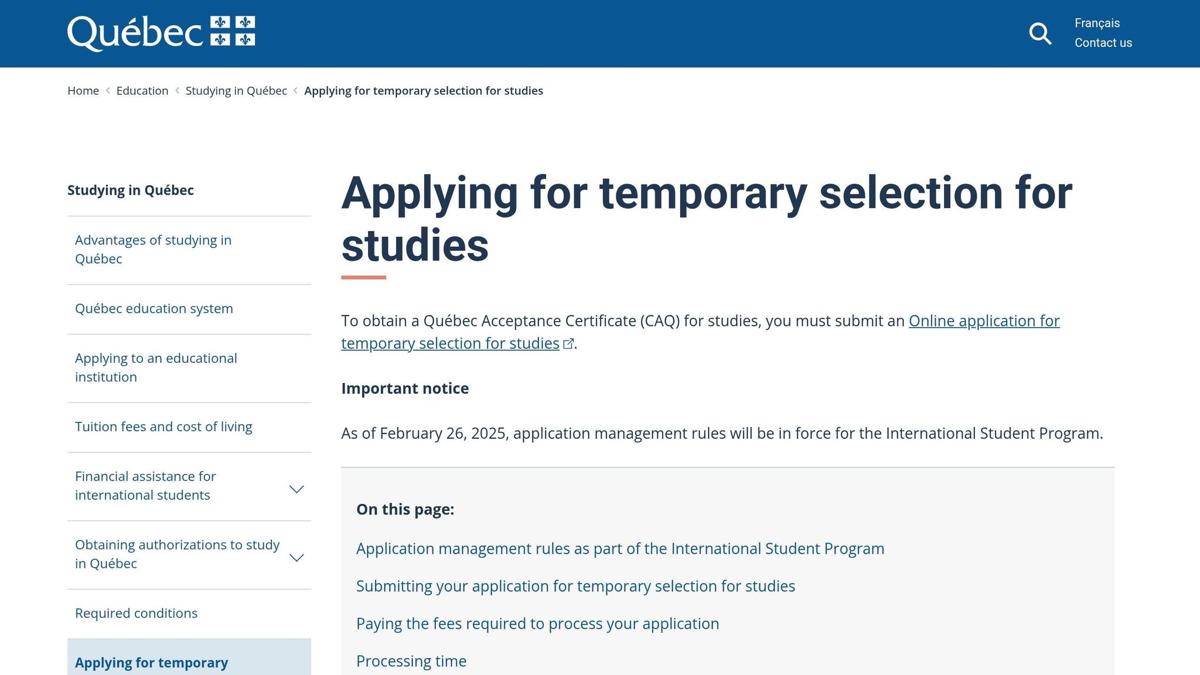
For temporary foreign workers, French proficiency is crucial for CAQ renewals under Bill 96. Without adequate training, the cost of replacing a worker can hit an average of CAD 20,000. However, structured and measurable language programs help employees reach Level 4 proficiency in time for renewal deadlines, achieving a 95% success rate and saving up to CAD 25,000 per retained worker[1][2]. Dedicating 8% of your learning and development (L&D) budget to tracking these metrics ensures your organization stays ahead of compliance requirements.
Supporting Quebec's Language Priorities
Investing in language training also aligns your organization with Quebec’s broader economic and linguistic goals. Workplace francisation demonstrates a commitment to the province’s language priorities and fosters cultural integration. The Canadian government’s Action Plan for Official Languages 2023–2028 includes a CAD 4.1 billion investment, with CAD 242.8 million earmarked for French second-language learning programs[1]. Companies that align with these initiatives not only enhance their employer brand but also gain an edge in attracting talent in a competitive market.
Quebec further supports these efforts with its Refundable Tax Credit for French-Language Training, which covers 20–50% of L&D expenses[1]. By taking advantage of these incentives and embedding francisation into diversity, equity, and inclusion strategies, organizations create a welcoming environment for temporary foreign workers while promoting francophone vitality. This approach goes beyond meeting regulatory standards - it positions your company as a forward-thinking leader in Quebec’s workforce, driving long-term benefits in employee satisfaction and compliance.
Conclusion
Directing your L&D budget towards language training is a smart move that delivers tangible benefits across your organization. With Quebec's Bill 96 now in force and the June 1, 2025, deadline mandating French as the primary language in the workplace, companies must act promptly to ensure compliance and maintain workforce stability. This isn't just about meeting legal requirements - it’s a financially sound decision.
Take advantage of Quebec's mandatory 1% training budget (applicable to payrolls exceeding CAD 2 million) and government subsidies that cover 50–75% of training costs to implement francisation programs efficiently. Tools like Conversaflex, powered by AI, provide 24/7 access, automated OQLF-compliant reporting, and job-specific vocabulary training that employees can apply immediately.
Language training also plays a critical role in employee retention and career growth. Boosting French proficiency helps employees advance in their roles while enhancing their workplace skills, offering a clear return on investment.
Start by conducting a language audit to pinpoint gaps in proficiency. From there, adopt a blended learning approach that combines AI-driven practice with focused, human-led sessions. Built-in analytics simplify compliance reporting and cut down on administrative tasks. This method not only supports workforce development but also positions your organization as a progressive employer. Aligning your L&D initiatives with Quebec’s language goals helps build a bilingual team prepared to excel in Canada’s evolving marketplace.
FAQs
What French level do our temporary foreign workers need for CAQ renewal?
Temporary foreign workers in Quebec are now required to show Level 4 spoken French proficiency, as outlined by the Échelle québécoise des niveaux de compétence en français, in order to renew their Certificat d’acceptation du Québec (CAQ). This measure aligns with the province's standards for temporary workers.
What proof is required for LMIA applications under Bill 96?
Businesses in Quebec with 25 or more employees are required to demonstrate compliance with the francization process when applying for a Labour Market Impact Assessment (LMIA) under Bill 96. This involves providing documentation that outlines the French language requirements as part of the application.
How do we measure and document French progress for compliance?
Organizations track and document progress in French by using language audits and proficiency assessments to pinpoint skill gaps and compliance requirements. Keeping detailed records - such as training logs, progress reports, and certifications - provides evidence of continual improvement. AI-powered tools, like Conversaflex, simplify this process by monitoring progress and creating comprehensive reports, making compliance documentation both accurate and ready for audits. Regular evaluations and certifications play a key role in confirming proficiency advancements and meeting legal requirements.